KwaiKEG/KwaiAgents
A complete agent toolkit with fine-tuned 7B models and a benchmark
KwaiAgents ships a lightweight agent system alongside its own fine-tuned 7B/14B models, training data, and a benchmark to measure whether agents can actually plan, reflect, and use tools.
Not currently ranked — collecting fresh signals.
star history
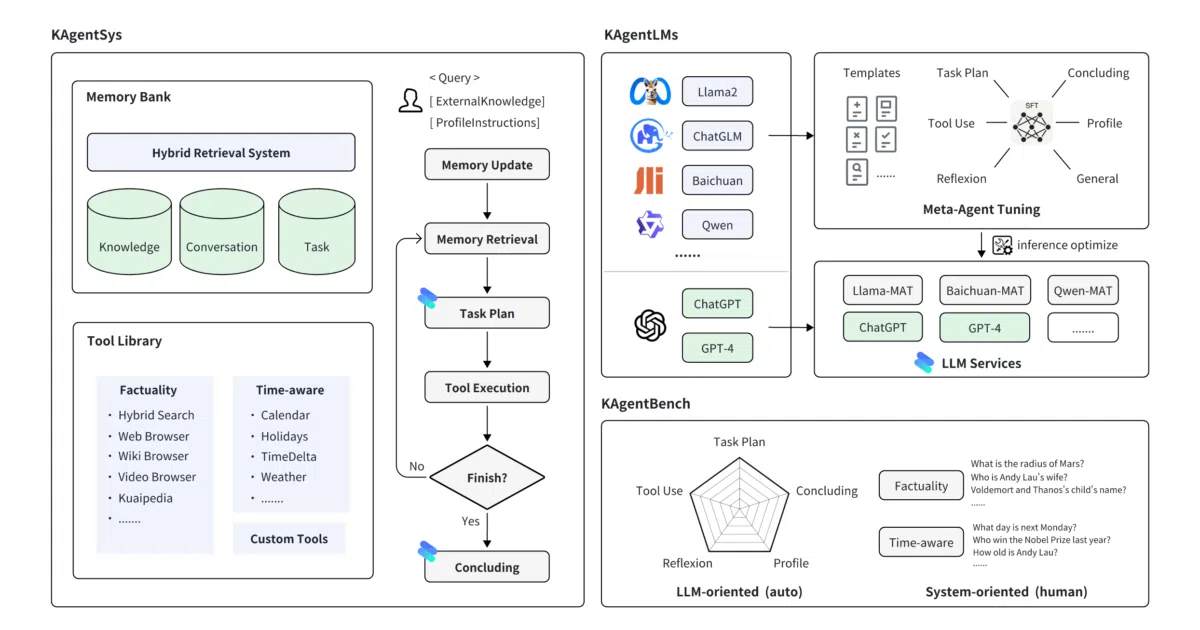
What it does KwaiAgents is a research release from Kuaishou’s KwaiKEG team that bundles four things: a lightweight agent runtime called KAgentSys-Lite, a family of fine-tuned models named KAgentLMs, the KAgentInstruct dataset of over 200k agent-related instructions, and KAgentBench, a suite of 3,000+ human-edited test cases. The system answers complex questions by planning, reflecting, and calling tools, and it supports both OpenAI APIs and local inference via vLLM or llama.cpp.
The interesting bit The project does not assume you will use GPT-4. Instead, it offers “Meta-agent tuned” 7B and 14B models—built on Qwen and Baichuan2—that the authors claim outperform GPT-3.5-turbo on their own benchmark, and it even provides a GGUF build for CPU-only deployment. KAgentSys-Lite itself is an evolution of BabyAGI and Auto-GPT, though the team candidly notes it lacks the full system’s memory mechanisms and broader toolset.
Key highlights
- Ships specialized models (Qwen-7B/14B/1.5-14B and Baichuan2-13B) fine-tuned for planning, reflection, and tool-use via Meta-agent tuning.
- Includes the full data pipeline: over 200k partially human-edited training instructions and 3,000+ benchmark cases with automated evaluation across planning, tool-use, reflection, concluding, and profiling.
- KAgentSys-Lite runs against OpenAI endpoints or fully offline via vLLM/FastChat on GPU, or llama.cpp on CPU.
- Provides a standardized benchmark and evaluation code, so you can compare agent capabilities quantitatively rather than by vibe.
- Supports custom tools beyond the built-in set.
Caveats
- KAgentSys-Lite is explicitly a limited version of the internal system: fewer tools, no memory mechanisms, and “slightly reduced performance capabilities.”
- The strong benchmark results come from the project’s own KAgentBench; independent third-party evaluation on other tasks is not shown in the README.
- The codebase for the lite system is separate from the full production system, having evolved from existing open-source projects like BabyAGI and Auto-GPT.
Verdict Worth a look if you are researching agent architectures or need a reproducible benchmark to test whether your local 7B model can actually plan and use tools. Skip it if you want a polished, memory-enabled production agent out of the box.
Frequently asked
- What is KwaiKEG/KwaiAgents?
- KwaiAgents ships a lightweight agent system alongside its own fine-tuned 7B/14B models, training data, and a benchmark to measure whether agents can actually plan, reflect, and use tools.
- Is KwaiAgents open source?
- Yes — KwaiKEG/KwaiAgents is an open-source project tracked on heatdrop.
- What language is KwaiAgents written in?
- KwaiKEG/KwaiAgents is primarily written in Python.
- How popular is KwaiAgents?
- KwaiKEG/KwaiAgents has 1.2k stars on GitHub.
- Where can I find KwaiAgents?
- KwaiKEG/KwaiAgents is on GitHub at https://github.com/KwaiKEG/KwaiAgents.