Intuition-Lab/personal-model
Give Your Coding Agent a Memory That Keeps Receipts
It learns how you think by watching your Mac, then hands an evidence-linked model of you to your coding agents via MCP.
Feature · 21 Jul 2026
Persome Wants to Build a Root, Not a Chatbot
An open-source Mac runtime that structures your digital activity into an evidence-linked personal model, giving coding agents grounded context through MCP while keeping the raw data local and inspectable.
Read the in-depth article →
Not currently ranked — collecting fresh signals.
star history
What it does
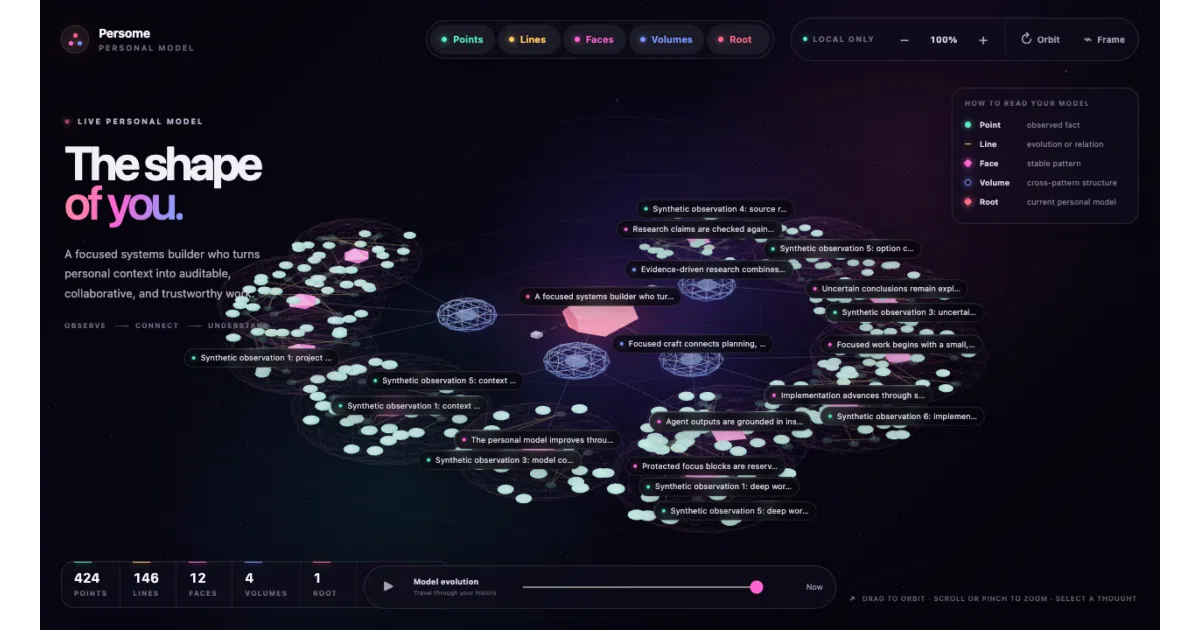
Persome is a local-first macOS application that observes your focused activity—subject to explicit macOS permissions—and incrementally builds a structured model of your work. It organizes observations into sourced Points, connected Lines, inferred Faces, and higher-order Volumes, all rolling up into a single Root: a current, revisable snapshot of how you work and what matters. Connected MCP clients like Codex or Claude Code can query this model to pick up unfinished tasks, respect your priorities, and cite evidence instead of hallucinating context.
The interesting bit
The unusual part is the epistemic humility baked into the geometry: new evidence can overturn old inferences, and the system reports missing Faces or a sparse Root rather than fabricating them. More practically, Persome can “lend” an existing coding-agent subscription—Codex, Claude Code, or Cursor—to power its background semantic modeling without ever holding the client’s OAuth token, keeping the LLM bill on hardware you already rent.
Key highlights
- Runs entirely on your Mac; no cloud required for capture or storage, and no Full Disk Access requested.
- Exposes your personal model to trusted MCP clients so the same prompt produces different, personalized answers for different users.
- Imports existing Markdown, Obsidian, and Notion history to bootstrap the model before live capture begins.
- Uses a deterministic hierarchy—
Points,Lines,Faces,Volumes,Root—where every claim retains a source receipt for verification. - Background semantic stages can consume your coding agent’s own subscription allowance via an isolated CLI bridge.
Caveats
- macOS 13+ only; there is no Windows or Linux path in the current release.
- Semantic modeling requires an LLM (local or hosted), though basic BM25 recall works without one.
- Live capture needs Accessibility and, optionally, Screen Recording permissions, which may give privacy-conscious users pause despite the local-first architecture.
Verdict
Worth a look if you live in macOS and want coding agents that remember your open loops without leaking context to the cloud. Skip it if you are not comfortable granting macOS Accessibility access or if you expect a fully autonomous agent rather than a context layer that keeps you in the loop.
Frequently asked
- What is Intuition-Lab/personal-model?
- It learns how you think by watching your Mac, then hands an evidence-linked model of you to your coding agents via MCP.
- Is personal-model open source?
- Yes — Intuition-Lab/personal-model is open source, released under the Apache-2.0 license.
- What language is personal-model written in?
- Intuition-Lab/personal-model is primarily written in Python.
- How popular is personal-model?
- Intuition-Lab/personal-model has 1.3k stars on GitHub.
- Where can I find personal-model?
- Intuition-Lab/personal-model is on GitHub at https://github.com/Intuition-Lab/personal-model.