Gen-Verse/LatentMAS
Multi-agent LLMs that gossip in embeddings instead of English
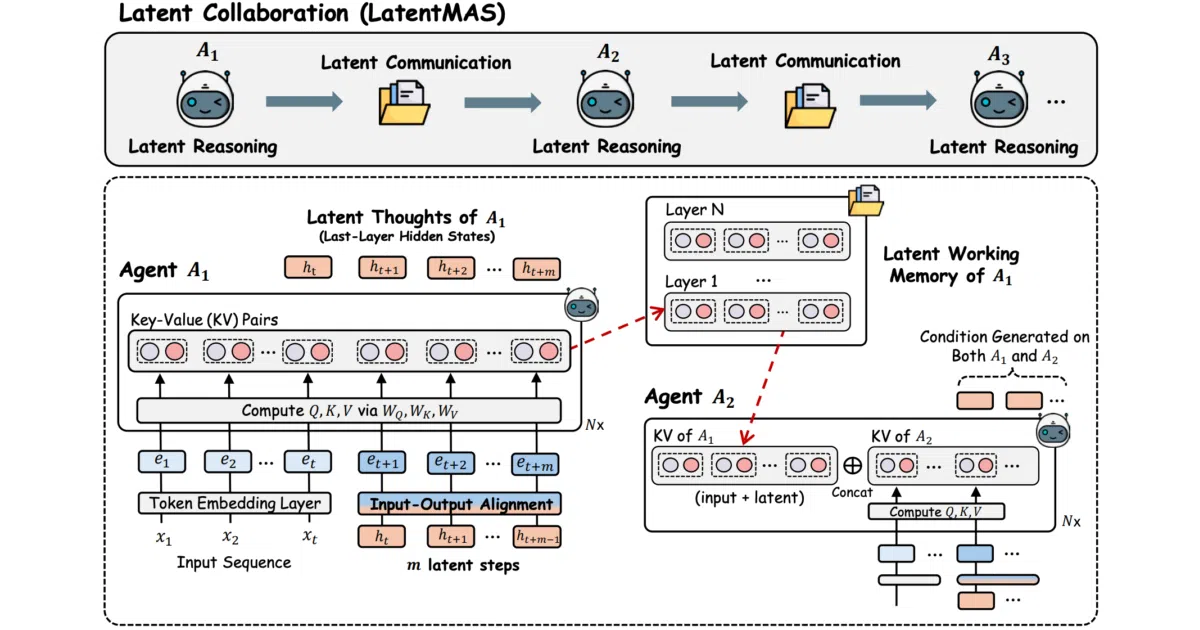
LatentMAS moves multi-agent collaboration from token space into the model’s latent space, cutting tokens by roughly half and wall-clock time by 3×–7× compared to text-based baselines.
Not currently ranked — collecting fresh signals.
star history
What it does
LatentMAS is a multi-agent reasoning framework where agents communicate by swapping latent thoughts—hidden states and KV-cache entries—rather than generating long textual reasoning traces. It works with standard HuggingFace transformers and optionally vLLM backends, targeting math, science, coding, and medical QA benchmarks. The repository contains reproduction code for single-agent baselines, text-based multi-agent systems, and the latent-space method.
The interesting bit
The framework uses a training-free latent-space alignment that lets agents read each other’s “working memory” directly, skipping the usual ritual of writing intermediate thoughts in English. The authors report this cuts token usage by roughly 50–80% and wall-clock time by 3×–7× compared to standard text-based multi-agent or chain-of-thought baselines.
Key highlights
- Agents pass hidden states and KV-cache updates instead of text, operating in the model’s latent space.
- Compatible with any HuggingFace model; optional vLLM support via a hybrid two-GPU pipeline.
- Training-free alignment mechanism (
latent_space_realign) treated as a task-specific hyperparameter. - Reproduces experiments across 9 tasks including GSM8K, AIME, GPQA, MBPP+, and HumanEval+.
- Active ecosystem with community extensions for scientific discovery, heterogeneous agents, and kNN-based latent retrieval.
Caveats
- vLLM integration requires modifying internal vLLM backend code, which the README notes is not officially supported and may introduce minor numeric drift versus the HF backend.
- The
latent_space_realigntoggle is task-dependent, so you’ll need to experiment to find whether it helps for your specific model and benchmark.
Verdict
Worth a look if you’re building multi-agent LLM pipelines and drowning in token costs or latency. Skip it if you need fully supported, drop-in vLLM acceleration without backend hacks.
Frequently asked
- What is Gen-Verse/LatentMAS?
- LatentMAS moves multi-agent collaboration from token space into the model’s latent space, cutting tokens by roughly half and wall-clock time by 3×–7× compared to text-based baselines.
- Is LatentMAS open source?
- Yes — Gen-Verse/LatentMAS is open source, released under the Apache-2.0 license.
- What language is LatentMAS written in?
- Gen-Verse/LatentMAS is primarily written in Python.
- How popular is LatentMAS?
- Gen-Verse/LatentMAS has 1.2k stars on GitHub.
- Where can I find LatentMAS?
- Gen-Verse/LatentMAS is on GitHub at https://github.com/Gen-Verse/LatentMAS.