CRui5in/paper-ppt-agent
Turning research papers into PowerPoint by committee
It distills dense research PDFs and LaTeX sources into editable slide decks using a trio of specialized AI agents so you don't have to manually copy-paste figures at 2 AM.
Not currently ranked — collecting fresh signals.
star history
What it does
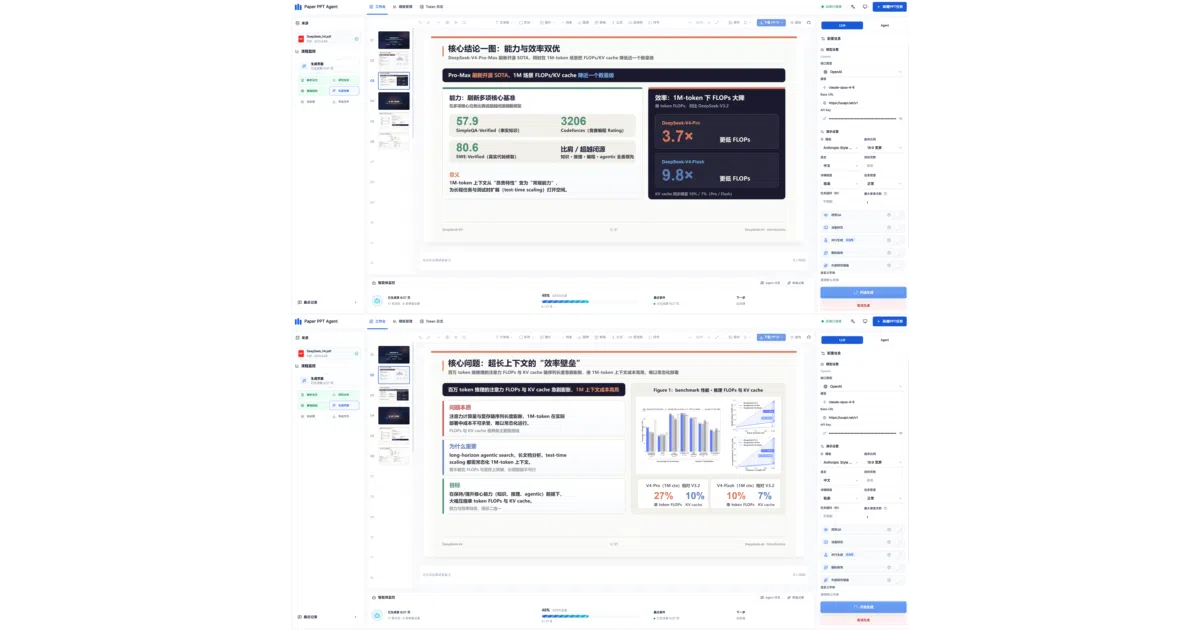
Paper PPT Agent ingests academic PDFs or LaTeX source files and produces editable PowerPoint files. A three-stage agent pipeline—Strategist, Executor, and Critic—plans the narrative, assembles the slides, and audits layout quality. Everything lands in a browser-based editor where you can tweak pages, notes, and fonts before exporting.
The interesting bit
Instead of treating slide generation as a single-shot prompt, the project runs a full quality-control loop. It performs static checks for text overflow and overlapping elements, can render slides as images for multimodal visual review, and uses Gemini embeddings to semantically match content with relevant icons from a library.
Key highlights
- Multi-agent workflow with feedback loops and automatic version snapshots
- Static and optional visual QA for layout issues like low contrast and element overlap
- Semantic icon matching via Gemini Embedding RAG
- Built-in web editor based on PPTist for post-generation tweaks
- Supports multiple LLM providers and bilingual output
Caveats
- Visual QA is explicitly marked experimental
- Agent generation mode requires local installation of Claude Code or Codex
- Template import via Agent mode currently depends specifically on Claude Code
Verdict
Great for researchers and students who regularly turn papers into talks. Skip it if you just need a quick one-page summary or already have a rigid slide workflow you refuse to change.
Frequently asked
- What is CRui5in/paper-ppt-agent?
- It distills dense research PDFs and LaTeX sources into editable slide decks using a trio of specialized AI agents so you don't have to manually copy-paste figures at 2 AM.
- Is paper-ppt-agent open source?
- Yes — CRui5in/paper-ppt-agent is open source, released under the AGPL-3.0 license.
- What language is paper-ppt-agent written in?
- CRui5in/paper-ppt-agent is primarily written in Python.
- How popular is paper-ppt-agent?
- CRui5in/paper-ppt-agent has 1k stars on GitHub.
- Where can I find paper-ppt-agent?
- CRui5in/paper-ppt-agent is on GitHub at https://github.com/CRui5in/paper-ppt-agent.