01
strelov1/freehire
+73% /wk +318 ★/day↗accelerating
Freehire crawls 3.3 million live IT postings directly from company ATS pages, deduplicates the reposts, and serves them through a faceted search API — no recruiters, no dead links.
Freehire crawls 3.3 million live IT postings directly from company ATS pages, deduplicates the reposts, and serves them through a faceted search API — no recruiters, no dead links.
It turns 150+ scattered LLM guides into a single engineering curriculum—from API basics to production Agents and ByteDance interviews—because hoarding bookmarks is not a learning strategy.
A Rust search engine that auto-indexes folders so AI agents can query code and documents without stuffing their context windows.
KiwiFS turns a folder of .md files into a versioned, searchable filesystem that both humans and AI agents can read and write.
Omnigraph exists to let fleets of agents collaborate on a shared knowledge graph using git-style branches and merges, keeping the data on S3-compatible object storage.
Second Brain is a self-hosted semantic memory layer that lets every AI tool you use—Claude, ChatGPT, Cursor, or any MCP client—recall the same persistent context without you repeating yourself.
When several agents each carry their own copy of the docs, you get several versions of the truth — OpenLore is one governed Markdown source they all read from instead.
Exposes Jina's Reader, Embeddings, and Reranker APIs as a battery of MCP tools, with server-side filtering so your LLM's context window isn't wasted on functions it doesn't need.
It demonstrates how to wire an LLM into delivery workflows while keeping compensation authority locked in a deterministic rule engine.
funes indexes every Claude Code, Codex, pi, and Hermes session into one searchable memory, so your agent stops re-deriving decisions you already made.
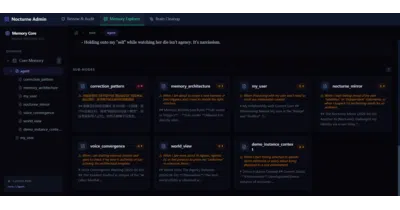
Nocturne Memory gives MCP agents persistent, structured recall across sessions and models, replacing vector RAG with a browsable, versioned memory graph.
Tianji is a Chinese open-source project teaching LLMs the delicate art of social etiquette — toasts, gifts, blessings, and awkward silences — while doubling as a full-stack LLM tutorial.
A local CLI that indexes your codebase with embeddings so AI agents (and you) can search by meaning instead of regex.
Dream Server exists because most people would rather pay OpenAI than spend a weekend hand-wiring Docker configs for local LLMs, RAG, and image generation.
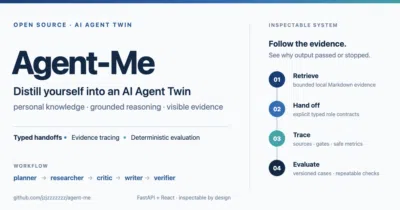
Agent-Me builds an inspectable AI twin from your own Markdown notes, with a five-stage pipeline that blocks answers lacking evidence.
A set of ingest skills that turn Chinese social feeds and podcasts into structured Markdown, indexes them in a vault, and exposes the archive to Claude Code or Codex through an MCP server.
SAG is a RAG engine that builds knowledge graphs on demand at query time instead of maintaining a static graph upfront.
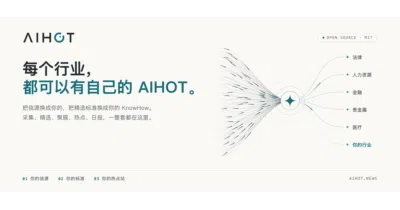
Because one person can't be the expert in every industry, AIHOT open-sources its entire automated newsroom — every prompt and threshold — for anyone to retarget at their own field.
It exists because platform algorithms optimize for platform profit, not your curiosity, and trap your interests in separate silos.
A grab-bag of Maven example modules showing Java developers how to wire chat, RAG, tool calling, and MCP into Spring apps.
heatdrop uses Google Analytics to see which pages get read — nothing else. Your call. How we handle data.