AMAP-ML/LongHorizon-Harness · 11 Sep 2026 · Feature
Alibaba's Harness Makes Agents Prove It Before Moving On

Rachel Stein
Contributing Editor
LongHorizon-Harness wraps existing agents in a verification loop that externalizes task state, because the real bottleneck in long-horizon work is not reasoning but bookkeeping.
AMAP-ML/LongHorizon-Harness
★1.8k stars Velocity · 7d +181 ★/day ↗accelerating
The Hype and the Timing
Early August 2026, a 29-page preprint from Alibaba’s DreamX Team climbed to #1 on Hugging Face’s Daily Papers weekly ranking. Within days the open-source repository had shipped two point releases, a browser dashboard was teased, and a WeChat QR code appeared for early adopters. The attention is not mere algorithmic hype. It lands precisely as the industry recalibrates from raw model scale toward a quieter discipline: harness engineering. Curated lists like awesome-harness-engineering have accumulated thousands of stars, and Databricks now formalizes the relationship as Agent = Model + Harness—the model reasons, while the harness executes, remembers, and constrains. LongHorizon-Harness is the most visible open-source wager yet that the next leap in autonomous agents will come from orchestration, not from another weights dump.
The Problem: Context Rot and Self-Grading
The technical critique is almost blunt. Most existing agent harnesses stuff execution, state tracking, and completion assessment into a single, ever-growing context window. The agent plans a step, executes it, observes the result, and decides whether it succeeded—all inside the same conversational blob. The authors identify this as a recipe for context rot and compounding self-assessment errors. A LinkedIn review of the paper puts it more pithily: agents are effectively grading their own homework across multi-step tasks. When a task spans dozens of hours and hundreds of actions, one misread log or hallucinated file edit metastasizes through every subsequent decision. The model does not merely forget; it confabulates a progress narrative that the next round treats as ground truth. METR’s findings, cited in the paper, note that agent task horizons are doubling faster than ever, yet longer horizons do not inherently improve reliability. Meanwhile, benchmarks like LongCLI-Bench show state-of-the-art agents stalling below 20 percent pass rates on long-horizon programming tasks, with self-correction delivering only marginal gains. The brain is not the bottleneck; the bookkeeping is.
Three Roles, One Trusted State
LongHorizon-Harness responds by treating long-horizon execution as an explicit task-state management problem rather than a prompting problem. It wraps existing backends—Claude Code, Codex CLI, or anything compatible with its lightweight AgentAdapter—in a Manage-Execute-Audit (MEA) loop that splits responsibilities across context boundaries.
The Manager maintains the original goal, verified progress, and the next subtask. The Executor starts each round with a deliberately fresh context, focusing on one clearly defined action through GUI or CLI tools, after which its reasoning is discarded. Crucially, the Auditor operates read-only, inspecting files, interfaces, logs, and tests in the real environment without access to the Executor’s reasoning trace. Only facts that survive this independent verification enter the persistent task state. If the Executor hallucinates a successful test run, the Auditor sees the failing log and the state remains unchanged. The next round resumes from the last verified checkpoint, not from a fabricated narrative.
This separation is the project’s central insight. By externalizing task state from the agent’s own memory, the harness turns a monolithic, stateful conversation into a stateless, verifiable pipeline. The architecture also permits model mixing: a capable model can manage and audit while a cheaper one executes, or each role can run through a different backend entirely. A web dashboard visualizes each round’s plan, execution result, audit evidence, and reason for rework, turning an opaque agent loop into an inspectable assembly line.
Measured Gains, Meager Baselines
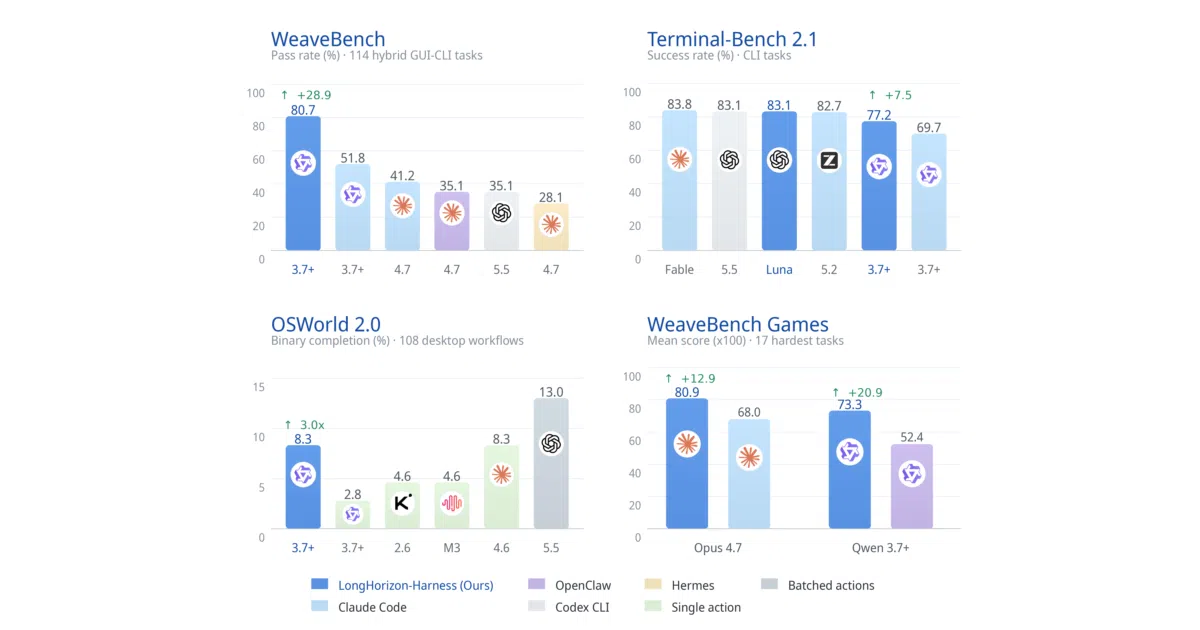
The authors benchmarked hundreds of tasks across GUI, CLI, and mixed environments—web frontends, data analysis, 3D tools, document editing, systems debugging, and even healthcare forms. The results are impressive in relative terms and humbling in absolute ones.
On WeaveBench, a hybrid GUI-and-CLI suite, Qwen 3.7-Plus rose from 51.8 percent to 80.7 percent pass rate when wrapped in the harness. Terminal-Bench 2.1 saw a more modest climb from 69.7 percent to 77.2 percent, though with 24 percent fewer tokens. The most striking figure is OSWorld 2.0, a full-desktop task benchmark, where the same model jumped from 2.8 percent to 8.3 percent binary completion—a threefold relative gain that still leaves the absolute success rate in single digits. Claude Opus 4.7 on an OSWorld subset improved from 20.0 percent to 34.3 percent. These numbers demonstrate consistent structural improvement across models and domains, but they also confirm that long-horizon desktop autonomy remains largely unsolved. A threefold increase on a near-zero baseline is progress, not a product.
Harness Engineering Comes in Flavors
LongHorizon-Harness is not the only architecture betting on orchestration. Atlassian recently replaced Rovo’s hybrid orchestrator with a Long Horizon reasoning engine that flattens subagent tools into a single-LLM, single-context iterative loop running up to 150 iterations. Where Atlassian keeps everything inside one coherent context to preserve reasoning chains, Alibaba’s harness explicitly fractures context across roles to prevent contamination. The two approaches share a diagnosis—short-horizon, rigid routing fails complex tasks—but prescribe opposite cures. Atlassian trusts a unified model to iterate; LongHorizon-Harness trusts separation of duties to keep the model honest.
Both fit into a broader industry pattern. XMPro’s industrial Agentic Harness, Databricks’ ReAct infrastructure, and Stripe’s thousands of weekly agent-merged code changes all point to the same conclusion: constraints and structured execution environments unlock more real work than raw parameter counts. The harness is becoming the product, whether it runs in a refinery SCADA system or a macOS desktop session.
The Rough Edges
The framework is candid about its limitations, and independent reviewers have noted others. Token costs and latency rise because every round now involves three role invocations and an audit. Desktop completion rates remain low even with the harness. There is a verification ceiling: when task success depends on hidden state or conditions that are hard to observe, the Auditor cannot reliably certify progress. The paper also lacks role-level ablations, making it difficult to attribute gains precisely to the Manager, Executor, or Auditor. Platform support is currently tested on macOS; Windows support ships but has not been thoroughly validated. This is research infrastructure, not a shrink-wrapped product.
Outlook: Infrastructure Over Intelligence
LongHorizon-Harness makes a specific bet on the future of autonomous systems: the bottleneck is bookkeeping, not brainpower. By forcing agents to prove their work in a read-only audit before any state advances, it replaces the honor system of self-reported progress with a ledger of verified facts. Whether the MEA loop becomes the dominant pattern or gets absorbed into native agent backends—much as Claude Code and Codex already iterate on their own—remains an open question. Anthropic and OpenAI are already pushing longer autonomous runs with strategic auto-approval and human steering, suggesting that harness logic and model capability will likely converge. What is clear is that the era of judging an agent solely by its model card is ending. The harness is the new frontier.
Sources
- ai-boost/awesome-harness-engineering
- Advancing Long-Horizon Agents for Real-World Tasks
- Long-Horizon Agents Are Here. Full Autopilot Isn't
- Your AI Agent Needs a Harness — Here's What That ...
- LongHorizon-Harness: Advancing Long-Horizon Agents for ...
- LongCLI-Bench: A Preliminary Benchmark and Study for ...
- What is an AI Agent Harness?
- LongHorizon-Harness: Advancing Long-Horizon Agents for ...
- Long Horizon: How Atlassian Built a Reasoning Engine for ...
- Agent Harnesses for PMs: What Turns AI Systems into ...
- LongHorizon-Harness Under Review: Teaching Agents to ...
- Thoughts on Long-Horizon Agents : r/AI_Agents