zjunlp/DeepKE
An academic extraction toolkit that grew into an LLM swiss army knife
DeepKE bundles classical deep learning and LLM pipelines so you can extract entities, relations, and attributes for knowledge graphs without committing to a single paradigm.
Not currently ranked — collecting fresh signals.
star history
What it does
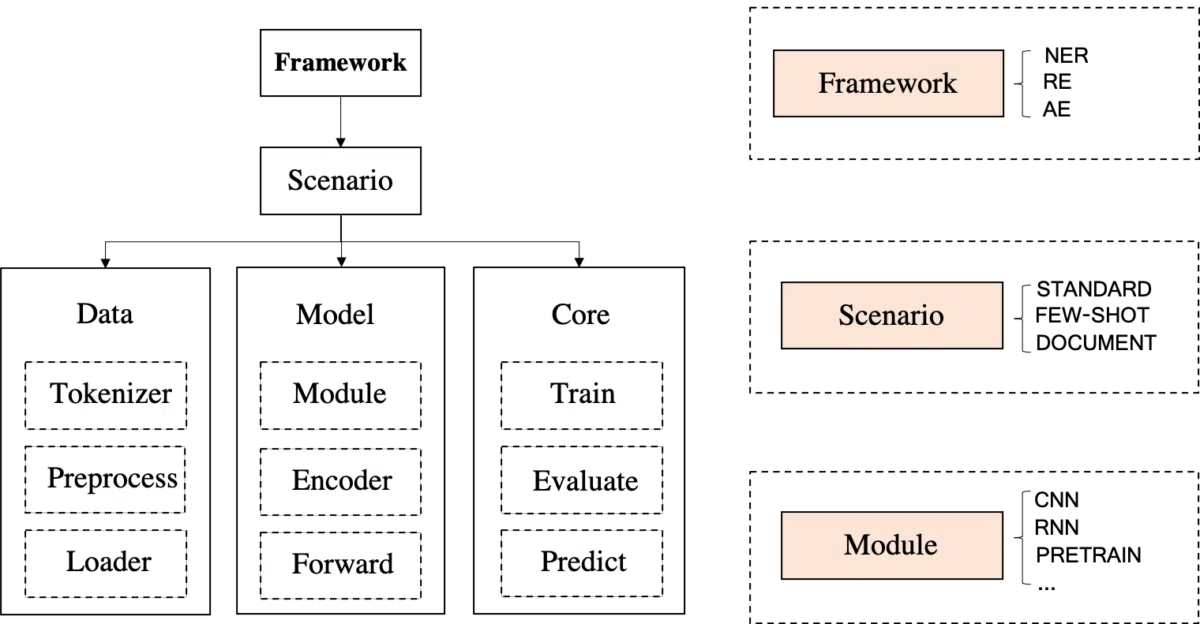
DeepKE is an open-source toolkit for constructing knowledge graphs through information extraction. It handles named entity recognition, relation extraction, attribute extraction, and event extraction across both standard supervised and low-resource settings. Originally built around fine-tuned deep learning models, the project now also hosts LLM-based extraction via DeepKE-LLM and OneKE, plus MCP service tools that let large models call lightweight extraction utilities.
The interesting bit
Rather than abandoning its pre-LLM architecture, DeepKE layers new capabilities on top: you can still run LightNER or KnowPrompt for efficient few-shot extraction, or swap in a 13B instruction-tuned model for zero-shot work. The recent MCP integration effectively turns the toolkit into a set of callable tools for LLM agents, which is a pragmatic admission that small specialized models and large general ones each have their place.
Key highlights
- Supports Chinese and English extraction, including a schema-based bilingual model (
OneKE) and instruction datasets (IEPile,InstructIE). - Covers the full pipeline: NER, relation extraction, attribute extraction, and event extraction in one framework.
- Ships with off-the-shelf models under
DeepKE-cnSchemafor users who want pretrained weights rather than training from scratch. - Implements both document-level and multimodal extraction scenarios, not just sentence-level text.
- Publishes its own EMNLP 2022 paper and maintains active documentation, demo sites, and Colab notebooks.
Caveats
- The README warns that Linux is strongly recommended and Windows path handling can be brittle.
- Dependency constraints are strict: for example, the traditional
pip install deepkepath requires pip version ≤ 24.0, while the LLM branch needs a completely separate environment. - The codebase spans multiple eras—classical DeepKE, DeepKE-LLM, and MCP tools—so navigating the repository can feel like reading a palimpsest.
Verdict Researchers and engineers working on Chinese-English knowledge graph construction should look here, especially if they want to compare classical and LLM-based extraction without switching frameworks. If you need a single, opinionated pipeline with clear versioning, the sprawling scope may frustrate you.
Frequently asked
- What is zjunlp/DeepKE?
- DeepKE bundles classical deep learning and LLM pipelines so you can extract entities, relations, and attributes for knowledge graphs without committing to a single paradigm.
- Is DeepKE open source?
- Yes — zjunlp/DeepKE is open source, released under the MIT license.
- What language is DeepKE written in?
- zjunlp/DeepKE is primarily written in Python.
- How popular is DeepKE?
- zjunlp/DeepKE has 4.5k stars on GitHub.
- Where can I find DeepKE?
- zjunlp/DeepKE is on GitHub at https://github.com/zjunlp/DeepKE.