zai-org/GLM-4
A 32B open model that ruminates its way toward GPT-4o parity
Zhipu AI open-sourced a tiered family of 32B and 9B chat, reasoning, and research models that aim to match frontier closed systems without the frontier hardware requirements.
Not currently ranked — collecting fresh signals.
star history
What it does
The GLM-4-0414 release is a family of open-weights language models from Zhipu AI, built around a 32-billion-parameter base pretrained on 15 trillion tokens. The suite includes a generalist chat model (GLM-4-32B-0414), a reasoning specialist (GLM-Z1-32B-0414), and a research-grade “rumination” model (GLM-Z1-Rumination-32B-0414) that can call search tools during extended deliberation. A distilled 9-billion-parameter reasoning variant (GLM-Z1-9B-0414) rounds out the lineup for lightweight deployment.
The interesting bit The rumination model is the odd duck: instead of standard chain-of-thought, it performs deeper, longer analysis on open-ended tasks—like drafting comparative urban policy reports—using end-to-end reinforcement learning graded against ground-truth rubrics while optionally searching the web. Zhipu AI explicitly positions it as an open counter to OpenAI’s Deep Research.
Key highlights
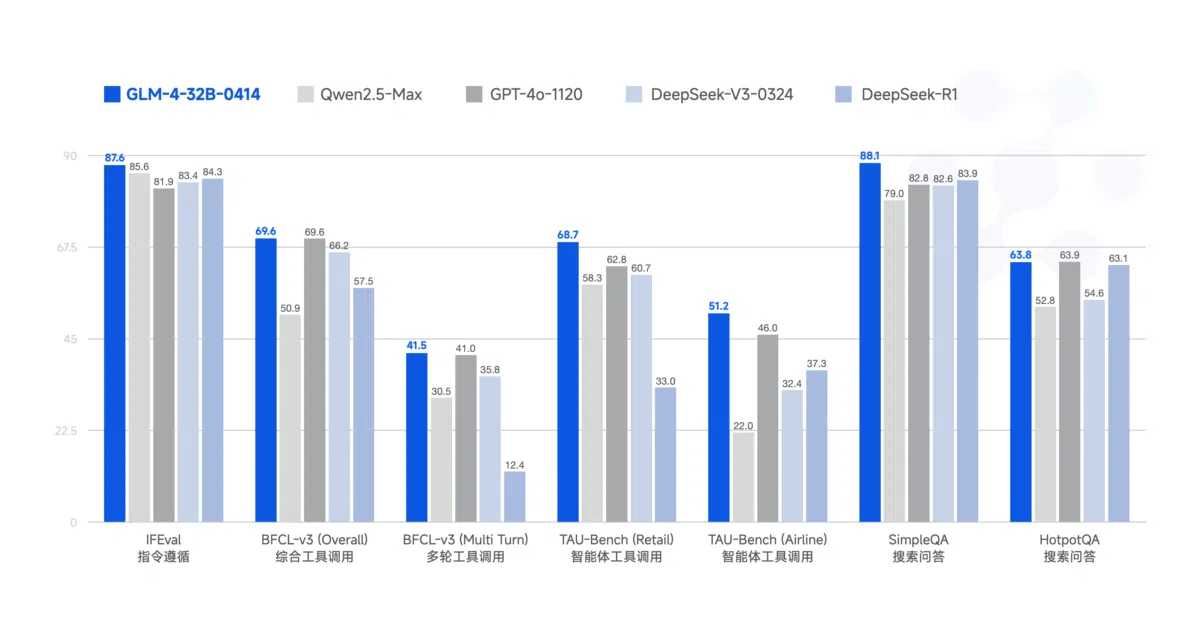
- The 32B base model is claimed to match
GPT-4oandDeepSeek-V3-0324(671B) on several code-generation and Q&A benchmarks despite the far smaller parameter count. - Post-training sharpens instruction following, function calling, and agentic “atomic capabilities” through rejection sampling and reinforcement learning.
GLM-Z1-Rumination-32B-0414targets research-style writing and complex task decomposition with scaled RL and live search integration.- Context windows reach 128K for most variants; the 9B reasoning model is pitched as the top open-source performer in its weight class for resource-constrained scenarios.
- Weights are hosted across Hugging Face, ModelScope, Modelers, and WiseModel.
Caveats
- The README asserts benchmark parity with
GPT-4oandDeepSeek-V3, but does not reproduce the actual scores or evaluation methodology in the visible text. - Showcase demos are explicitly translated from Chinese prompts, so English prompt behavior may differ.
- The visible documentation is almost entirely model cards and output galleries; training or inference tooling is not shown in the provided excerpt.
Verdict Developers seeking a locally deployable alternative to frontier closed models—particularly for coding agents, function calling, or long-form research workflows—should test the 32B series and the surprisingly capable 9B distill. If you need exhaustive benchmark tables or training infrastructure inside the repository itself, the current documentation is mostly a model card and showcase gallery.
Frequently asked
- What is zai-org/GLM-4?
- Zhipu AI open-sourced a tiered family of 32B and 9B chat, reasoning, and research models that aim to match frontier closed systems without the frontier hardware requirements.
- Is GLM-4 open source?
- Yes — zai-org/GLM-4 is open source, released under the Apache-2.0 license.
- What language is GLM-4 written in?
- zai-org/GLM-4 is primarily written in Python.
- How popular is GLM-4?
- zai-org/GLM-4 has 7.1k stars on GitHub.
- Where can I find GLM-4?
- zai-org/GLM-4 is on GitHub at https://github.com/zai-org/GLM-4.