yizhongw/self-instruct
When the student writes the syllabus
It exists to reduce the drudgery of manual annotation by making a language model generate its own instruction-tuning data from a tiny seed set.
Not currently ranked — collecting fresh signals.
star history
What it does
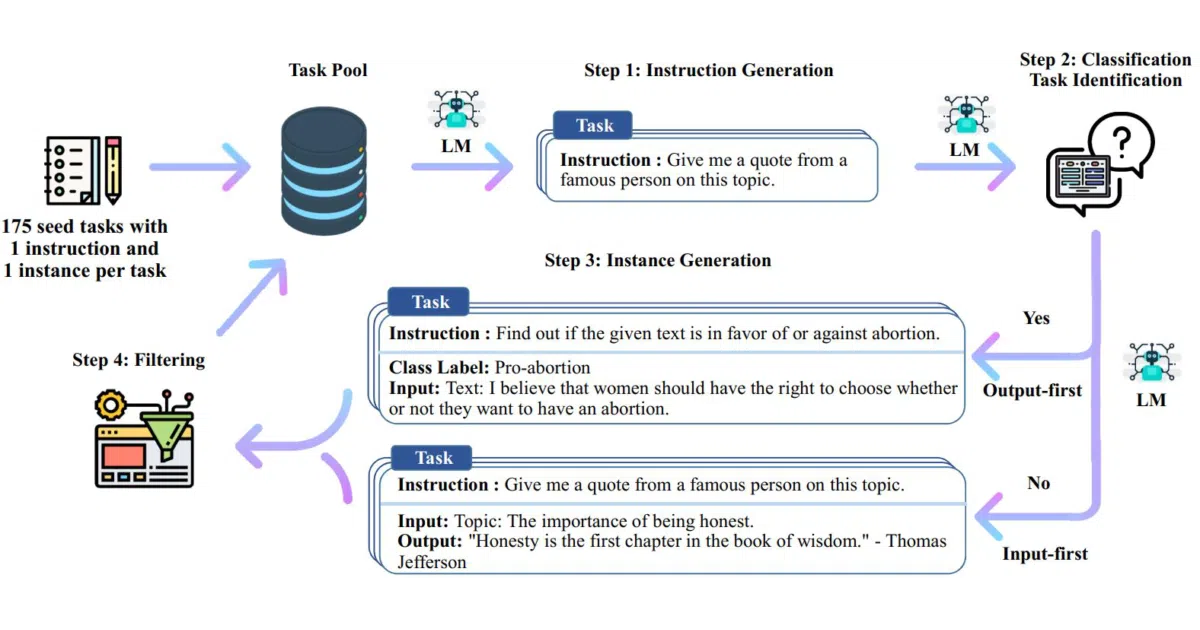
Self-Instruct is a bootstrapping framework that iteratively expands a small set of human-written instructions into a large synthetic dataset. It prompts a pretrained model like GPT-3 to dream up new instructions and corresponding input-output pairs, filters out the low-quality or redundant ones, and feeds the result back into the pool for further rounds. The resulting 52k instructions and 82k instances can then be used to fine-tune the model to follow natural language commands more effectively.
The interesting bit
The clever part is the ouroboros-like feedback loop: the model’s own generations become its future training material. The authors also acknowledge the messiness upfront—nearly half the synthetic data points in their sample had problems, which is a refreshingly honest admission in a field that often pretends synthetic data is pristine.
Key highlights
- Ships with a ready-made dataset of 52k instructions and 82k input-output instances generated from GPT-3, plus the 175 original seed tasks.
- Includes a separate evaluation benchmark of 252 expert-written, user-oriented tasks designed to test real-world instruction following.
- Open-sources the full generation pipeline—instruction generation, classification detection, instance creation, and filtering—as shell scripts.
- Reformatted data is provided in standard GPT-3 fine-tuning format (prompt + completion).
Caveats
- The authors flag the work as still in progress and warn that the repository may shift underfoot.
- The released synthetic data is noisy: the authors estimate 46% of sampled data points contain errors or biases, so it requires caution and likely additional filtering.
- The generation scripts have only been tested against GPT-3 via the OpenAI API, so running them against other models or local setups is officially uncharted territory.
Verdict
Researchers and practitioners who need to instruction-tune models on a budget should look here, especially for the dataset and the bootstrapping concept. If you need production-grade, perfectly clean training data out of the box, this is explicitly not it.
Frequently asked
- What is yizhongw/self-instruct?
- It exists to reduce the drudgery of manual annotation by making a language model generate its own instruction-tuning data from a tiny seed set.
- Is self-instruct open source?
- Yes — yizhongw/self-instruct is open source, released under the Apache-2.0 license.
- What language is self-instruct written in?
- yizhongw/self-instruct is primarily written in Python.
- How popular is self-instruct?
- yizhongw/self-instruct has 4.6k stars on GitHub.
- Where can I find self-instruct?
- yizhongw/self-instruct is on GitHub at https://github.com/yizhongw/self-instruct.