xiaomi-research/Xiaomi-OCR-0
Xiaomi's 0.8B OCR model punches far above its weight class
A tiny vision-language model that turns messy documents into clean Markdown, tables, and LaTeX — and beats models several times its size.
Collecting fresh signals — velocity needs a few days of history.
collecting data…
star history
What it does
Xiaomi-OCR-0 is a unified 0.8B-parameter vision-language model built on Qwen3.5-0.8B, trained on a roughly 170M-sample OCR-centric corpus. Feed it a document page and it emits structured Markdown — tables as HTML, formulas as LaTeX. It also handles key information extraction (JSON output) and OCR-centric visual question answering, all through one model.
The interesting bit
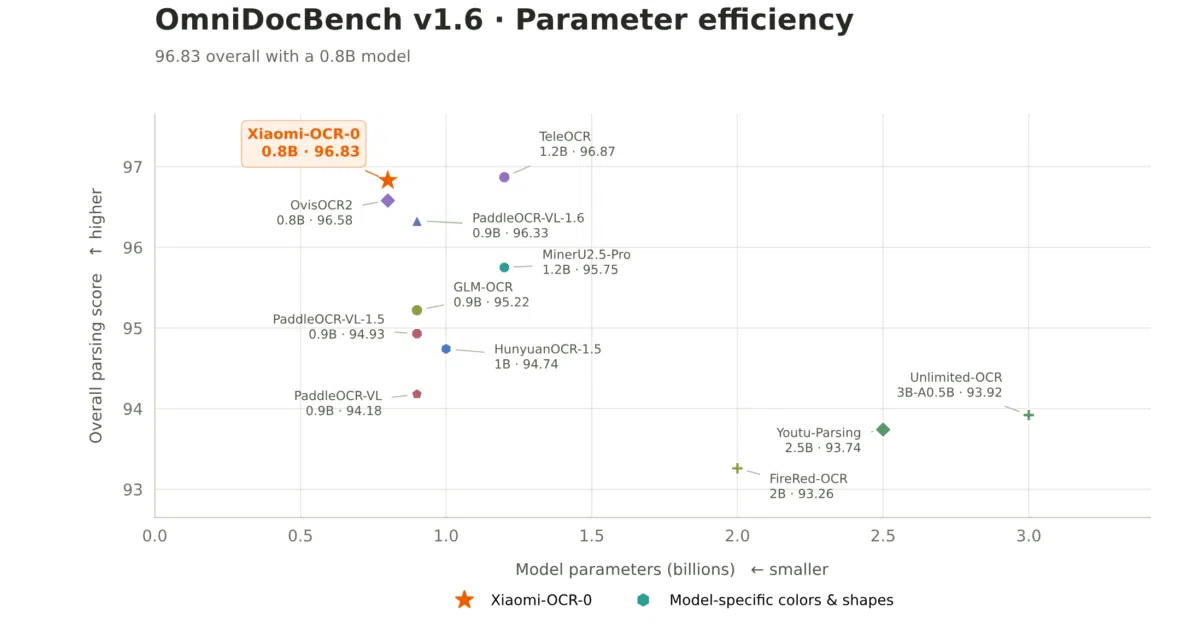
The training recipe combines Q-Mask text anchoring, continued pretraining, and mixed-task reinforcement learning — and the size-to-performance ratio is the story. It scores 83.2 mean across five OCR-VQA benchmarks, beating Qwen3.5-2B (80.9) with less than half the parameters. It even matches Seed 2.0 Pro on historical handwriting and calligraphy scripts.
Key highlights
- 95.24 on Real5-OmniDocBench (#1 in the repo’s comparison), 96.83 on OmniDocBench v1.6
- 97.84 on UniMER-Test formula recognition; 92.27 TEDS on PubTabNet tables
- Runs locally via SGLang, vLLM, or an experimental Ollama BF16 build (~1.8 GB)
- Ships as an MCP service, so agents can drive it directly; a browser demo covers page/region parsing, KIE, and VQA
- Two parsing modes: concurrent region parsing for clean printed docs, whole-page mode for handwriting, calligraphy, and irregular layouts
Caveats
- Region mode drags in PaddlePaddle, PaddleX, and PP-DocLayoutV3 as extra dependencies — whole-page OCR, KIE, and VQA work without them.
- The Ollama route is explicitly experimental: validation covered 7 samples on Apple Silicon, and the repo states it does not establish general accuracy parity with the benchmark numbers.
- Default output cap is 4096 tokens, which may bite on dense pages.
Verdict
If you’re building a local document-parsing pipeline or want an agent-friendly OCR backend without renting a datacenter, this is squarely aimed at you. If you need top scores on every benchmark regardless of size, the bigger models still win a few tables.
Frequently asked
- What is xiaomi-research/Xiaomi-OCR-0?
- A tiny vision-language model that turns messy documents into clean Markdown, tables, and LaTeX — and beats models several times its size.
- Is Xiaomi-OCR-0 open source?
- Yes — xiaomi-research/Xiaomi-OCR-0 is open source, released under the Apache-2.0 license.
- What language is Xiaomi-OCR-0 written in?
- xiaomi-research/Xiaomi-OCR-0 is primarily written in Python.
- How popular is Xiaomi-OCR-0?
- xiaomi-research/Xiaomi-OCR-0 has 1k stars on GitHub.
- Where can I find Xiaomi-OCR-0?
- xiaomi-research/Xiaomi-OCR-0 is on GitHub at https://github.com/xiaomi-research/Xiaomi-OCR-0.