wrtnlabs/autobe
Vibe coding meets waterfall: AI backends that actually compile
AutoBE turns natural language requirements into structured TypeScript backends by forcing its AI agents through a compiler-checked waterfall pipeline before emitting a single line of code.
Not currently ranked — collecting fresh signals.
star history
What it does
AutoBE is a chat-based AI agent that generates complete NestJS/Prisma backends from natural language requirements. It runs a rigid waterfall pipeline—requirements analysis, database design, API specification, E2E tests, and implementation—using over 40 specialized agents. The output includes documentation, an entity relationship diagram, type-safe DTOs, and a client SDK.
The interesting bit
Instead of asking LLMs to write TypeScript directly, AutoBE makes them assemble language-neutral ASTs that are validated by built-in compilers before any code is generated. This pre-flight structural check aims to catch schema mismatches and type errors at the conceptual level, turning vibe coding into something closer to a formal build process.
Key highlights
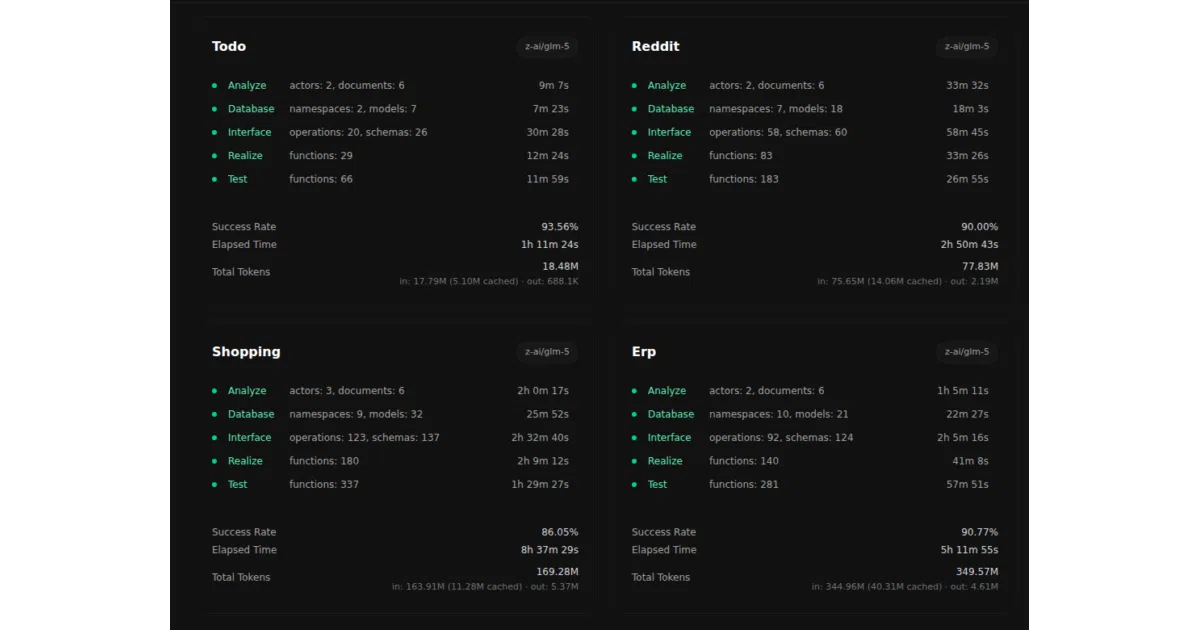
- Benchmarks itself against 13+ LLM models across four project types, grading compilation correctness, test coverage, and security
- Top scorer
glm-5averages 86/100 (grade B); most models hover in the B-to-C range across the suite - Generates a type-safe client SDK alongside the backend for frontend integration
- Supports stopping at any pipeline phase if you only need, say, an ERD or API spec
- Currently TypeScript-only, though the AST pipeline is designed to eventually support other languages
Caveats
AGPL-3.0license may complicate commercial adoption without open-sourcing derivative work- Runs locally via a playground application; no hosted service is mentioned
- Benchmark grades top out at B for most models, with several scoring C on complex projects like Shopping
Verdict
A solid experiment if you want AI-generated backend scaffolding that values structure over chaos, particularly for NestJS/Prisma stacks. Skip it if you need a hosted platform or a language other than TypeScript today.
Frequently asked
- What is wrtnlabs/autobe?
- AutoBE turns natural language requirements into structured TypeScript backends by forcing its AI agents through a compiler-checked waterfall pipeline before emitting a single line of code.
- Is autobe open source?
- Yes — wrtnlabs/autobe is open source, released under the AGPL-3.0 license.
- What language is autobe written in?
- wrtnlabs/autobe is primarily written in TypeScript.
- How popular is autobe?
- wrtnlabs/autobe has 1.4k stars on GitHub.
- Where can I find autobe?
- wrtnlabs/autobe is on GitHub at https://github.com/wrtnlabs/autobe.