walkinglabs/learn-harness-engineering
Why Your AI Coder Needs a Harness, Not a Bigger Model
A course on building the structural harnesses—state tracking, verification, and scope limits—that prevent smart AI coding agents from breaking your codebase and calling it done.
Velocity · 7d
+105
★ / day
Trend
↘cooling
star history
What it does
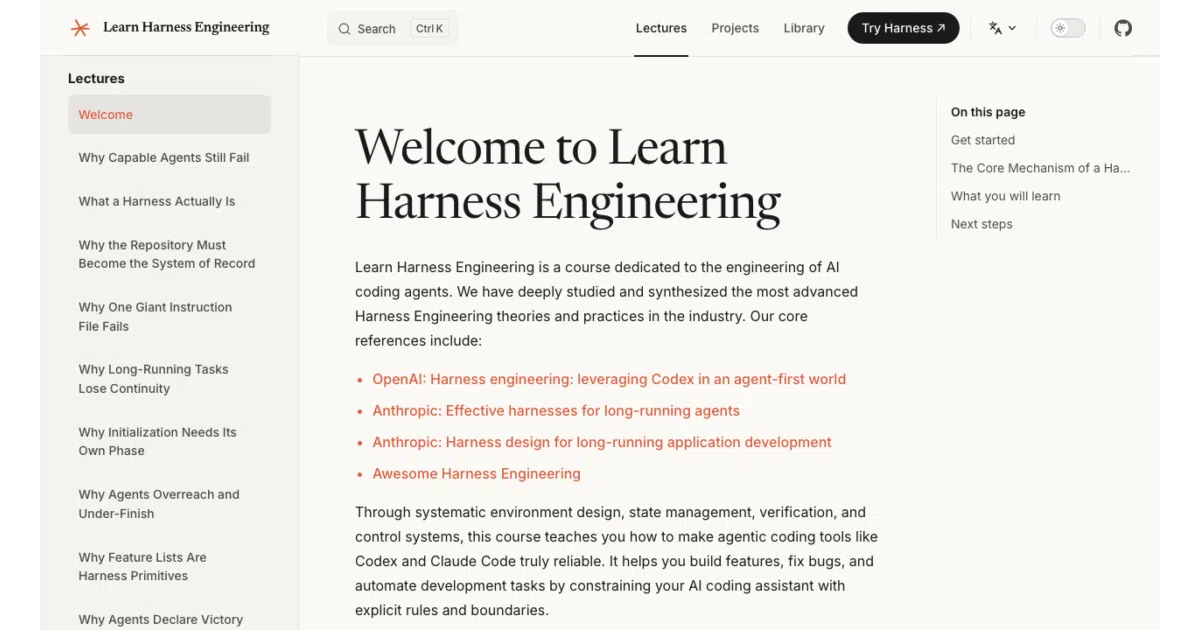
Learn Harness Engineering is a curriculum of 12 lectures and 6 hands-on projects, offered in 13 languages, that teaches you to build the operational scaffolding around LLM coding agents. Instead of focusing on prompt engineering, it treats the agent’s working environment—instruction files, state logs, verification pipelines, and scope constraints—as the product. The goal is to make the agent read the harness, execute one feature at a time, and prove completion with passing tests rather than a confident “done.”
The interesting bit
The course leans on a stark Anthropic experiment: the same model and prompt produced a broken mess in 20 minutes without a harness, but a working 2D game editor in six hours with one. The harness doesn’t make the model smarter; it makes the output accountable.
Key highlights
- Built around published research from OpenAI and Anthropic on harness design for long-running agents
- Includes a
skills/harness-creator/scaffold generator for production-grade harness files (AGENTS.md, feature lists,init.sh, verification workflows) - Teaches progressive instruction disclosure, disk-persisted session state, and clean handoffs between multi-turn sessions
- Ships with a PDF build pipeline and a GitHub Actions workflow to release coursebooks
Verdict
Worth your time if you’re trying to move Claude, GPT, or Codex from “impressive demo” to “actually ships features.” Skip it if you want a drop-in agent runtime—this is a methodology course with templates, not a framework.
Frequently asked
- What is walkinglabs/learn-harness-engineering?
- A course on building the structural harnesses—state tracking, verification, and scope limits—that prevent smart AI coding agents from breaking your codebase and calling it done.
- Is learn-harness-engineering open source?
- Yes — walkinglabs/learn-harness-engineering is open source, released under the MIT license.
- What language is learn-harness-engineering written in?
- walkinglabs/learn-harness-engineering is primarily written in TypeScript.
- How popular is learn-harness-engineering?
- walkinglabs/learn-harness-engineering has 21.5k stars on GitHub and is currently cooling off.
- Where can I find learn-harness-engineering?
- walkinglabs/learn-harness-engineering is on GitHub at https://github.com/walkinglabs/learn-harness-engineering.