uezo/aiavatarkit
A Python framework for talking anime heads and VRChat bots
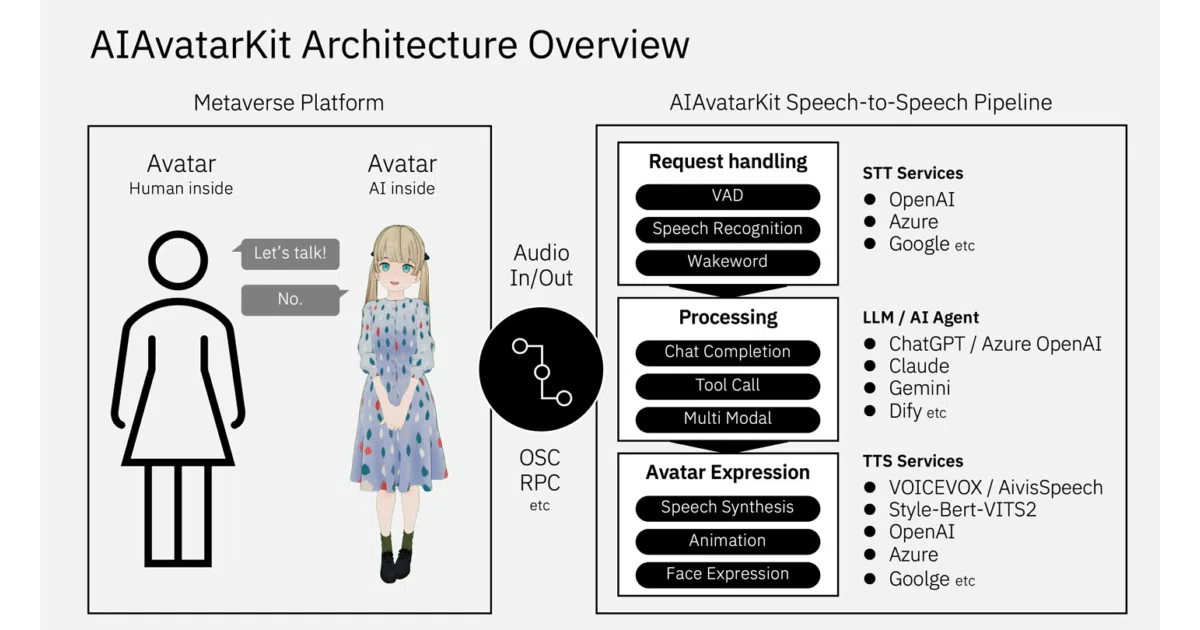
AIAvatarKit wires up speech-to-speech pipelines so you can build conversational avatars without writing glue code for VAD, STT, LLM, and TTS yourself.
Not currently ranked — collecting fresh signals.
star history
What it does
AIAvatarKit is a Python framework that handles the full speech-to-speech loop for conversational AI avatars. It ingests audio, detects voice activity, transcribes speech, runs it through an LLM, synthesizes a response, and drives facial expressions and lip sync. Out of the box it targets VRChat, cluster, and Vket Cloud, but also runs standalone via WebSocket or HTTP with browser-based UIs.
The interesting bit
The project treats the avatar as a platform-agnostic backend service rather than a client-side toy. It abstracts LLM differences behind a unified interface, supports server-side conversation history via OpenAI’s Responses API, and can stream progress updates during slow tool calls so the avatar doesn’t just freeze mid-sentence.
Key highlights
- Modular pipeline: swap VAD (Silero, built-in silence detection), STT (Google, Azure, OpenAI, AmiVoice), LLM (ChatGPT, Claude, Gemini, Dify, LiteLLM), and TTS (VOICEVOX, OpenAI, Style-Bert-VITS2)
- WebSocket variant of OpenAI Responses API claims up to 40% latency reduction in tool-call-heavy workflows
- Agent-native: tool calls, dynamic tool calls, background execution, and MCP support
- Character management with diaries, schedules, long-term memory, and automated daily updates
- Runs on Raspberry Pi and integrates with Twilio for telephony
Caveats
- README warns that technical blog posts may reference pre-v0.6 APIs; some features require downgrading to v0.5.8 to match older tutorials
- Claude and Gemini support are API-only (no Amazon Bedrock or Vertex AI)
- OpenAI Responses API variants don’t support Dynamic Tool Calls due to server-side history management
Verdict
Worth a look if you’re building voice-driven NPCs, VTuber backends, or telephony bots and don’t want to hand-roll the audio pipeline. Skip it if you just need a chat widget — this is overkill without the speech and avatar layers.
Frequently asked
- What is uezo/aiavatarkit?
- AIAvatarKit wires up speech-to-speech pipelines so you can build conversational avatars without writing glue code for VAD, STT, LLM, and TTS yourself.
- Is aiavatarkit open source?
- Yes — uezo/aiavatarkit is open source, released under the Apache-2.0 license.
- What language is aiavatarkit written in?
- uezo/aiavatarkit is primarily written in Python.
- How popular is aiavatarkit?
- uezo/aiavatarkit has 699 stars on GitHub.
- Where can I find aiavatarkit?
- uezo/aiavatarkit is on GitHub at https://github.com/uezo/aiavatarkit.