tinyfish-io/tinyfish-cookbook
A cookbook where every recipe is a web scraper with a job
Two dozen sample apps built on TinyFish's agent-driven web APIs — less a library, more a showroom for what "give a URL and a goal, get JSON" actually looks like.
Velocity · 7d
+2.6
★ / day
Trend
→steady
star history
What it does This repo collects standalone example apps — each folder a self-contained TypeScript project — built on TinyFish, a hosted “web layer for AI agents.” TinyFish exposes four endpoints: fast structured Search, a Fetch that renders pages in a real browser and returns clean markdown, an Agent that takes a URL plus a natural-language goal and returns JSON, and a rentable managed cloud Browser for your own Playwright/Selenium scripts. The recipes demonstrate the pattern end to end: price comparison across retailers, scholarship discovery, port congestion tracking, a Discord bot for anime figure hunters.
The interesting bit The recipes are organized by what they do, not what’s under the hood — a deliberate framing that says the boring part (browser automation, stealth proxies, credential vaulting) is the vendor’s problem. Several have live demos, so you can judge the output quality before reading a line of code. There’s also an agent Skill that teaches coding agents when to reach for Search vs. Fetch vs. Agent, which is a quietly practical touch.
Key highlights
- ~25 recipes across shopping, travel, research, education, and finance — many with deployed live demos
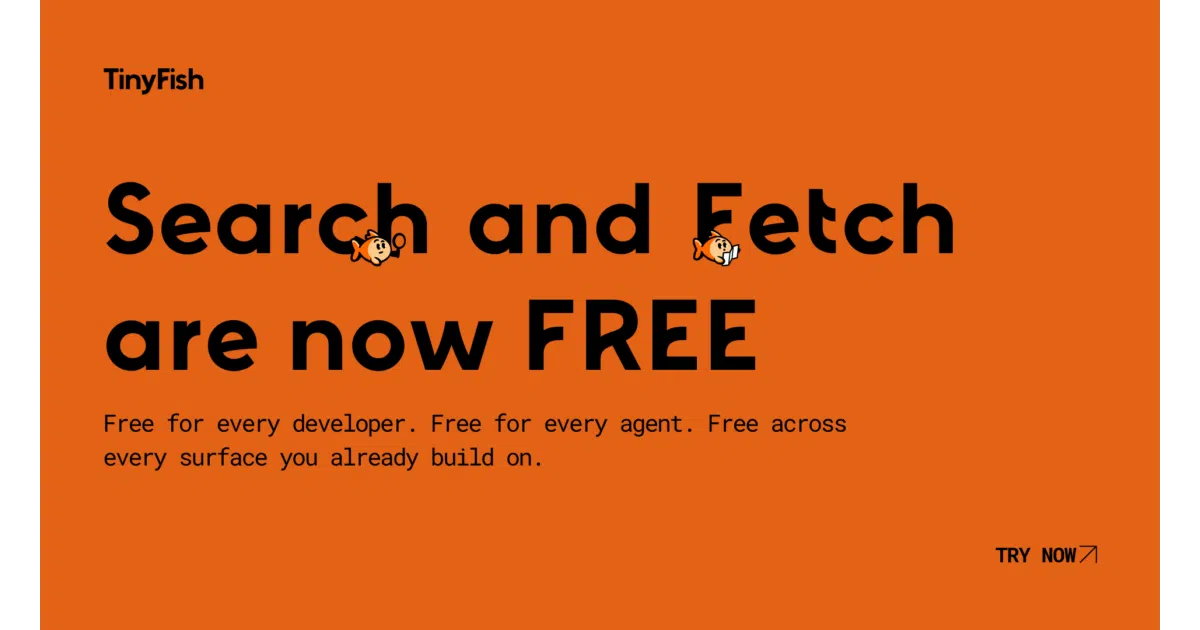
- Search and Fetch endpoints are free (rate-limited, no credit card); Agent and Browser are metered
- Fetch strips nav, scripts, and cookie banners, so you’re not paying tokens on junk HTML
- Also ships n8n workflow JSONs, an MCP server, Python and TypeScript SDKs, and a CLI that writes results to disk instead of your context window
- Built-in stealth (rotating proxies) and a Vault for authenticated flows with encrypted session reuse
Caveats
- This is a vendor cookbook — the examples are showcases for a commercial API, not a general-purpose toolkit; the free tier covers Search and Fetch only
- The README is heavy on marketing framing; per-recipe quality varies and isn’t documented here
Verdict Worth browsing if you’re building agents that need to read the live web and want working reference apps instead of docs. Skip it if you want something self-hosted — everything here routes through TinyFish’s cloud.
Frequently asked
- What is tinyfish-io/tinyfish-cookbook?
- Two dozen sample apps built on TinyFish's agent-driven web APIs — less a library, more a showroom for what "give a URL and a goal, get JSON" actually looks like.
- Is tinyfish-cookbook open source?
- Yes — tinyfish-io/tinyfish-cookbook is open source, released under the MIT license.
- What language is tinyfish-cookbook written in?
- tinyfish-io/tinyfish-cookbook is primarily written in TypeScript.
- How popular is tinyfish-cookbook?
- tinyfish-io/tinyfish-cookbook has 2.3k stars on GitHub and is currently holding steady.
- Where can I find tinyfish-cookbook?
- tinyfish-io/tinyfish-cookbook is on GitHub at https://github.com/tinyfish-io/tinyfish-cookbook.