thu-ml/SLA
A trainable mashup of sparse and linear attention for diffusion
SLA fuses sparse and linear attention into a single trainable layer so diffusion transformers can run faster without freezing the attention pattern.
Collecting fresh signals — velocity needs a few days of history.
collecting data…
star history
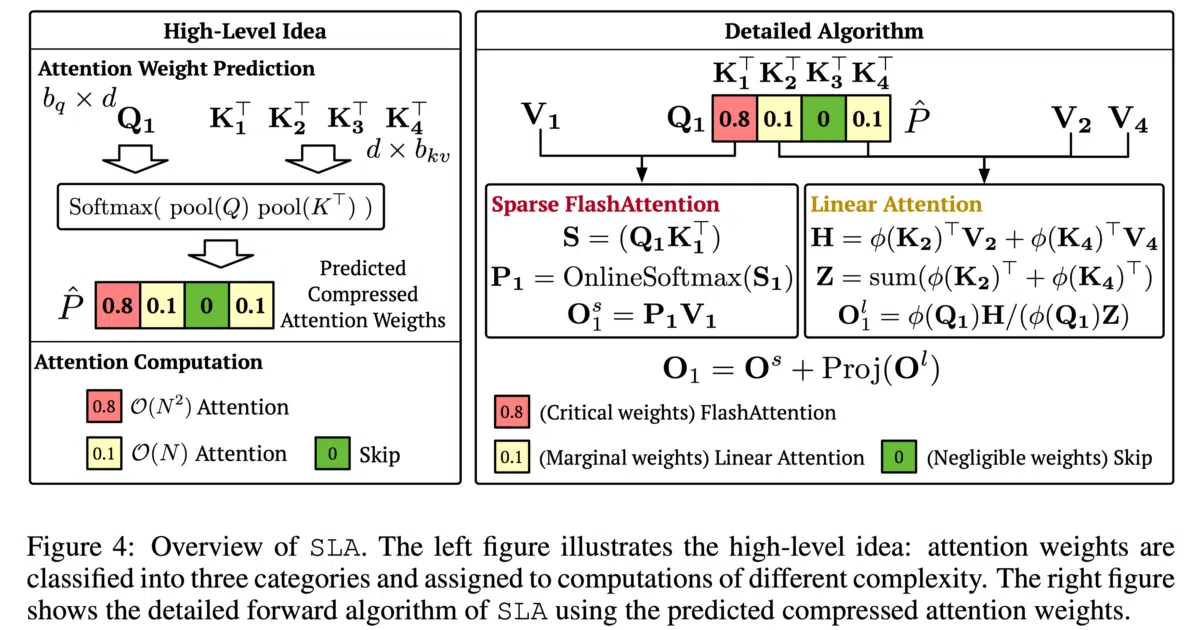
What it does SLA is a drop-in attention replacement for diffusion transformers that mixes sparse top-k selection with linear feature-map attention. The whole mechanism stays differentiable, so you can fine-tune it end-to-end rather than treating it as a frozen inference hack. The repo ships two versions on separate branches and includes SageSLA, a SageAttention-based fast path for when you just need speed.
The interesting bit Most sparse attention tricks are inference-only patches; SLA is designed to be trained end-to-end, meaning the model learns which tokens to ignore instead of relying on a hand-wired heuristic. It also marries two usually separate acceleration strategies—sparsity and linearization—into one mechanism.
Key highlights
- Fuses sparse top-k selection with linear feature-map attention in a single layer
- Fine-tunable: the sparsity pattern is learned, not hard-coded
- Ships two implementations (main and SLA-1 branches)
- Includes
SageSLA, a faster inference variant built on SageAttention - Targets diffusion transformers and video generation workloads
Caveats
- The README shows API usage but doesn’t quote speedups or accuracy trade-offs in text; you’ll need to check the paper or the effectiveness/efficiency charts for hard numbers
- It is unclear which specific diffusion frameworks are supported out of the box versus requiring manual integration
Verdict Worth a look if you’re training or fine-tuning diffusion transformers and standard full attention has become a compute bottleneck. If you just want a plug-and-play inference drop-in for an existing frozen model, SageSLA might help, but the project’s real pitch is the trainable angle.
Frequently asked
- What is thu-ml/SLA?
- SLA fuses sparse and linear attention into a single trainable layer so diffusion transformers can run faster without freezing the attention pattern.
- Is SLA open source?
- Yes — thu-ml/SLA is open source, released under the Apache-2.0 license.
- What language is SLA written in?
- thu-ml/SLA is primarily written in Python.
- How popular is SLA?
- thu-ml/SLA has 513 stars on GitHub.
- Where can I find SLA?
- thu-ml/SLA is on GitHub at https://github.com/thu-ml/SLA.