thedotmack/claude-mem
Giving Claude Code a memory that outlasts the terminal
Persistent memory for coding agents that currently forget everything when the session ends.
Feature · 08 Oct 2026
Every Agent Forgets. claude-mem Made That a Business.
A hook-driven memory layer for Claude Code has ridden the agent-hype wave to nearly 100k stars — by treating forgetting as an engineering problem, and a revenue opportunity.
Read the in-depth article →
Velocity · 7d
+190
★ / day
Trend
↘cooling
star history
What it does
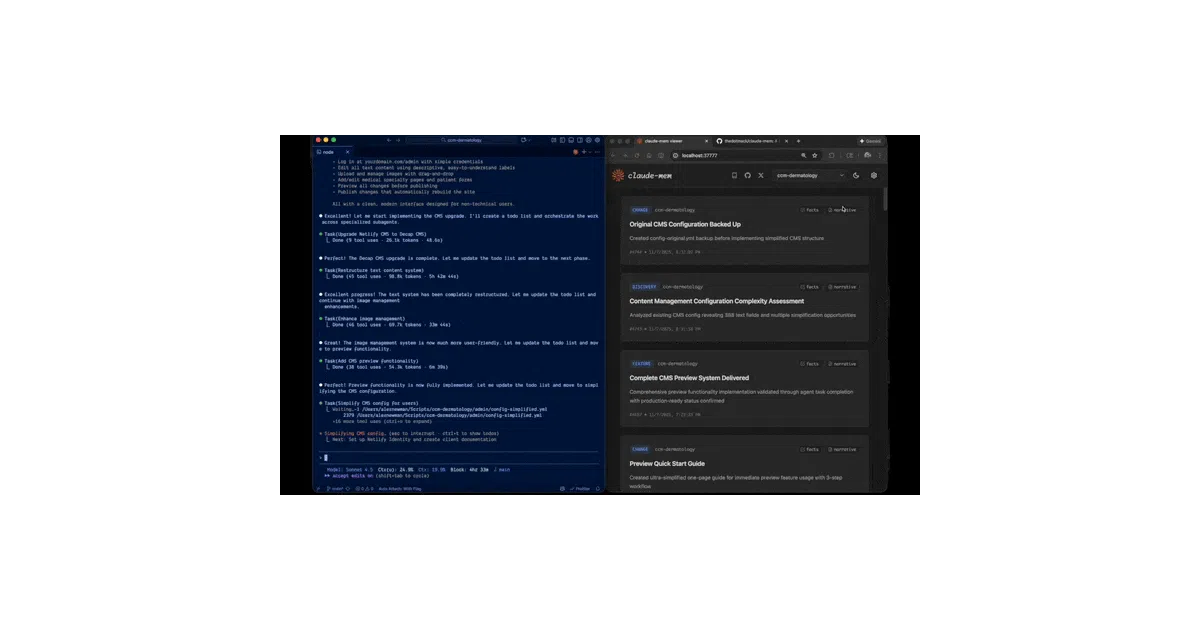
claude-mem is a persistent memory layer for Claude Code, Gemini CLI, OpenCode, and similar agents. It hooks into session lifecycle events to record tool usage and observations, stashes them in a local SQLite database with Chroma vector search, and automatically primes new sessions with relevant history. The goal is continuity: your agent remembers yesterday’s decisions without you repeating them.
The interesting bit
Instead of dumping entire chat logs into the context window, the project treats retrieval as a token-budget problem. It exposes a three-layer MCP search workflow—index, timeline, then full observation—that the documentation claims yields ~10× token savings by filtering before fetching details. There is also a local web viewer on port 37777 if you want to browse your agent’s memory like a security DVR.
Key highlights
- Hooks into session lifecycle events (
SessionStart,PostToolUse,SessionEnd, and others) to record observations automatically - Stores data locally in SQLite with hybrid semantic and keyword search via Chroma
- Surfaces memory through a local web viewer and MCP tools with progressive disclosure layers
- Supports
<private>tags to keep sensitive content out of the persistent store - Also integrates with OpenClaw gateways and Claude Desktop
Caveats
- Installing via
npm install -gonly gets the SDK, not the plugin hooks or worker service; thenpxroute is required for full functionality - Experimental features like Endless Mode live in a beta channel
- The architecture depends on Bun and Node ≥ 18
Verdict
Worth a look if you live in Claude Code or Gemini CLI and are tired of re-establishing context each morning. Skip it if you prefer stateless agent interactions or don’t want another local service running on port 37777.
Frequently asked
- What is thedotmack/claude-mem?
- Persistent memory for coding agents that currently forget everything when the session ends.
- Is claude-mem open source?
- Yes — thedotmack/claude-mem is open source, released under the Apache-2.0 license.
- What language is claude-mem written in?
- thedotmack/claude-mem is primarily written in TypeScript.
- How popular is claude-mem?
- thedotmack/claude-mem has 103.1k stars on GitHub and is currently cooling off.
- Where can I find claude-mem?
- thedotmack/claude-mem is on GitHub at https://github.com/thedotmack/claude-mem.