tgoai/tgo
A self-hosted support stack run by LLM agent committees
TGO lets enterprises build self-hosted AI agent teams that handle multi-channel support, query RAG knowledge bases, and escalate to humans when the LLM hits a wall.
Not currently ranked — collecting fresh signals.
star history
What it does
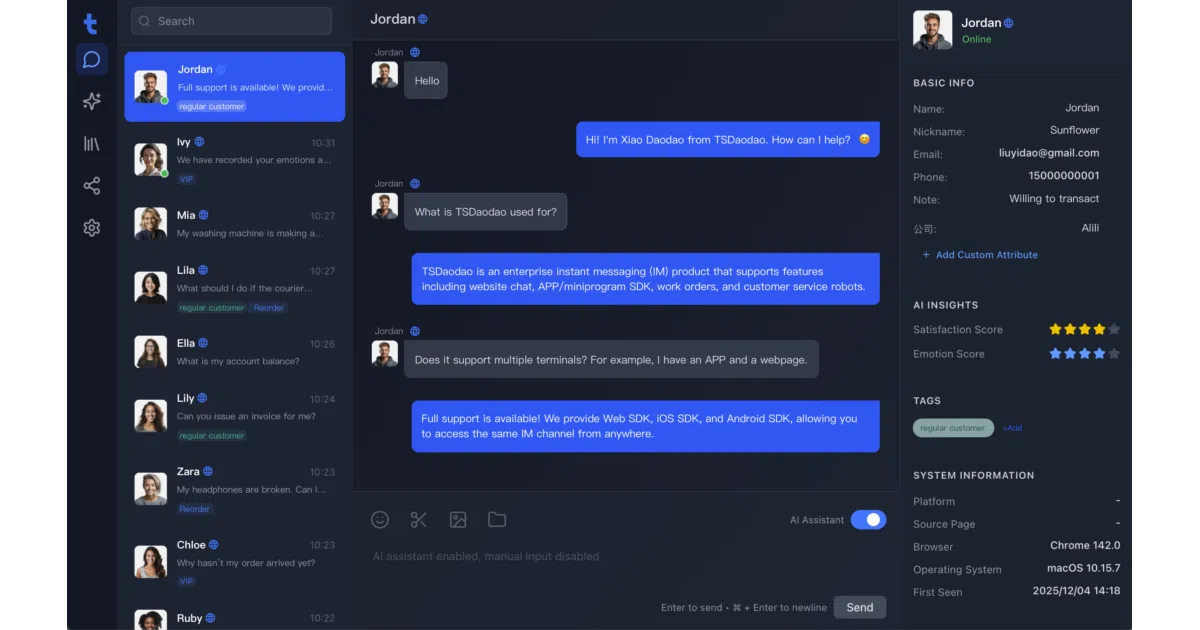
TGO is a sprawling, self-hosted customer service platform that treats support as a multi-agent LLM workflow. It ingests messages from web widgets, WeChat, Slack, Telegram, and email into a central system where AI agents—backed by RAG document search and MCP tool integrations—field requests. If the bots stall, the system hands off to human agents through a unified workspace. The whole thing is split across fifteen separate repositories handling everything from workflow DAGs to device management.
The interesting bit
The architecture is unusually fragmented for an open-source project: Python FastAPI services for AI logic and RAG, a TypeScript/React dashboard, Go and Flutter widget SDKs, and even a dedicated device-agent binary for remote shell access. That modularity lets you swap LLM providers or swap out the entire instant-messaging backend (it ships with WuKongIM), but it also means you are effectively adopting a small ecosystem, not a single app.
Key highlights
- Multi-channel intake: web, WeChat, Feishu, DingTalk, Telegram, Slack, and email.
- RAG knowledge bases spanning documents, Q&A pairs, and crawled websites with vector semantic search.
- MCP tool store with OpenAPI schema parsing and custom project-level tools.
- Human-AI collaboration with smart handoff, visitor tracking, and a unified agent workspace.
- Workflow engine supporting DAG topologies mixing LLM, API, condition, and tool nodes.
Caveats
- The README lists steep baseline hardware (4+ CPU cores, 8+ GiB RAM) but never clarifies whether that is for a minimal trial or a production workload.
- With fifteen separate repositories spanning Python, TypeScript, Go, and Dart, operational complexity is high; there is no mention of a managed SaaS or single-binary distribution.
- The linked documentation lives on the project’s marketing site, and the README itself stays high-level, so deep architectural detail is scarce.
Verdict
Worth a look if you run a support organization that needs deep LLM integration and must keep data on-premise. Probably overkill if you just need a basic chat widget and already pay for Zendesk.
Frequently asked
- What is tgoai/tgo?
- TGO lets enterprises build self-hosted AI agent teams that handle multi-channel support, query RAG knowledge bases, and escalate to humans when the LLM hits a wall.
- Is tgo open source?
- Yes — tgoai/tgo is an open-source project tracked on heatdrop.
- What language is tgo written in?
- tgoai/tgo is primarily written in TypeScript.
- How popular is tgo?
- tgoai/tgo has 642 stars on GitHub.
- Where can I find tgo?
- tgoai/tgo is on GitHub at https://github.com/tgoai/tgo.