tencentmusic/cube-studio
Tencent Music’s kitchen-sink MLOps platform signs off
An open-source attempt to unify notebooks, MLOps pipelines, LLM training, domestic GPU clusters, and tenant billing under one Kubernetes roof.
Not currently ranked — collecting fresh signals.
star history
What it does
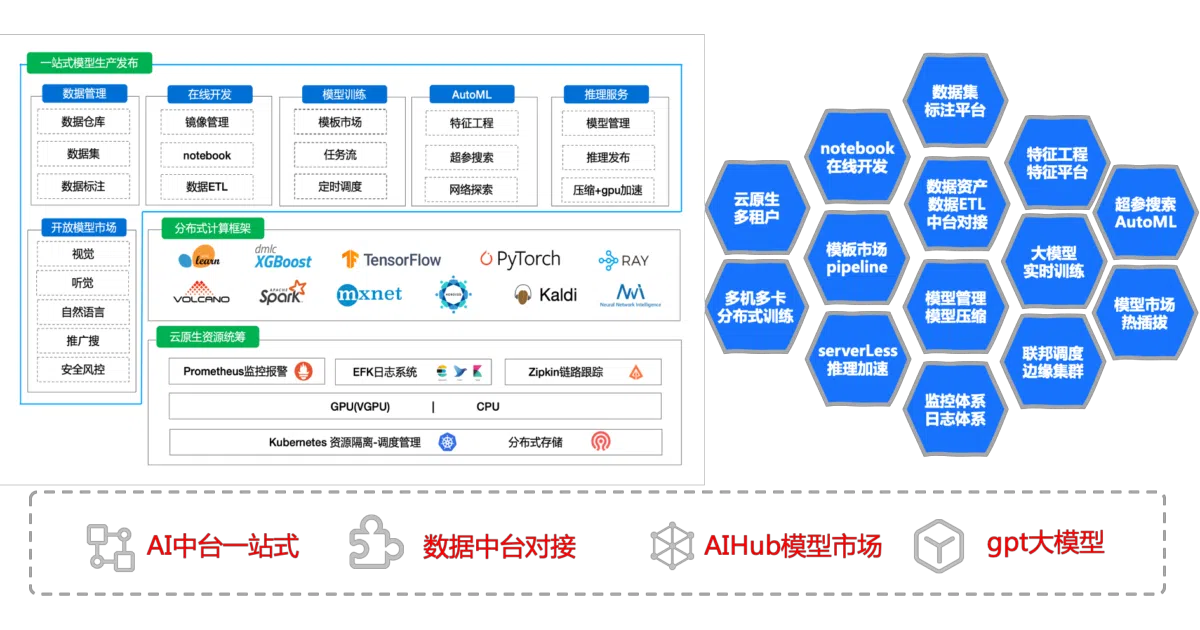
Cube Studio is a Kubernetes-based control plane that bundles the entire AI lifecycle—notebooks, drag-and-drop pipeline orchestration, distributed training, hyper-parameter search, model serving, and LLM fine-tuning—into a single web interface. It also layers on operational concerns like tenant metering, resource quotas, SSO, and an AI model marketplace. The README is essentially a massive feature matrix that suggests the authors aimed to check every box in the MLOps playbook.
The interesting bit
The platform makes an unusually aggressive bet on domestic Chinese hardware, explicitly supporting Huawei Ascend NPUs, Hygon DCUs, Cambricon MLUs, and Tianshu GPUs alongside the usual NVIDIA stack, plus RDMA over Mellanox and ARM64 nodes. It also treats LLM operations as first-class citizens, offering DeepSeek fine-tuning, reward-model training, reinforcement learning, and multi-machine inference via vLLM, Ollama, and MindIE.
Key highlights
- Full-lifecycle MLOps: notebooks, pipeline orchestration, distributed training frameworks (
PyTorch,DeepSpeed,ColossalAI,Horovod,Ray,Volcano), hyper-parameter search, and model serving. - Domestic hardware integration: supports Huawei NPUs, Hygon DCUs, Cambricon MLUs, Tianshu GPUs, plus VGPU virtualization, RDMA/Mellanox, and ARM64.
- LLM-native features: SFT fine-tuning, reward models, RL training, and multi-machine inference backends including
vLLM,Ollama, andMindIE. - Platform operations: built-in metering, billing, tenant resource limits, SSO/LDAP, and a private knowledge base.
- Repository status: the README states the
tencentmusicrepo was archived on 2026-05-18; documentation has moved to thedata-infraorganization.
Caveats
- The README is a raw feature matrix with almost no architectural or usage detail, so the depth and maturity of individual modules is unclear.
- The repository is explicitly archived as of 2026-05-18 and no longer maintained under
tencentmusic. - The scope spans edge computing, automated annotation, metering, and LLM ops, but the README leaves integration and maintenance details largely unexplained.
Verdict
Study this if you are architecting a private AI cloud that must juggle domestic Chinese silicon, tenant billing, and LLM pipelines. Otherwise, treat it as a comprehensive feature checklist to borrow from, not a distribution to deploy wholesale.
Frequently asked
- What is tencentmusic/cube-studio?
- An open-source attempt to unify notebooks, MLOps pipelines, LLM training, domestic GPU clusters, and tenant billing under one Kubernetes roof.
- Is cube-studio open source?
- Yes — tencentmusic/cube-studio is an open-source project tracked on heatdrop.
- How popular is cube-studio?
- tencentmusic/cube-studio has 5.1k stars on GitHub.
- Where can I find cube-studio?
- tencentmusic/cube-studio is on GitHub at https://github.com/tencentmusic/cube-studio.