taehoonlee/tensornets
TensorFlow model zoo that treats networks as plain functions, not objects
TensorNets gives you ResNet, YOLO, and friends as simple functions returning tf.Tensor, with pre-trained weights and a side of old-school TF 1.x sessions.
Not currently ranked — collecting fresh signals.
star history
What it does
TensorNets is a collection of 25+ computer vision architectures—ResNet, DenseNet, EfficientNet, YOLO variants, Faster R-CNN, and more—implemented as plain functions in TensorFlow. Each model takes a tf.Tensor and returns a tf.Tensor, with pre-trained weights and preprocessing available via .pretrained() and .preprocess() methods. It covers image classification and object detection, and includes utilities for inspecting intermediate layers, weights, and model summaries.
The interesting bit
The author claims all Inception variants fit in ~500 lines versus 2000+ in Google’s official models, achieved by using tf.contrib.layers and avoiding custom classes entirely. The object detection models are decoupled from their “stem” backbones—you can pair YOLOv2 with any network in the library, not just the default Darknet19.
Key highlights
- Supports TensorFlow 1.4 through 2.1 (with compatibility shims for TF 2)
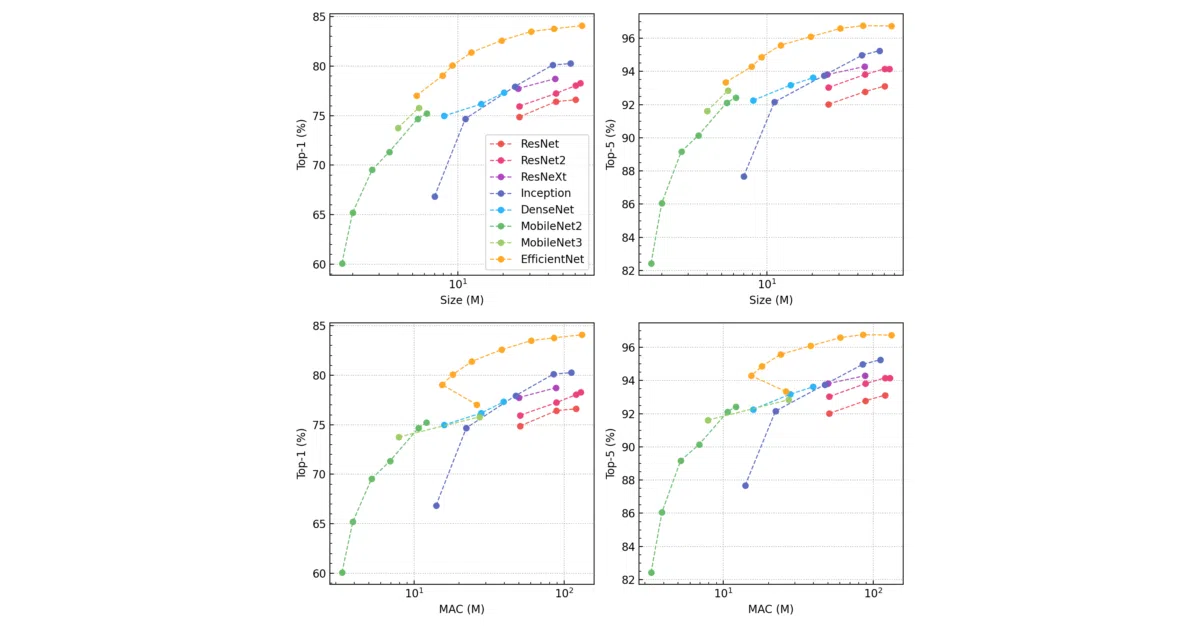
- Pre-trained weights available for all classification models; ImageNet validation accuracies and inference speeds benchmarked on Tesla P100
- Introspection methods:
middles(),outputs(),weights(),summary()for debugging and feature extraction - Multi-GPU usage shown in examples; transfer learning with custom class counts supported via
is_training=True - Object detection requires manual ROI pooling setup for Faster R-CNN, and detection APIs vary slightly between YOLOv2, YOLOv3, and Faster R-CNN
Caveats
- Built around
tf.Sessionandtf.placeholder, making it a TF 1.x project with compatibility workarounds rather than native TF 2 / Keras tf.contrib.layersis deprecated in modern TensorFlow, and the Travis CI badge suggests maintenance may have slowed- Faster R-CNN requires compiling a separate C++ ROI pooling extension with manual Makefile edits
Verdict
Worth a look if you’re maintaining legacy TensorFlow 1.x pipelines and want drop-in, inspectable models without Keras abstraction overhead. Skip it if you’re on TF 2.x or later—modern tf.keras.applications or Hugging Face have superseded this approach.
Frequently asked
- What is taehoonlee/tensornets?
- TensorNets gives you ResNet, YOLO, and friends as simple functions returning tf.Tensor, with pre-trained weights and a side of old-school TF 1.x sessions.
- Is tensornets open source?
- Yes — taehoonlee/tensornets is open source, released under the MIT license.
- What language is tensornets written in?
- taehoonlee/tensornets is primarily written in Python.
- How popular is tensornets?
- taehoonlee/tensornets has 994 stars on GitHub.
- Where can I find tensornets?
- taehoonlee/tensornets is on GitHub at https://github.com/taehoonlee/tensornets.