synchopate/llama-modchip
A 284B model on a 64 GB desktop, no GPU in sight
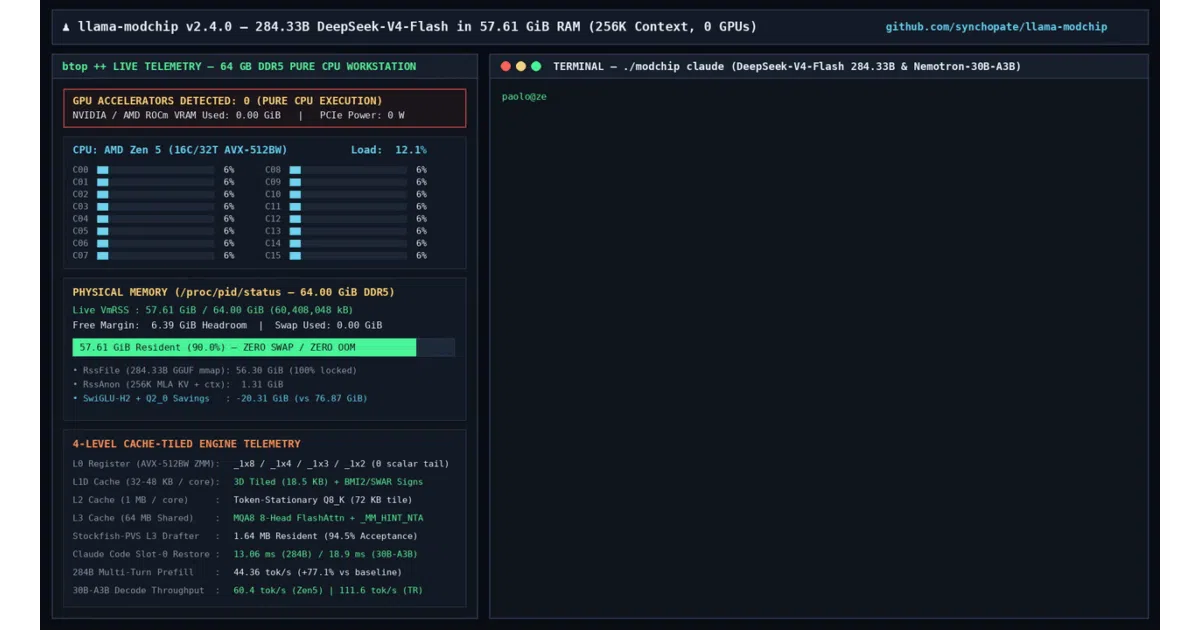
llama-modchip patches llama.cpp kernels and re-quantizes MoE checkpoints so DeepSeek-V4-Flash fits — and runs — entirely in system RAM.
Collecting fresh signals — velocity needs a few days of history.
collecting data…
star history
What it does
It’s a bundle of ggml/llama.cpp kernel patches, quantization transcoders, and runtime tooling for running sparse MoE models purely on CPU (x86_64 AVX-512/AVX2, ARM64 NEON/SVE, Apple Metal). The headline trick: shrinking DeepSeek-V4-Flash (284.33B total, 13.17B active) from a 76.87 GiB UD-IQ1_S build down to 56.56 GiB at 1.71 bpw, so the model plus a 256K KV cache fits in 64 GB of RAM with zero swap. Smaller 30B MoEs run on 16–32 GB laptops at 25–60 tok/s.
The interesting bit
The quantization is surgical rather than uniform: shared experts, MLA projections, and embeddings stay in Q4_K/Q5_K/F32, while the 256 routed experts get crushed to IQ1_S with a second-order “SwiGLU-H2” scale-matching scheme, and boundary layers get gentler treatment. The drafter is a 1.64 MB Zobrist n-gram table borrowed from Stockfish’s chess engine — a genuinely odd lineage for speculative decoding.
Key highlights
- 44.4 tok/s prefill and 9.1–14.7 tok/s decode on a 16-core Zen 5 CPU, 0 GPUs
- SIMD cache-tiling patches claim +77% prefill / +53% decode vs stock kernels
/dev/shmKV snapshots restore 40-tool Claude Code agent context in 13–33 ms- Default mode evaluates all Top-6 experts with zero dropping (1.0 logit cosine similarity vs unpatched runtime)
- Hybrid mode puts the hot trunk on a 16 GB GPU with cold experts in RAM (~80.8 tok/s)
Caveats
- The custom
Fractal-64tensors (type ID 40) are rejected by stock llama.cpp, Ollama, and LM Studio — you’re locked into their patched runtime or prebuilt binary. - 1.71 bpw is aggressive; the README reports a 100/100 quality gate for the 30B build, but quality claims for the 284B rest on their own eval scripts.
- The 284B path is Linux x86_64 territory; Windows is routed through a hybrid GPU+CPU path instead.
Verdict Worth a look if you have a big-RAM desktop and want frontier-ish MoE models without a GPU, or if you enjoy reading quantization schemes as spectator sport. If you’re on a Mac with 16 GB or need guaranteed upstream-llama.cpp compatibility, move along.
Frequently asked
- What is synchopate/llama-modchip?
- llama-modchip patches llama.cpp kernels and re-quantizes MoE checkpoints so DeepSeek-V4-Flash fits — and runs — entirely in system RAM.
- Is llama-modchip open source?
- Yes — synchopate/llama-modchip is open source, released under the Apache-2.0 license.
- What language is llama-modchip written in?
- synchopate/llama-modchip is primarily written in Python.
- How popular is llama-modchip?
- synchopate/llama-modchip has 525 stars on GitHub.
- Where can I find llama-modchip?
- synchopate/llama-modchip is on GitHub at https://github.com/synchopate/llama-modchip.