syncable-dev/memtrace-public
Memory for coding agents that skips the LLM entirely
Memtrace parses your codebase into a bi-temporal call graph so agents get blast radius and history in milliseconds, not LLM invoices.
Collecting fresh signals — velocity needs a few days of history.
star history
What it does
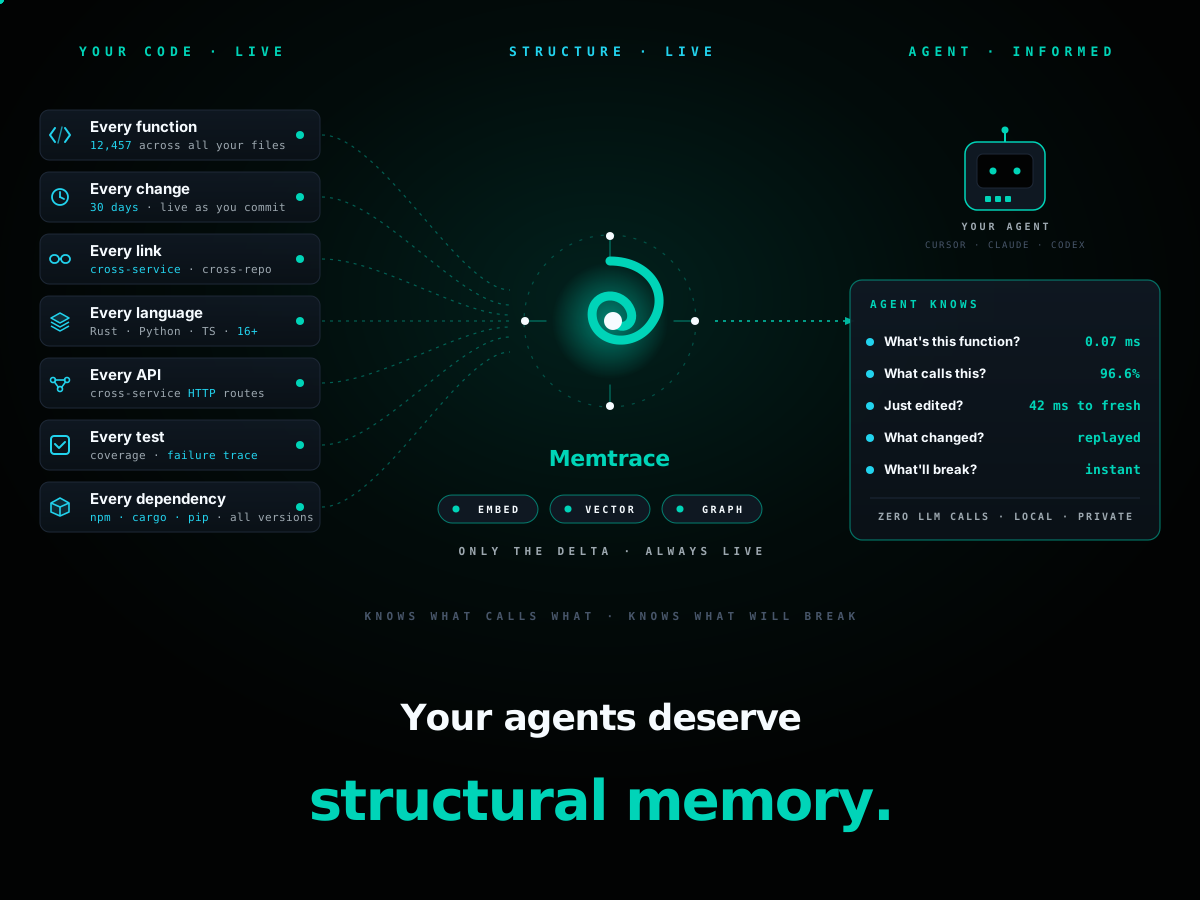
Memtrace indexes a codebase with Rust and Tree-sitter into a structural knowledge graph — functions, classes, call edges, imports — and exposes it to AI coding agents over MCP. Agents query it instead of re-reading files, so they can answer “who calls this?” or “what breaks if I change it?” directly. It also keeps full version history per symbol, so agents can time-travel through how code evolved. Works with Cursor, Claude Code, Codex, DeepSeek Harness, VS Code, and Windsurf.
The interesting bit
Unlike memory systems like Mem0 or Graphiti, it makes zero LLM calls to build the graph — relationships are parsed deterministically from ASTs, not inferred. That’s the whole pitch: 1,500 files indexed in ~1.5 seconds for $0, versus hours and $10–50 of API spend for LLM-driven approaches. The tradeoff is honest — it’s code-only, not conversational entity memory.
Key highlights
- Bi-temporal graph: every symbol carries version history, with six scoring modes (impact, novelty, recency, etc.)
- 25+ MCP tools: blast radius, dead code detection, cross-repo HTTP API topology, direct Cypher queries
- Hybrid retrieval: Tantivy BM25 + vector embeddings + reciprocal rank fusion
- Runs fully local — source never leaves your machine (only license checks and aggregate counts phone home)
- Louvain community detection auto-identifies architectural modules
Caveats
- Private beta with a waitlist — you can’t just install it today
- Proprietary EULA, not open source, despite the public repo
- Benchmarks are self-published, though the suite is reproducible and grounded in
pyright/astrather than Memtrace’s own index
Verdict
Worth a look if you run multiple agents on the same repo and are tired of blind refactors. Skip it if you need open-source licensing or conversational memory — it’s deliberately neither.
Frequently asked
- What is syncable-dev/memtrace-public?
- Memtrace parses your codebase into a bi-temporal call graph so agents get blast radius and history in milliseconds, not LLM invoices.
- Is memtrace-public open source?
- Yes — syncable-dev/memtrace-public is an open-source project tracked on heatdrop.
- What language is memtrace-public written in?
- syncable-dev/memtrace-public is primarily written in Python.
- How popular is memtrace-public?
- syncable-dev/memtrace-public has 504 stars on GitHub.
- Where can I find memtrace-public?
- syncable-dev/memtrace-public is on GitHub at https://github.com/syncable-dev/memtrace-public.