spring-projects/spring-ai
Java’s rebuttal to the Python AI monoculture
It gives Java developers a Spring-native way to wire enterprise data and APIs into AI models, on the bet that generative apps won't stay a Python-only club.
Velocity · 7d
+25
★ / day
Trend
↗accelerating
star history
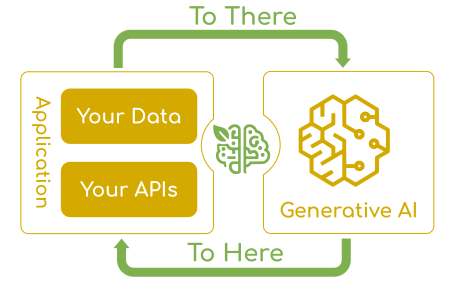
What it does Spring AI is an application framework that brings Spring’s usual design habits—portability, modularity, and POJOs—to the messy world of LLMs, embeddings, and vector stores. It wraps major providers like OpenAI, Anthropic, Google, Amazon, and Ollama behind a portable API, and does the same for a long list of vector databases. The goal is to let a typical Spring shop plug enterprise data and internal APIs into AI models without adopting a parallel Python stack.
The interesting bit
The project wears its inspiration on its sleeve—LangChain and LlamaIndex are name-checked—but insists it is not a direct port. Instead, it tries to make AI patterns feel like ordinary Spring idioms: a fluent ChatClient that echoes WebClient, structured output mapped straight to POJOs, and an Advisors API that packages recurring generative-AI patterns into reusable, model-agnostic interceptors. It is essentially an argument that the JVM deserves to be more than a Python satellite in the generative-AI era.
Key highlights
- Portable abstractions across major model providers (chat, embeddings, images, audio, moderation) and vector stores (PGVector, Elasticsearch, Redis, MongoDB, and a dozen others).
- A SQL-like metadata filter API for vector stores, plus built-in support for RAG, conversation memory, and function calling.
- Spring Boot auto-configuration and starters, so dependencies behave like any other Spring starter.
- An ETL pipeline for document ingestion and evaluation utilities to test for hallucinated responses.
- Targets Java 17+ and Spring Boot 3.5.x/4.x depending on the release branch.
Caveats
- The build is picky: it requires a specific JDK distribution (Liberica 17.0.19+) for nullability checks, and compiling from source can trip over CPU-architecture-specific native dependencies like PyTorch. macOS users on Apple Silicon need to be careful not to accidentally run under Rosetta.
- The repository contains large model files tracked via Git LFS, so a standard clone will either require LFS or skip them.
- Breaking changes are documented up to version 1.0.0.M1 and higher, so upgrading from early milestones may require manual intervention.
Verdict Worth a look if you are a Java developer who wants to keep AI logic inside the Spring ecosystem rather than maintaining a separate Python microservice. If you are already happy with LangChain in Python and have no JVM footprint, this is mostly someone else’s solution to someone else’s problem.
Frequently asked
- What is spring-projects/spring-ai?
- It gives Java developers a Spring-native way to wire enterprise data and APIs into AI models, on the bet that generative apps won't stay a Python-only club.
- Is spring-ai open source?
- Yes — spring-projects/spring-ai is open source, released under the Apache-2.0 license.
- What language is spring-ai written in?
- spring-projects/spring-ai is primarily written in Java.
- How popular is spring-ai?
- spring-projects/spring-ai has 9.6k stars on GitHub and is currently accelerating.
- Where can I find spring-ai?
- spring-projects/spring-ai is on GitHub at https://github.com/spring-projects/spring-ai.