sno-ai/sno-station
Your coding agents cover each other's shifts — and get smarter overnight
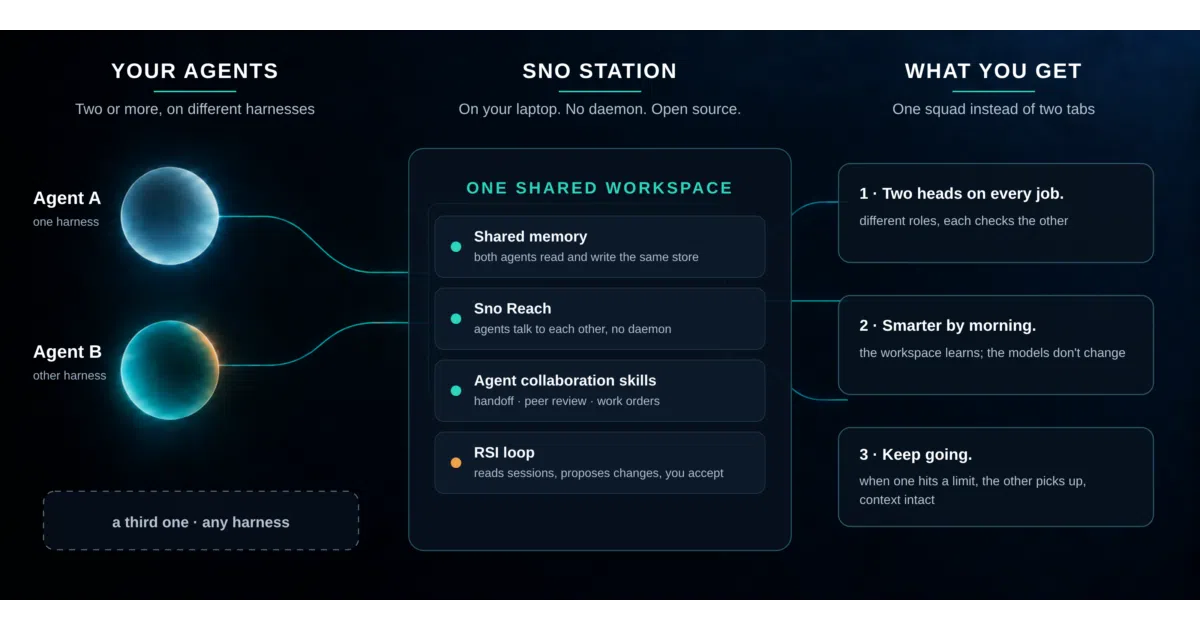
Sno Station wires Claude Code, Codex, Cursor and friends into one local squad with shared encrypted memory, cross-vendor review, and a nightly loop that rewrites their own skills (with your sign-off).
Collecting fresh signals — velocity needs a few days of history.
collecting data…
star history
What it does
Sno Station is an open-source TypeScript workstation that turns the agents you already run — Codex, Claude Code, Hermes, Cursor, OpenClaw — into a single squad on your laptop. They share one encrypted memory store, pass tasks between each other when one hits its rate limit, and review each other’s work (the reviewer is always from a different harness). Everything — memory, messages, skills — lives locally; no daemon, no server, and the optional sno.ai cloud account is genuinely optional.
The interesting bit
The nightly “RSI” loop reads your agents’ session logs, spots repeated mistakes, and proposes edits to the agents’ own skill files — nothing applies until you run the accept command. The README backs this with real evidence: after one night’s changes, failures in three touched skills dropped to zero, and the loop independently found a release-script bug zsh had been hiding from bash.
Key highlights
- Shared encrypted memory across five harnesses, with per-language storage and intact CJK text in keys and search
sno reach callhands off a task mid-stream with a handover brief — the README documents a real 2%-quota handover that completed while the owner slept- Dual Brain cross-vendor peer review: the authors report months of reviews where not one came back empty
- Runs fully offline; the key never leaves your machine and Sno never receives your database
- Self-updating CLI, Apache-2.0, README in nine languages
Caveats
- Cursor support is newest and partial: no per-prompt memory in
cursor-agent -p, no Windows, no Linux app, no cloud agents - The evidence sections are self-reported from the maintainers’ own machine — impressive, but you’ll want to verify on yours
- The install path is a curl-to-shell one-liner; the security boundary details live in
docs/security.md, which is worth reading
Verdict
If you already juggle two or more coding agents and lose context at quota walls, this is a genuinely interesting piece of glue — ambitious glue, with receipts. If you’re a single-agent, single-harness person, there’s little here for you yet.
Frequently asked
- What is sno-ai/sno-station?
- Sno Station wires Claude Code, Codex, Cursor and friends into one local squad with shared encrypted memory, cross-vendor review, and a nightly loop that rewrites their own skills (with your sign-off).
- Is sno-station open source?
- Yes — sno-ai/sno-station is open source, released under the Apache-2.0 license.
- What language is sno-station written in?
- sno-ai/sno-station is primarily written in TypeScript.
- How popular is sno-station?
- sno-ai/sno-station has 509 stars on GitHub.
- Where can I find sno-station?
- sno-ai/sno-station is on GitHub at https://github.com/sno-ai/sno-station.