slee-persis/GVS5H
Five cheap models on each other's shoulders beat one expensive gorilla
A training-free orchestration trick gets five Qwen3.8-27B instances to match Claude Fable 5 on hard coding benchmarks — at 9% of the cost, or on a single GPU.
Collecting fresh signals — velocity needs a few days of history.
collecting data…
star history
What it does
GVS5H (“Gorilla vs. 5 Humans”) is the research code and paper behind ledger-based zero-shot self-orchestration: fresh instances of one model decompose a problem and coordinate through a shared filesystem holding a plan, notes, and the current solution. No fine-tuning, no special training — just inference-time organization. The repo ships the benchmark harness (escalation/run_bench.py), the paper, and run data under permissive licenses (MIT for code, CC BY 4.0 for paper and data).
The interesting bit
The coordination medium is deliberately boring: a filesystem. Instances persist context as files rather than in some fancy message-passing protocol, and the authors attribute the gains to decomposition plus that persistent context. It’s the “five kids on each other’s shoulders” approach — individually small, collectively gorilla-height.
Key highlights
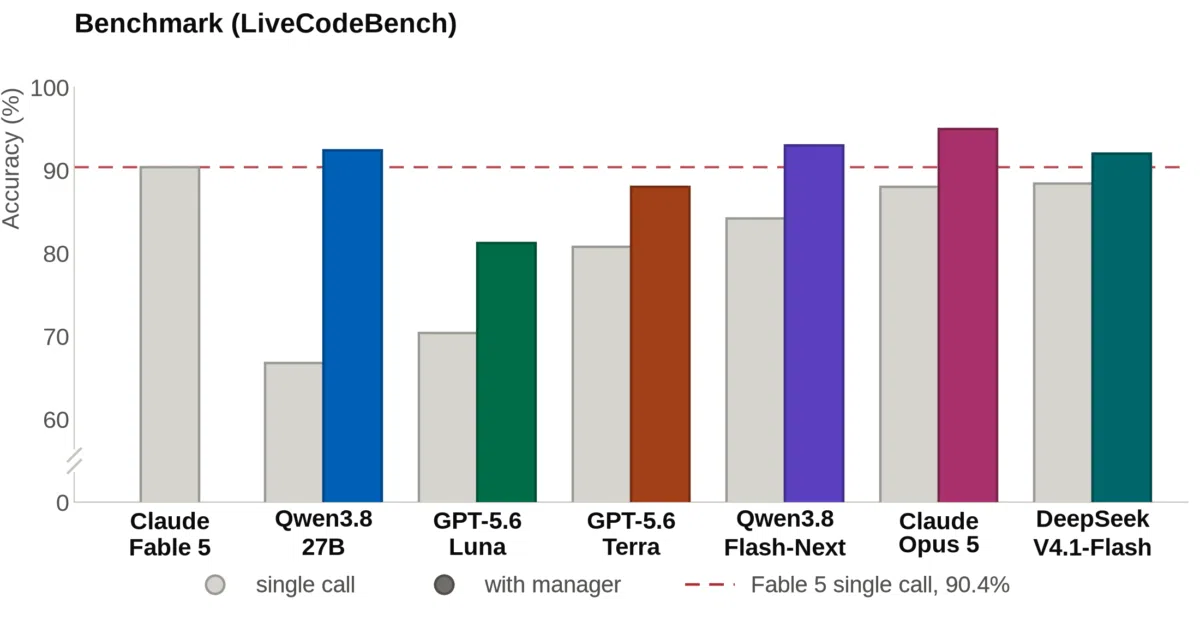
- Orchestrated Qwen3.8 Flash Next hits 93.0% pass@1 on the 100 latest hard LiveCodeBench problems vs. Claude Fable 5’s 90.4%, at 9% of the cost.
- Locally served, open-weight Qwen3.8-27B jumps from 66.8% to 92.4% — frontier-adjacent accuracy on self-hostable weights.
- Gains up to 25.6 percentage points across eleven models on pinned backends.
- Training-free: works purely at inference time, so it applies to any model you can spin up five of.
Caveats
- The authors are upfront that gains are not universal — some models were unchanged or worse under orchestration.
- One comparison (Opus 5) ran on an earlier scaffold version through OpenRouter rather than the pinned five-instance setup, so that data point isn’t apples-to-apples.
Verdict
Worth a look if you’re trying to squeeze frontier coding accuracy out of mid-size open models, especially self-hosted. If you already pay for a top-tier API and your tasks are cheap, the orchestration overhead may not buy you much.
Frequently asked
- What is slee-persis/GVS5H?
- A training-free orchestration trick gets five Qwen3.8-27B instances to match Claude Fable 5 on hard coding benchmarks — at 9% of the cost, or on a single GPU.
- Is GVS5H open source?
- Yes — slee-persis/GVS5H is open source, released under the MIT license.
- What language is GVS5H written in?
- slee-persis/GVS5H is primarily written in Python.
- How popular is GVS5H?
- slee-persis/GVS5H has 1.1k stars on GitHub.
- Where can I find GVS5H?
- slee-persis/GVS5H is on GitHub at https://github.com/slee-persis/GVS5H.