simstudioai/sim
Sim Wants to Be the Figma for Your AI Agent Team
Sim exists so you can orchestrate LLMs, tools, and vector stores on a visual canvas instead of writing another ad-hoc Python script.
Velocity · 7d
+12
★ / day
Trend
↗accelerating
star history
What it does
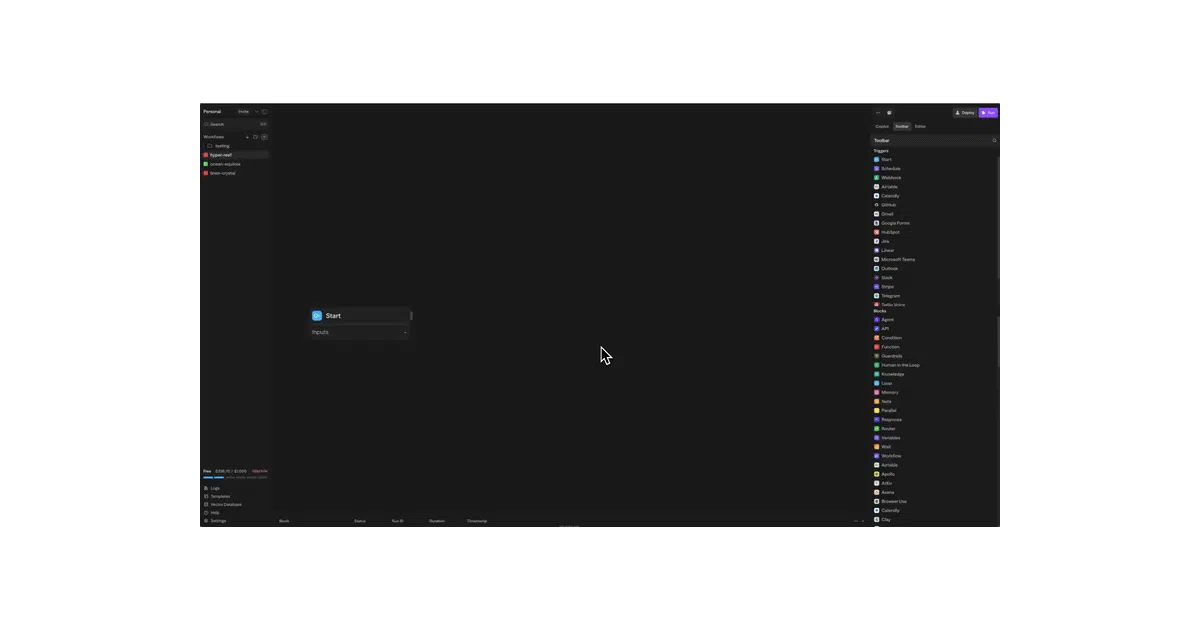
Sim is an open-source platform for building and running AI agent workflows through a visual node editor. You arrange agents, tools, and logic blocks on a canvas—built with ReactFlow—and execute them against various LLMs and vector databases. It packages the whole thing as a Next.js application that can be cloud-hosted or run on your own hardware, with support for local models via Ollama and vLLM.
The interesting bit
The project is refreshingly upfront about being a well-architected integration: ReactFlow, Drizzle ORM, Better Auth, and Trigger.dev stitched together inside a Turborepo monorepo. That makes it competent glue rather than reinvention. The standout detail is sandboxed execution—untrusted code runs inside isolated-vm and E2B—so the visual editor does not become a remote-code-execution footgun.
Key highlights
- Visual workflow builder using ReactFlow; demos show instant execution on the canvas.
- Claims to connect 1,000+ integrations and LLMs, though the README never names them.
- Built-in RAG support through PostgreSQL with pgvector for document grounding.
- Self-hostable via Docker or manual setup using Bun, Node 20+, and PostgreSQL.
- Sandboxed code execution using
isolated-vmand E2B.
Caveats
- The Copilot assistant is a Sim-managed service; self-hosted instances must still fetch an API key from the cloud-hosted
sim.aito use it. - The README advertises “1,000+ integrations” without listing providers or detailing how they are implemented.
Verdict
Worth a look if you want a self-hostable, visual node editor for agent workflows and do not mind a standard TypeScript stack. Give it a pass if you need a fully offline solution with no cloud dependencies, or if you prefer code-first orchestration over clicking nodes.
Frequently asked
- What is simstudioai/sim?
- Sim exists so you can orchestrate LLMs, tools, and vector stores on a visual canvas instead of writing another ad-hoc Python script.
- Is sim open source?
- Yes — simstudioai/sim is open source, released under the Apache-2.0 license.
- What language is sim written in?
- simstudioai/sim is primarily written in TypeScript.
- How popular is sim?
- simstudioai/sim has 29.9k stars on GitHub and is currently accelerating.
- Where can I find sim?
- simstudioai/sim is on GitHub at https://github.com/simstudioai/sim.