serengil/deepface
Python face recognition for developers who’d rather not touch Keras
DeepFace wraps a zoo of pre-trained face models into a single Python API so you can verify identities, search databases, and analyze attributes without hand-rolling a Keras pipeline.
Not currently ranked — collecting fresh signals.
star history
What it does
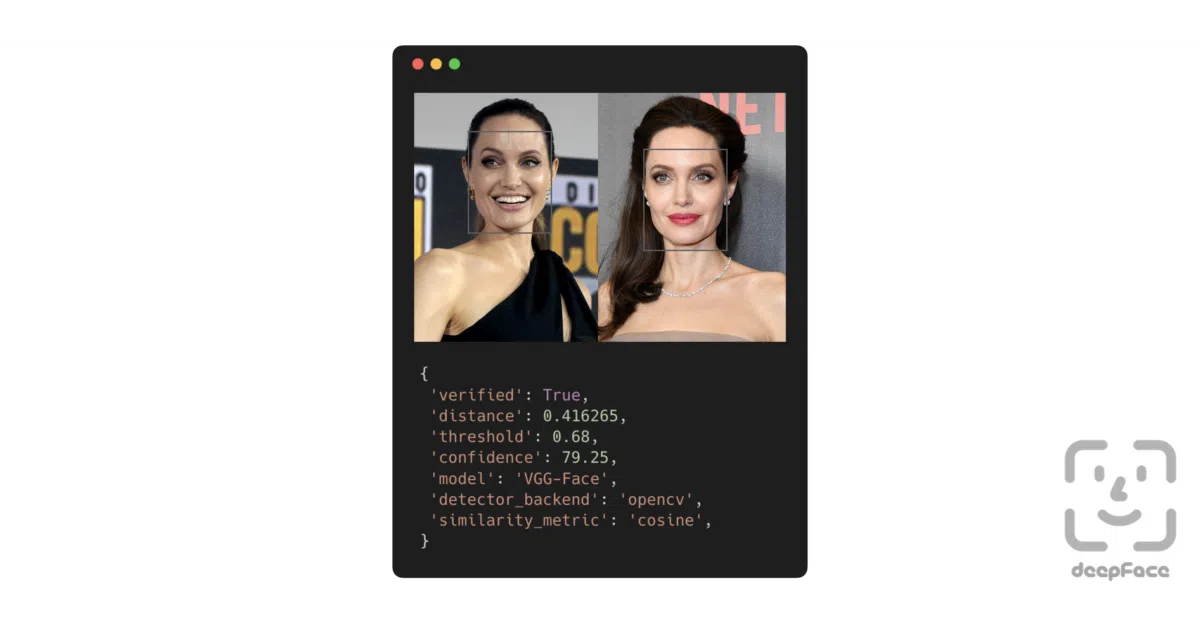
DeepFace bundles the entire face-recognition pipeline—detection, alignment, normalization, representation, and verification—into plain Python function calls. It wraps nine pre-trained backends, including VGG-Face, FaceNet, ArcFace, and Dlib, and exposes them through a single interface for one-to-one verification, one-to-many search, and real-time webcam analysis. The library also performs facial attribute analysis, predicting age, gender, emotion, and race from a single image.
The interesting bit
The value is less the model variety and more the plumbing: DeepFace handles tedious pre-processing in the background and recently added database-backed vector search with approximate-nearest-neighbor support for Postgres, Mongo, Neo4j, Pinecone, and Weaviate, letting a directory of JPEGs scale into a queryable index.
Key highlights
- Wraps nine recognition backends, from classic VGG-Face to newer GhostFaceNet and Buffalo_L.
- Claims to exceed human-level accuracy (97.53%) on standard facial recognition benchmarks.
- Attribute models report ±4.65 MAE for age and 97.44% accuracy for gender prediction.
- Supports both flat-directory and vector-database storage for face embeddings.
- Includes a real-time
streammode that locks onto a face for five consecutive frames before analyzing.
Verdict
Developers who need quick face verification or attribute extraction without maintaining TensorFlow/Keras boilerplate will find this a pragmatic shortcut. If you are training custom models or need fine-grained control over every pipeline stage, this is the wrong layer of abstraction.
Frequently asked
- What is serengil/deepface?
- DeepFace wraps a zoo of pre-trained face models into a single Python API so you can verify identities, search databases, and analyze attributes without hand-rolling a Keras pipeline.
- Is deepface open source?
- Yes — serengil/deepface is open source, released under the MIT license.
- What language is deepface written in?
- serengil/deepface is primarily written in Python.
- How popular is deepface?
- serengil/deepface has 23.6k stars on GitHub.
- Where can I find deepface?
- serengil/deepface is on GitHub at https://github.com/serengil/deepface.