ruvnet/metaharness
Your repo deserves its own agent. This mints one.
Every serious repo deserves its own agent, not another generic framework—this mints one on demand.
Not currently ranked — collecting fresh signals.
star history
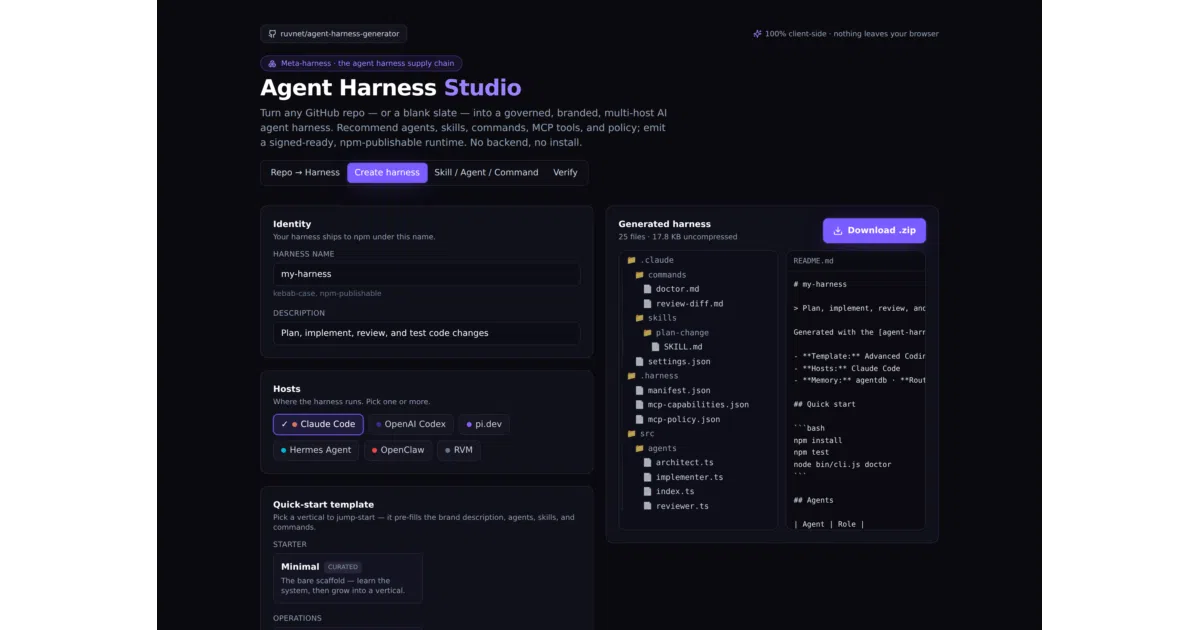
What it does MetaHarness ingests a GitHub repository—or starts from scratch—and generates a complete, npm-publishable agent harness branded to your name. The scaffold includes a repo-aware CLI, an MCP server with default-deny tooling, project-scoped memory, and governance policies, all tuned to the target codebase’s file layout. It targets nine hosts, from Claude Code and OpenAI Codex to a hardware-isolated RVM sandbox, emitting host-specific configuration without executing the repository’s code.
The interesting bit The project treats the harness itself as the product, not the underlying model, and aggressively optimizes for cost through an internal model router and two complementary evolution systems: Darwin Mode, which mutates and tests harness configs in a sandbox, and Weight-EFT, which distills cheap open-weight models to reduce expensive frontier-model escalations. It is a deeply meta take on the scaffolding layer—less “use my agent” and more “own your agent factory.”
Key highlights
- Ships a browser-based Studio and a CLI that both generate behaviorally identical output without network calls or installs.
- Scaffolds 19 vertical templates—coding, research, trading, legal, gaming—with domain-specific agents, skills, and slash commands.
- Publishes generated harnesses as first-class npm packages under your own scope, complete with witness-signed provenance and release gates.
- Includes a static
mcp-scanauditor that flags shell grants, wildcard permissions, and unguarded secrets in agent tools. - Claims a small, routed model can deliver frontier-quality research at roughly one-tenth the cost on its internal DRACO benchmark.
Caveats
- The project’s surface area is sprawling; navigating between ADRs, host-specific packages, and evolution modes demands patience.
- Weight-EFT fine-tuning is explicitly GPU-gated, so cost-saving model distillation may require hardware you don’t have.
- The documentation is rich but self-referential, burying practical boundaries under a thicket of internal codenames and architecture decision records.
Verdict Teams running multiple codebases or shipping agent tools to clients should look here; it is a toolkit for building productized agent distributions, not for developers who just want a single chat-with-my-repo script.
Frequently asked
- What is ruvnet/metaharness?
- Every serious repo deserves its own agent, not another generic framework—this mints one on demand.
- Is metaharness open source?
- Yes — ruvnet/metaharness is open source, released under the MIT license.
- What language is metaharness written in?
- ruvnet/metaharness is primarily written in TypeScript.
- How popular is metaharness?
- ruvnet/metaharness has 716 stars on GitHub.
- Where can I find metaharness?
- ruvnet/metaharness is on GitHub at https://github.com/ruvnet/metaharness.