ruvnet/RuView
Using your neighbor's WiFi to see through walls
Because commodity WiFi already bounces off your body, RuView uses cheap ESP32 nodes to detect presence, vital signs, and even body pose without cameras or wearables.
Feature · 13 Jul 2026
RuView Treats Your WiFi Router as a Through-Wall Motion Studio
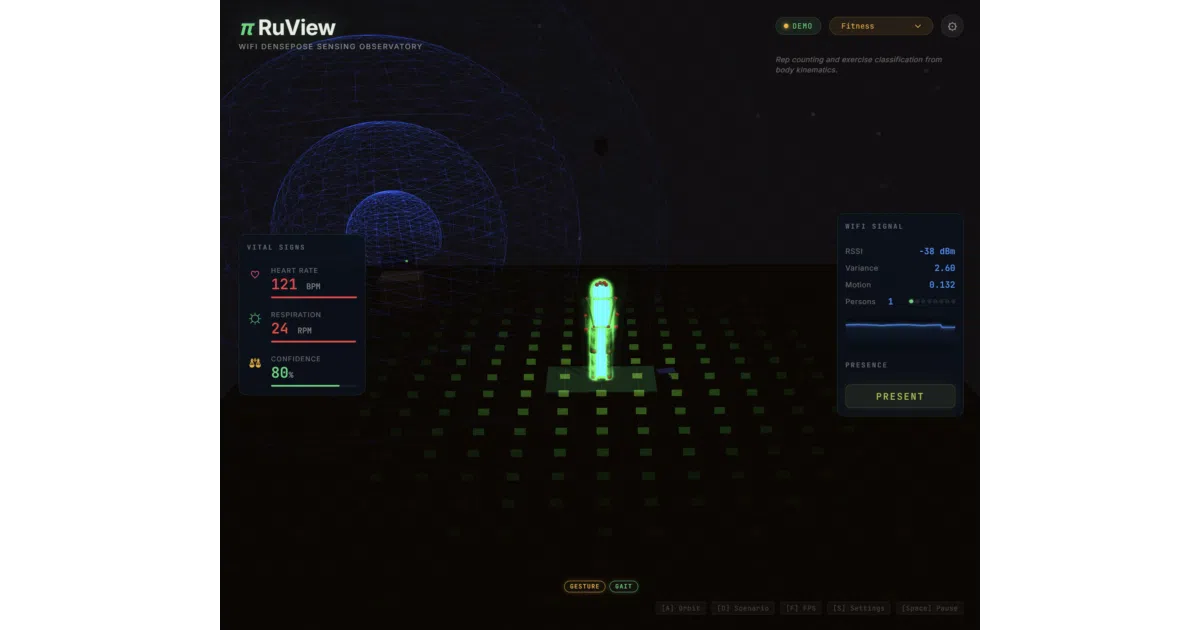
RuView extracts body pose, vital signs, and room occupancy from ordinary WiFi radio reflections, running entirely on edge hardware as an open-source alternative to cameras and wearables.
Read the in-depth article →
Velocity · 7d
+133
★ / day
Trend
↘cooling
star history
What it does
RuView is an edge-computing system that reads Channel State Information from ESP32 radios—priced at roughly $9 per node—to detect human presence through walls, estimate breathing and heart rate, recognize activities like falls, and infer 17 body keypoints. It exposes all of this as smart-home entities via Home Assistant, Apple HomeKit, Google Home, and Amazon Alexa without requiring cameras, wearables, or cloud connectivity. Each node ships 21 entities, including semantic states such as possible-distress, bed-exit, and elderly-inactivity-anomaly.
The interesting bit The mesh doesn’t rely solely on your own access point; it hops six WiFi channels and treats neighboring routers as free radar illuminators. A 4-bit quantized embedding model fits in 8 KB and runs on a Raspberry Pi, while spiking neural networks locally adapt to a new room in under 30 seconds. Every measurement is cryptographically attested via an Ed25519 witness chain—an unusual level of paranoia for a home sensor.
Key highlights
- Claims 82.3% held-out temporal-triplet accuracy on presence detection using a self-supervised contrastive encoder; the authors explicitly retracted an earlier “100%” single-class figure.
- Achieves 82.69% torso-PCK@20 on the MM-Fi pose-estimation benchmark, beating MultiFormer and CSI2Pose, with an 8.4 ms cold-start on a Pi 5.
- 105 edge-module “Cogs” run directly on ESP32 hardware; the full stack with an optional Cognitum Seed is listed at a $140 total bill of materials.
- Through-wall sensing works up to roughly 5 meters, though the README notes this is signal-dependent.
- Smart-home integrations include a Matter bridge, HA-DISCO MQTT publisher, and native HAP-1.1 support for Siri voice queries.
Caveats
- The README bundles an enormous scope—pose estimation, vital signs, world-model prediction, 3D point-cloud fusion, and 105 edge modules—making it hard to tell which features are fully integrated versus experimental.
- The project publicly retracted an earlier “100% presence” accuracy claim, replacing it with the 82.3% figure; the sheer volume of benchmarks and architecture-decision records suggests a fast-moving, possibly unstable surface.
- Some headline features, like the OccWorld future-occupancy predictor, require an RTX 5080 and 3.4 GB VRAM, so “edge-only” depends heavily on which module you actually run.
Verdict Privacy-obsessed smart-home builders and RF tinkerers should look here—it’s a rare fully offline, camera-free presence system with honest benchmarking. If you just want a simple motion sensor, this is massive overkill, and the ESP32 mesh plus optional Seed node is not plug-and-play.
Frequently asked
- What is ruvnet/RuView?
- Because commodity WiFi already bounces off your body, RuView uses cheap ESP32 nodes to detect presence, vital signs, and even body pose without cameras or wearables.
- Is RuView open source?
- Yes — ruvnet/RuView is open source, released under the MIT license.
- What language is RuView written in?
- ruvnet/RuView is primarily written in Rust.
- How popular is RuView?
- ruvnet/RuView has 99.6k stars on GitHub and is currently cooling off.
- Where can I find RuView?
- ruvnet/RuView is on GitHub at https://github.com/ruvnet/RuView.