ruvnet/RuView · 13 Jul 2026 · Feature
RuView Treats Your WiFi Router as a Through-Wall Motion Studio

Minh Tran
Contributing Editor
RuView extracts body pose, vital signs, and room occupancy from ordinary WiFi radio reflections, running entirely on edge hardware as an open-source alternative to cameras and wearables.
ruvnet/RuView
★97.2k stars Velocity · 7d +151 ★/day ↗accelerating
star history
The Radio Mirror
Every WiFi router floods its environment with radio waves that reflect off walls, furniture, and human bodies. Most networks treat these reflections as noise to be filtered out. RuView treats them as data.
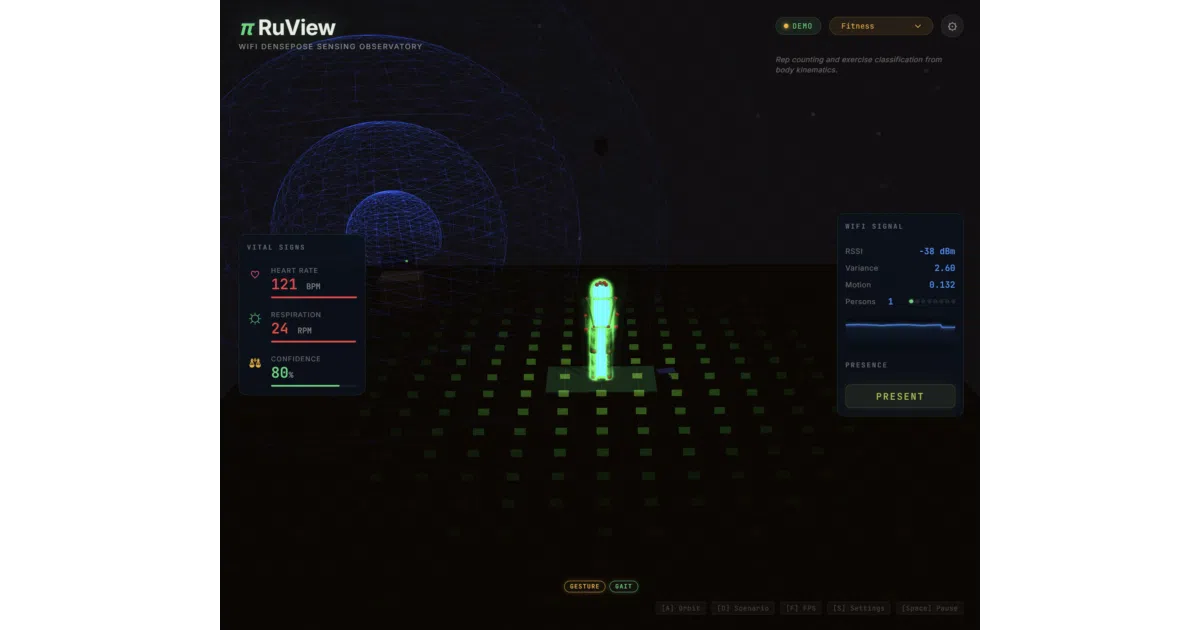
The project rests on Channel State Information (CSI), a measurement exposed by modern WiFi chipsets that captures how a signal propagates from transmitter to receiver. In indoor environments, a signal arrives at an antenna via a direct path and multiple reflected paths, each with distinct attenuation and phase shift—a phenomenon known as the multipath effect [1]. While RSSI (received signal strength) collapses these paths into a single, volatile number that fluctuates wildly even when a static link is disturbed, CSI preserves subcarrier-level granularity [7]. In OFDM-based standards, each subcarrier reports its own amplitude and phase response, yielding a sampled version of the Channel Frequency Response. A slight change in one multipath component can cause constructive or destructive interference that RSSI misreads as noise, whereas CSI sees the structural change [7]. RuView’s insight is that a person breathing or shifting weight perturbs these reflected paths in measurable ways, turning the room itself into a sensor. The approach is not theoretical; silicon vendors already ship WiFi chips that expose CSI through targeted APIs for automotive child-presence detection and healthcare monitoring [10].
Eight Kilobytes of Spatial Intelligence
What distinguishes RuView from academic proofs-of-concept is its relentless focus on edge deployment. The project ships a pretrained contrastive encoder that produces 128-dimensional embeddings from CSI streams. A 4-bit quantized variant occupies roughly eight kilobytes and runs inference in microseconds on a Raspberry Pi [9][12]. The presence-detection head reports an 82.3% held-out temporal-triplet accuracy, a figure the authors arrived at after retracting an earlier, overly optimistic “100% presence” claim measured on a single-class recording [9]. That retraction, noted plainly in the documentation, lends the project an unusual credibility.
For pose estimation, RuView publishes a separate model that achieves 82.69% torso-PCK@20 on the MM-Fi benchmark’s random_split protocol, exceeding prior published results from MultiFormer (72.25%) and CSI2Pose (68.41%) [9]. The Cognitum project page notes that camera-supervised training can push this to 92.9% PCK@20, though the open-source repository cautions that camera-free proxy-label accuracy remains limited to approximately 2.5% PCK@20, with a target of 35% still pending data collection [9][12].
The hardware proposition is equally aggressive: a mesh of ESP32-S3 nodes—costing roughly $9 each—captures CSI across multiple WiFi channels, using neighboring access points as passive radar illuminators [9][12]. A full system with a Cognitum Seed appliance for persistent vector storage and cryptographic attestation carries a bill of materials around $140 [12]. No cloud subscription, no GPU farm, no camera array.
Privacy by Physics
RuView’s most disruptive characteristic is not a software abstraction but a physical one. Because it interprets radio reflections rather than photons, it senses through drywall, concrete, and darkness without capturing images, audio, or biometric identifiers that trigger GDPR or HIPAA imaging regulations [9][12]. A camera in a bathroom or patient room is a legal liability; a WiFi mesh node is merely a network appliance.
This positions the project against two incumbents. On one side are wearable vital-sign monitors like VitalConnect’s VitalPatch, which require patient compliance, adhesive patches, and charging cycles to deliver continuous ECG and respiration data [11]. On the other are camera-based pose-estimation pipelines, which demand line-of-sight, visible light or infrared illumination, and rigorous data-retention policies. RuView offers contactless monitoring—breathing rate, heart rate, fall detection, occupancy counting—without requiring a subject to wear anything or consent to being filmed [8][12]. Sotera Wireless has pursued similar clinical goals for over a decade, but its ViSI Mobile system remains a wearable pack that relies on WiFi to transmit data rather than using the WiFi signal itself as the sensor [8].
The integration strategy reinforces this frictionless deployment. RuView exposes itself as a Matter bridge and MQTT publisher, shipping entities per node to Home Assistant, Apple Home, Google Home, and Amazon Alexa without custom skills [12]. It is the rare open-source sensing stack that treats consumer smart-home ecosystems as first-class citizens rather than afterthoughts.
The Module Bazaar
Beneath the pose and vital-signs demos lies a catalog of over one hundred signed edge modules—called Cogs—that run on the ESP32 mesh or a Cognitum Seed. These range from utilitarian occupancy counters and HVAC triggers to acoustic glass-break detectors and speculative research tools, with health and security categories dominating the list. Each module is a small signed binary attested via an Ed25519 chain. The architecture suggests an ambition to become not merely a model zoo but an operating system for ambient radio intelligence, where third-party developers ship sandboxed sensing applications to low-power nodes that continue working when the internet drops.
This ecosystem play is where RuView most directly challenges commercial IoT platforms. It is framed as an experimental counterpoint to AWS IoT Greengrass and Amazon Bedrock Agents: where Greengrass manages fleet deployment and Bedrock orchestrates hosted foundation models, RuView offers inspectable signal-processing pipelines that run locally on hardware cheaper than a monthly cloud bill [12]. Synaptics and other silicon vendors have long touted WiFi CSI for automotive child-presence detection and healthcare monitoring [10]; RuView open-sources the entire stack, from firmware to fusion runtime, letting researchers modify Fresnel-zone geometry and multipath models directly.
The Honest Gaps
The repository’s beta disclaimer is refreshingly specific. ESP32-C3 and original ESP32 chips are excluded due to insufficient DSP capacity. Single-node deployments suffer limited spatial resolution, and the project recommends two or more nodes for reliable person counting [12]. These are not marketing footnotes but visible rough edges in a project that is clearly still being forged.
Perhaps the deepest tension is in pose accuracy. The MM-Fi state-of-the-art result relies on camera-supervised training; the fully contactless, camera-free pipeline that RuView idealistically promises remains at roughly 2.5% PCK@20, far below the 35% threshold needed for practical gesture recognition [12]. The project has built the training infrastructure—MediaPipe paired with ESP32 CSI, end-to-end Candle pipelines—but the data-collection and evaluation phases are pending. It is a reminder that in WiFi sensing, the signal-processing frontend is often solved before the machine-learning backend catches up.
Outlook
RuView arrives at a moment when the industry is reconceptualizing WiFi not as mere connectivity but as an ambient sensing fabric [10]. The project’s through-wall capabilities—up to roughly five meters, signal-dependent—and its disaster-rescue module for rubble-penetrating survivor detection point toward applications where cameras and lidar simply cannot operate [9]. If the camera-free pose pipeline closes its accuracy gap, and if the Cog marketplace matures beyond its catalog phase, RuView could become the reference implementation for privacy-preserving spatial AI.
For now, it is a technically literate provocation: a demonstration that the radio waves already saturating every room are sufficient to track your breathing, count your meeting attendees, and alert your smart home when you fall—all from a $9 board that reports to no cloud.
Sources
- What Is CSI Sensing?
- A survey on vital signs monitoring based on Wi-Fi CSI data
- Has anyone tried RuView (WiFi sensing / presence detection) with ...
- Wireless sensing applications with Wi-Fi Channel State ...
- Contactless vital sign monitoring systems: a comprehensive survey ...
- RuView download | SourceForge.net
- Understanding CSI | Hands-on Wireless Sensing with Wi-Fi
- Wireless Vital Sign Monitoring System | Keep Your Patient Safe And ...
- Cognitum RuView | Privacy-First WiFi Sensing
- Wi-Fi Sensing
- Remote Patient Monitoring - VitalConnect
- RuView: Open Source Alternative to AWS IoT