raymin0223/mixture_of_recursions
Early-exiting LLMs that don't break the batch or the KV cache
An end-to-end learned router assigns each token its own recursion depth, unifying early-exiting with intact batching and KV caches.
Collecting fresh signals — velocity needs a few days of history.
collecting data…
star history
What it does
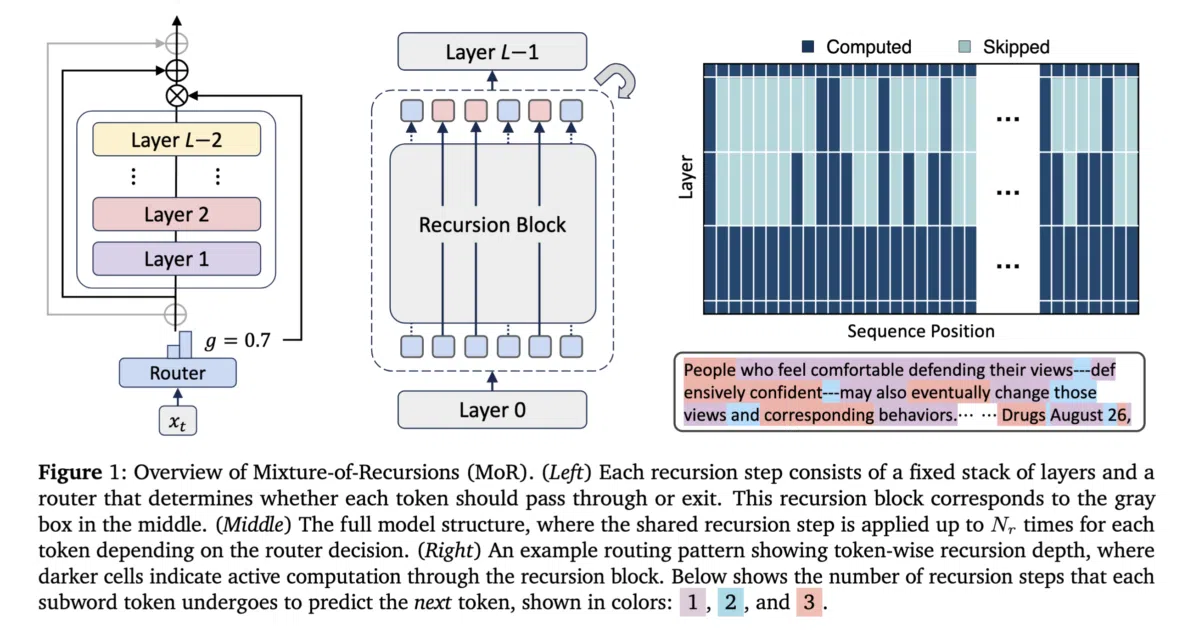
Mixture-of-Recursions (MoR) is a Llama-based transformer that lets individual tokens bail out of layers early instead of marching through the full stack. A trained router assigns each token a dynamic recursion depth on the fly, while shared parameters let tokens at different depths stay in the same batch. The authors claim up to 2× inference throughput at similar accuracy to standard transformers, plus lower training FLOPs and memory.
The interesting bit
The clever part is treating early-exiting and batched inference as one problem rather than two. MoR uses a recursion-wise KV caching strategy that selectively stores pairs to avoid the “missing KV cache” trap, and its expert-choice or token-choice routers scatter and gather tokens through shared recursive blocks so nothing idles waiting for slower neighbors.
Key highlights
- Built by modifying
LlamaForCausalLM, with two routing flavors: expert-choice and token-choice. - Trains end-to-end on FineWeb-Edu (SmolLM-Corpus) using 4× H100 or A100 GPUs via DeepSpeed or Accelerate.
- Evaluates with
lm-evaluation-harnessfor few-shot tasks and tracks validation loss for scaling-law analysis. - The codebase includes an automated YAML config generator for pretraining and evaluation scripts.
- Recursion-wise KV caching is designed to resolve the missing-cache problem while optimizing memory usage.
Caveats
- The current KV-sharing implementation computes all sequences against a shared cache and extracts outputs by masking, which the authors note is a simplification that leaves “further optimizations” on the table.
- Input packing currently allows attention across unrelated documents, and the authors flag FlexAttention and
grouped_mmas future optimizations rather than implemented features. - FSDP, Tensor Parallelism, and Pipeline Parallelism are explicitly left for future work, so scaling beyond the current 4-GPU setup is untested.
Verdict
Worth a look if you’re researching adaptive computation, early-exiting, or efficient LLM inference architectures. Production engineers seeking drop-in speedups should probably wait for the promised optimizations to land.
Frequently asked
- What is raymin0223/mixture_of_recursions?
- An end-to-end learned router assigns each token its own recursion depth, unifying early-exiting with intact batching and KV caches.
- Is mixture_of_recursions open source?
- Yes — raymin0223/mixture_of_recursions is open source, released under the Apache-2.0 license.
- What language is mixture_of_recursions written in?
- raymin0223/mixture_of_recursions is primarily written in Python.
- How popular is mixture_of_recursions?
- raymin0223/mixture_of_recursions has 627 stars on GitHub.
- Where can I find mixture_of_recursions?
- raymin0223/mixture_of_recursions is on GitHub at https://github.com/raymin0223/mixture_of_recursions.