raroque/boop-agent
Turn Claude Code or Codex into an iMessage-native agent
An iMessage-native personal agent template that turns your existing Claude Code or Codex subscription into a textable assistant with memory, sub-agents, and automations.
Not currently ranked — collecting fresh signals.
star history
What it does
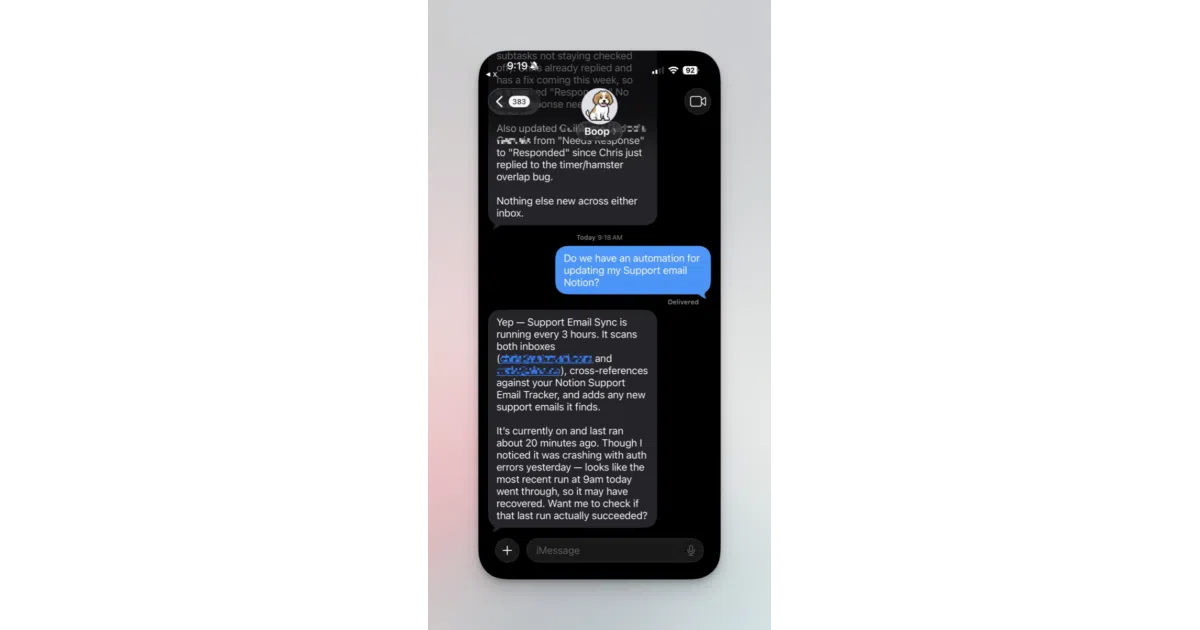
Boop is an iMessage-native personal agent architecture. You text a phone number, and an interaction agent dispatches the work to focused sub-agents that can search the web, query integrations, or browser-automate tasks. It runs on your existing Claude Code or Codex/ChatGPT subscription, so you do not need a separate Anthropic or OpenAI API key.
The interesting bit
The architecture treats the interaction agent as a deliberately under-powered dispatcher: it can only spawn sub-agents, manage memory, and draft messages, while being explicitly denied web access, files, or third-party integrations. That isolation, plus a draft-and-send gate where every external action waits for your confirmation before committing, keeps the agent from going rogue on your behalf. The memory system is equally paranoid: a daily adversarial pipeline proposes, challenges, and judges memory consolidations to merge duplicates and resolve contradictions.
Key highlights
- Runs on your existing Claude Code or Codex subscription; no separate provider API key required for the agent runtime
- Tiered memory (short, long, permanent) with vector search and a daily 3-phase adversarial consolidation process
- Dispatcher/worker split: the interaction agent cannot touch the web or integrations directly; only spawned sub-agents get those tools
- Draft-and-send safety: external actions stage a draft first and only commit after user confirmation via iMessage
- Composio integration layer provides hosted OAuth for Gmail, Slack, GitHub, Linear, Notion, and roughly 1,000 other toolkits
Caveats
- The author explicitly warns this was built for personal use, was never meant to be open-sourced, and is not optimized for cost or security
- Requires several third-party services (Sendblue, Convex, Composio, and a tunnel like ngrok) to function; not a self-contained single-tenant deployment
- Optional local browser use and Apple data connectors are off by default and must be explicitly enabled
Verdict
Good for developers who want a hackable template for a memory-backed iMessage agent and already pay for Claude Code or Codex. Skip it if you need a polished product, strict security guarantees, or a cheap single-tenant deployment.
Frequently asked
- What is raroque/boop-agent?
- An iMessage-native personal agent template that turns your existing Claude Code or Codex subscription into a textable assistant with memory, sub-agents, and automations.
- Is boop-agent open source?
- Yes — raroque/boop-agent is open source, released under the MIT license.
- What language is boop-agent written in?
- raroque/boop-agent is primarily written in TypeScript.
- How popular is boop-agent?
- raroque/boop-agent has 1.3k stars on GitHub.
- Where can I find boop-agent?
- raroque/boop-agent is on GitHub at https://github.com/raroque/boop-agent.