pytorch/glow
Taking neural networks down a three-level elevator to silicon
It lowers neural network graphs through multiple compiler stages to generate bare-metal code for a wide range of hardware accelerators.
Not currently ranked — collecting fresh signals.
star history
What it does
Glow is a machine learning compiler and execution engine built to serve as a backend for high-level frameworks. It ingests a traditional neural network dataflow graph and compiles it into native code for hardware accelerators. The project is backed by a consortium of silicon vendors and is actively developed under the PyTorch umbrella.
The interesting bit
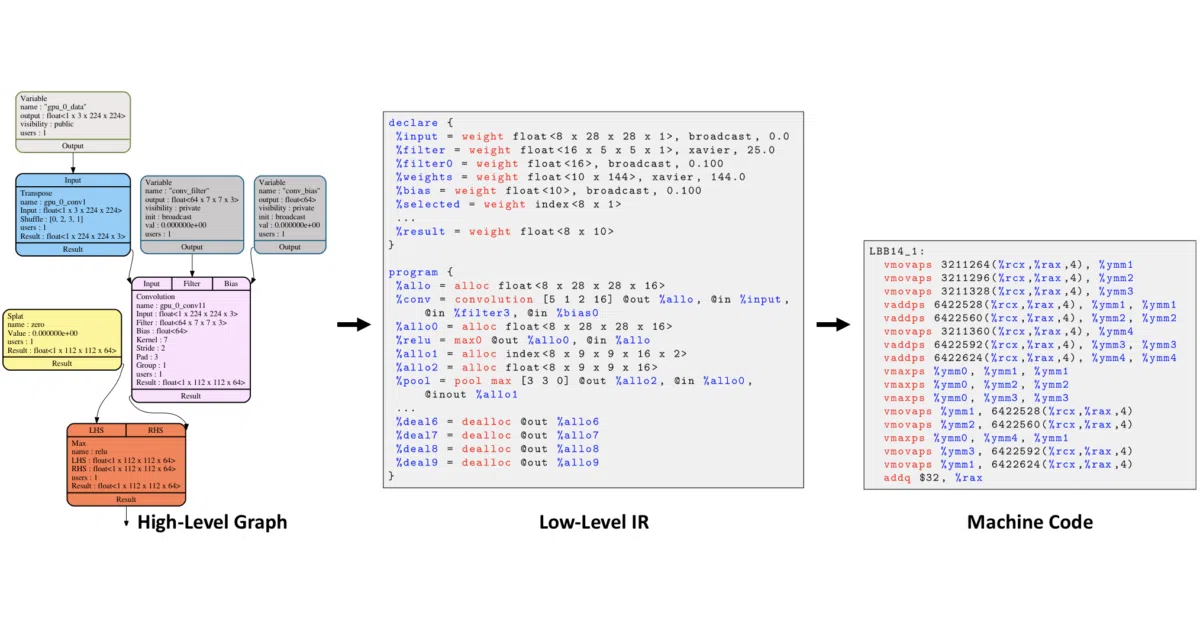
Instead of asking every hardware backend to support hundreds of high-level operators, Glow uses a lowering phase that collapses the operator space into a small set of linear algebra primitives. The compiler then optimizes across two distinct intermediate representations—one for domain-specific tweaks and another for memory layout and instruction scheduling—before emitting machine-specific code. This structure keeps frontend and backend concerns from exploding into an N×M matrix.
Key highlights
- Two-phase strongly-typed IR separates domain-specific optimizations from memory-related work like instruction scheduling and static allocation.
- A lowering phase shrinks the operator space so hardware backends only need to implement a small set of linear algebra primitives.
- Can compile networks ahead-of-time into standalone object files, with bundled ResNet50 examples in both quantized and non-quantized forms.
- Backed by a broad silicon partner list including Intel, Habana, Cadence, and Synopsys.
- Ships with C++ API examples for MNIST, CIFAR-10, and language modeling benchmarks.
Caveats
- The README explicitly labels the library as being in active development, with major plans tracked in GitHub issues and a roadmap wiki.
- Debug builds are noted to run “hundreds of times slower” than Release builds, which is a trap for anyone trying to benchmark the compiler.
- Build dependencies are extensive—LLVM 7 or later, protobuf, and platform-specific toolchain tweaks are required.
Verdict
This is for hardware vendors and framework maintainers who need a compiler backend with a rigorous multi-stage IR; if you are simply looking to run standard PyTorch models on commodity GPUs, this is not your tool.
Frequently asked
- What is pytorch/glow?
- It lowers neural network graphs through multiple compiler stages to generate bare-metal code for a wide range of hardware accelerators.
- Is glow open source?
- Yes — pytorch/glow is open source, released under the Apache-2.0 license.
- What language is glow written in?
- pytorch/glow is primarily written in C++.
- How popular is glow?
- pytorch/glow has 3.3k stars on GitHub.
- Where can I find glow?
- pytorch/glow is on GitHub at https://github.com/pytorch/glow.