python-adaptive/adaptive
Stop brute-forcing your parameter sweeps
A Python library that learns where to sample next instead of grinding through dense grids.
Not currently ranked — collecting fresh signals.
star history
What it does
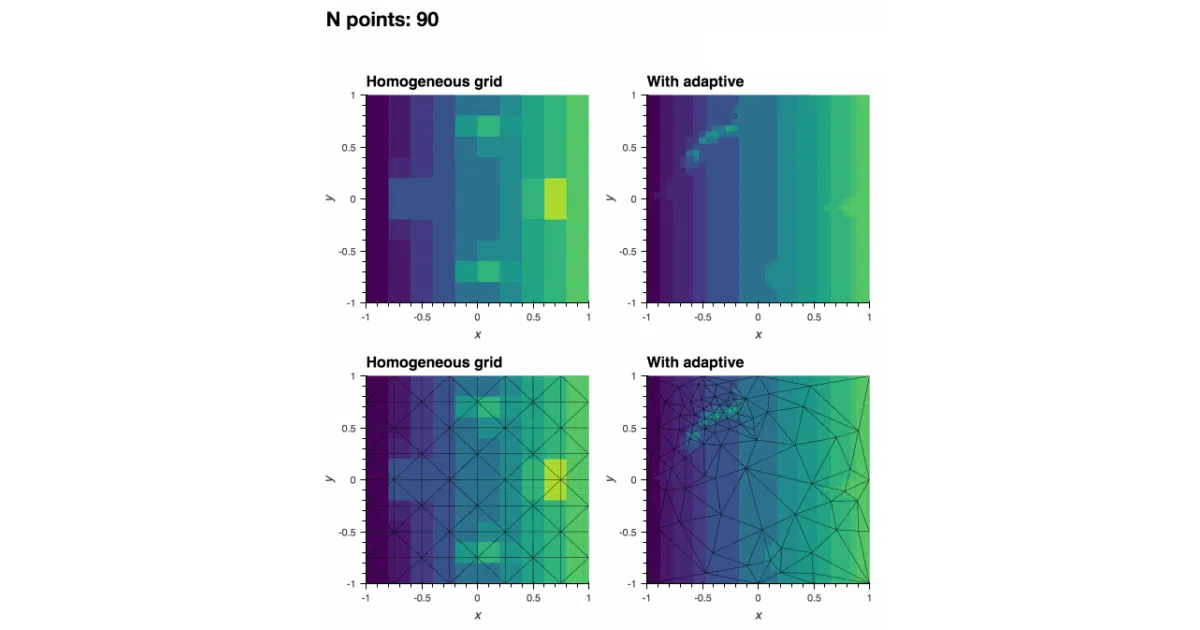
Adaptive runs expensive mathematical functions in parallel, but skips the wasteful part: it picks each new evaluation point based on what the function has already revealed. You define the function and bounds; the library decides where to look next, balancing exploration against whatever “interesting” means for your problem. It wraps the whole loop—sampling, learning, parallel dispatch, and live visualization—into a few lines of Python.
The interesting bit
The library treats sampling as an active-learning problem, not a scheduling problem. Each “learner” maintains its own model of where uncertainty or complexity lives, and the runner farms out points to whatever parallel backend you have lying around (from concurrent.futures to mpi4py to Dask). The live Jupyter widgets are genuinely useful for watching a 2D landscape fill in from the edges first, then drilling into the weird bits.
Key highlights
- Learners for 1D, 2D, ND, stochastic averaging, and numerical integration (including a CQUAD-based integrator)
- Built-in parallel backends:
concurrent.futures,mpi4py,loky,ipyparallel,distributed - Live plotting and info widgets inside Jupyter notebooks
- Custom loss functions to define “interesting” per domain
- Exports to NumPy arrays or Pandas DataFrames
- Requires Python 3.7+; conda-forge and PyPI packages available
Caveats
- Overhead makes it inefficient for functions faster than ~50 ms per evaluation
- JupyterLab needs manual labextension installs for the live widgets
- A draft paper exists but is, per the README, still being written
Verdict
Worth a look if you are burning CPU hours on parameter sweeps or expensive simulations with uneven complexity. Skip it if your functions are already fast or your grids are trivially small.
Frequently asked
- What is python-adaptive/adaptive?
- A Python library that learns where to sample next instead of grinding through dense grids.
- Is adaptive open source?
- Yes — python-adaptive/adaptive is open source, released under the BSD-3-Clause license.
- What language is adaptive written in?
- python-adaptive/adaptive is primarily written in Python.
- How popular is adaptive?
- python-adaptive/adaptive has 1.2k stars on GitHub.
- Where can I find adaptive?
- python-adaptive/adaptive is on GitHub at https://github.com/python-adaptive/adaptive.