puppyone-ai/puppyone
A shared drive for AI agents that censors itself per visitor
Puppyone builds a Git-versioned context host that feeds AI agents only the files they are cleared to see, via CLI, MCP, or sandbox.
Velocity · 7d
+0.3
★ / day
Trend
↗accelerating
star history
What it does
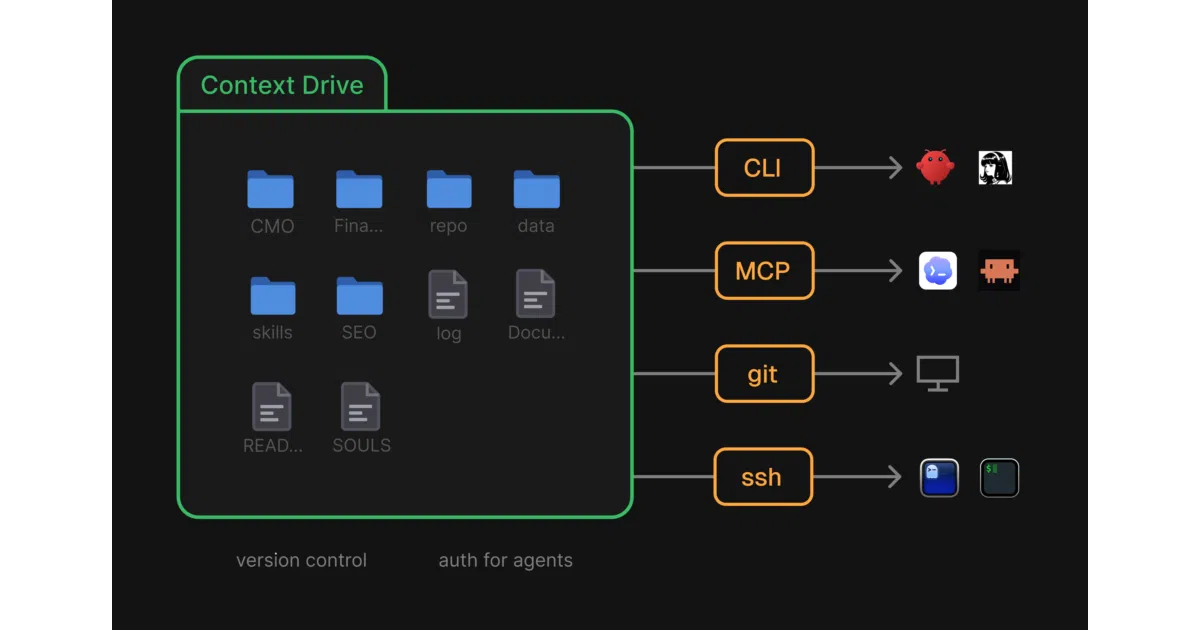
Puppyone is a centralized file system—branded a Context Drive—that ingests data from sources like GitHub, Gmail, Google Drive, and web pages, converts it into agent-friendly formats such as Markdown and JSON, and serves it to AI agents through scoped access points. It versions everything with Git-like semantics, tracks audit logs, and handles concurrent edits with checkout and commit workflows. Agents interact with it through a CLI, MCP endpoints, a REST API, sandboxed containers, or a web app, depending on what the tool supports.
The interesting bit
The standout idea is File Level Security (FLS): permissions are enforced at the filesystem layer, meaning an agent’s sandbox or MCP view is physically missing files it lacks access to—row-level security applied to directories rather than database tables. This turns a single shared drive into many filtered realities, which is a more paranoid and arguably more robust approach than simple access-control lists. The README also notes the self-hosted stack mounts the host Docker socket to run sandboxes locally, a convenience the authors explicitly caution against for remote or multi-tenant deployments.
Key highlights
- Connectors for GitHub, Gmail, Google Workspace, web pages, Supabase, and local filesystems normalize data into Markdown/JSON.
- Per-agent file permissions (FLS) enforced at the filesystem layer; unauthorized files simply do not appear in the agent’s environment.
- Git-style versioning with diffs, folder snapshots, rollback, and checkout/commit workflows for concurrent agent editing.
- Multiple access methods: auto-generated MCP endpoints, REST API, CLI, sandboxed Docker/E2B containers, and local folder sync.
- Available as a managed cloud service or a self-hosted Docker stack (Apache 2.0, though trademarks are reserved).
Caveats
- The self-hosted Docker setup shares the host Docker socket with the backend container to enable local sandboxes, which the README itself flags as a security concern for remote or multi-tenant deployments.
- Several features—agent chat and OAuth connectors like GitHub or Gmail—require manual API key configuration in self-hosted mode and do not work out of the box.
Verdict
Teams running multiple AI agents that need shared, auditable context with strict data segregation should look here; if you just need a single chatbot to read a few PDFs, this is over-engineered infrastructure.
Frequently asked
- What is puppyone-ai/puppyone?
- Puppyone builds a Git-versioned context host that feeds AI agents only the files they are cleared to see, via CLI, MCP, or sandbox.
- Is puppyone open source?
- Yes — puppyone-ai/puppyone is open source, released under the Apache-2.0 license.
- What language is puppyone written in?
- puppyone-ai/puppyone is primarily written in TypeScript.
- How popular is puppyone?
- puppyone-ai/puppyone has 1.3k stars on GitHub and is currently accelerating.
- Where can I find puppyone?
- puppyone-ai/puppyone is on GitHub at https://github.com/puppyone-ai/puppyone.