pollockjj/ComfyUI-MultiGPU
DisTorch shards diffusion models across devices to free your main GPU
It turns idle system RAM and secondary GPUs into 'Virtual VRAM' for ComfyUI model layers, freeing your main card for actual compute.
Not currently ranked — collecting fresh signals.
star history
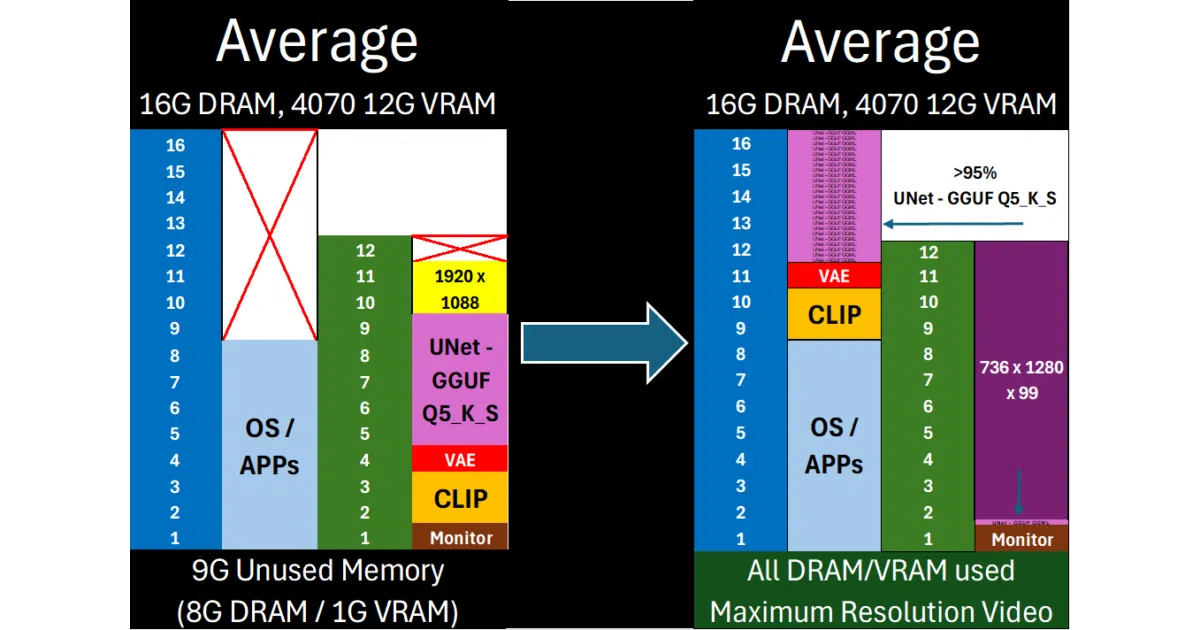
What it does ComfyUI-MultiGPU is a node pack that redistributes the static bulk of diffusion models—primarily the UNet, CLIP, and VAE—off your primary compute GPU and onto whatever else is available: system DRAM, a secondary CUDA card, or even an XPS device. The goal is to claw back VRAM on your main card so you can run larger batches, longer videos, or bigger latent spaces without constant model loading and unloading. It does this by wrapping ComfyUI’s native loaders with MultiGPU variants and injecting a custom distribution engine called DisTorch.
The interesting bit
DisTorch offers a virtual_vram_gb slider for simple offloading, but the real flavor is in Expert Mode, where you carve up a model with a text string—specifying exact gigabytes, ratios, or fractions of total device memory per component. It is essentially a manual, per-layer sharding tool that treats your entire machine as one uneven memory pool. The README is admirably clear that this is not parallel processing; workflows still run sequentially, and the win is simply keeping the heavy model weights out of the way.
Key highlights
- DisTorch2 adds universal
.safetensorssupport and claims potential speedups of up to 10% for GGUF inference over the previous version. - Includes bespoke nodes for WanVideoWrapper, allowing block-swap and multi-device placement inside video workflows.
- Supports GGUF-quantized models via ComfyUI-GGUF integration, with dedicated loaders for UNet and CLIP families.
- Coexists with ComfyUI’s own DynamicVRAM: it keeps DynamicVRAM active on initialized CUDA devices while falling back to legacy patching for off-grid secondary GPUs.
- Normal mode uses a single
virtual_vram_gbslider; Expert modes usebyte,ratio, orfractionstrings to target specific devices.
Caveats
- The README explicitly notes this improves memory management, not parallel processing—do not expect multi-GPU speedup, just more breathing room.
- “Up to 10% faster GGUF inference” is described as a potential speedup, not a guaranteed benchmark.
- The node list is extensive but largely consists of thin wrappers around existing ComfyUI and third-party loaders; the heavy lifting is the DisTorch distribution logic.
Verdict Worth a look if you are bumping against VRAM limits in ComfyUI and have unused system RAM or a second GPU collecting dust. If you are already swimming in VRAM on a single top-tier card, it adds complexity you do not need.
Frequently asked
- What is pollockjj/ComfyUI-MultiGPU?
- It turns idle system RAM and secondary GPUs into 'Virtual VRAM' for ComfyUI model layers, freeing your main card for actual compute.
- Is ComfyUI-MultiGPU open source?
- Yes — pollockjj/ComfyUI-MultiGPU is open source, released under the GPL-3.0 license.
- What language is ComfyUI-MultiGPU written in?
- pollockjj/ComfyUI-MultiGPU is primarily written in Python.
- How popular is ComfyUI-MultiGPU?
- pollockjj/ComfyUI-MultiGPU has 992 stars on GitHub.
- Where can I find ComfyUI-MultiGPU?
- pollockjj/ComfyUI-MultiGPU is on GitHub at https://github.com/pollockjj/ComfyUI-MultiGPU.