patoles/agent-flow
X-ray vision for Claude Code and Codex agents
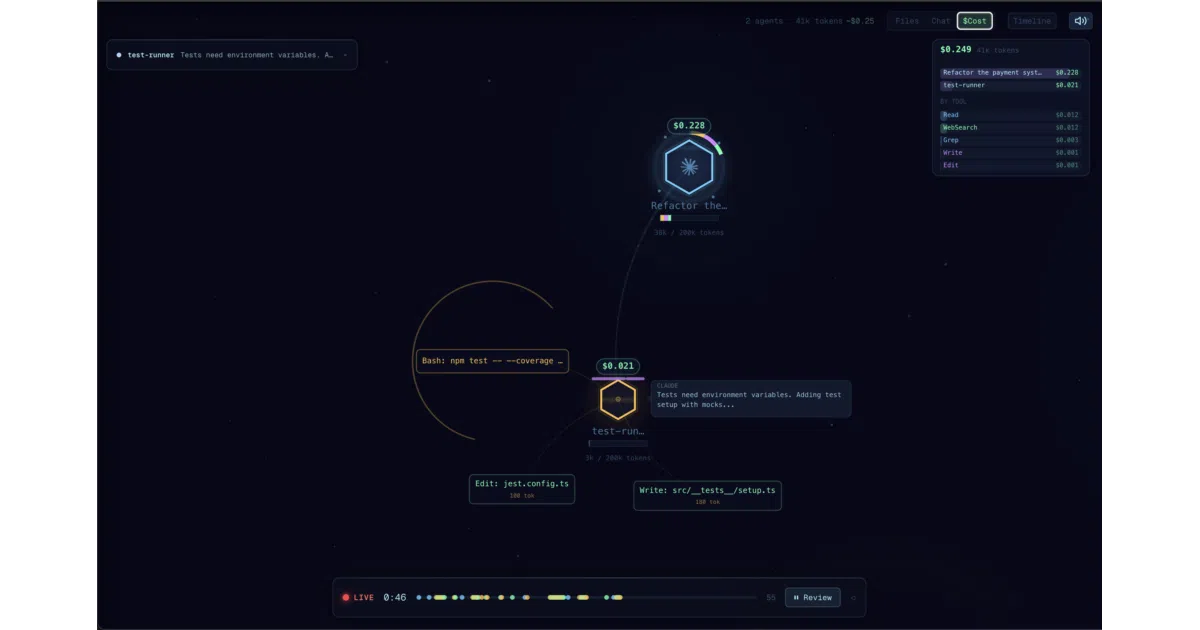
Agent Flow visualizes the branching tool calls and hidden coordination inside Claude Code and Codex sessions in real time.
Not currently ranked — collecting fresh signals.
star history
What it does
Agent Flow turns opaque agent execution into an interactive node graph. It streams events from Claude Code via lightweight HTTP hooks and tails Codex rollout logs, rendering tool calls, branching decisions, and subagent coordination as they happen. You get a live canvas, timeline, transcript, and file attention heatmap to trace exactly where an agent spent its time or went wrong.
The interesting bit
Instead of scraping terminal output, it hooks directly into Claude Code’s event stream for zero-latency updates, while simultaneously reading Codex’s own authoritative JSONL rollouts—including token counts the runtime emits itself. It tracks both runtimes side-by-side in the same view, which is rarer than you’d expect in current agent tooling.
Key highlights
- Live interactive node graph with pan, zoom, and click-to-inspect detail panels
- Concurrent dual-runtime support: auto-detects Claude Code and Codex sessions in parallel
- Ships as both a VS Code extension and a standalone web app that runs in the browser
- JSONL replay mode: point it at any event log file to re-watch or analyze past runs
- Multi-session tabs for tracking several agent jobs at once
Caveats
- Telemetry is enabled by default in the published standalone binary, though it is strictly aggregate and opt-out; the VS Code extension and dev builds emit nothing
- Auto-detection is limited to Claude Code and Codex; the tool also accepts generic JSONL logs, but on a manual basis
Verdict
Useful if you’re heavy into Claude Code or Codex and tired of guessing why an agent loop spiraled. If your workflow relies on other agent frameworks without JSONL exports, the auto-detection won’t help.
Frequently asked
- What is patoles/agent-flow?
- Agent Flow visualizes the branching tool calls and hidden coordination inside Claude Code and Codex sessions in real time.
- Is agent-flow open source?
- Yes — patoles/agent-flow is open source, released under the Apache-2.0 license.
- What language is agent-flow written in?
- patoles/agent-flow is primarily written in TypeScript.
- How popular is agent-flow?
- patoles/agent-flow has 1.7k stars on GitHub.
- Where can I find agent-flow?
- patoles/agent-flow is on GitHub at https://github.com/patoles/agent-flow.