p-christ/Deep-Reinforcement-Learning-Algorithms-with-PyTorch
PyTorch translations of deep RL's greatest hits
It collects working PyTorch implementations of eighteen foundational deep RL algorithms so you can compare DQN, PPO, SAC, and friends without switching frameworks.
Not currently ranked — collecting fresh signals.
star history
What it does
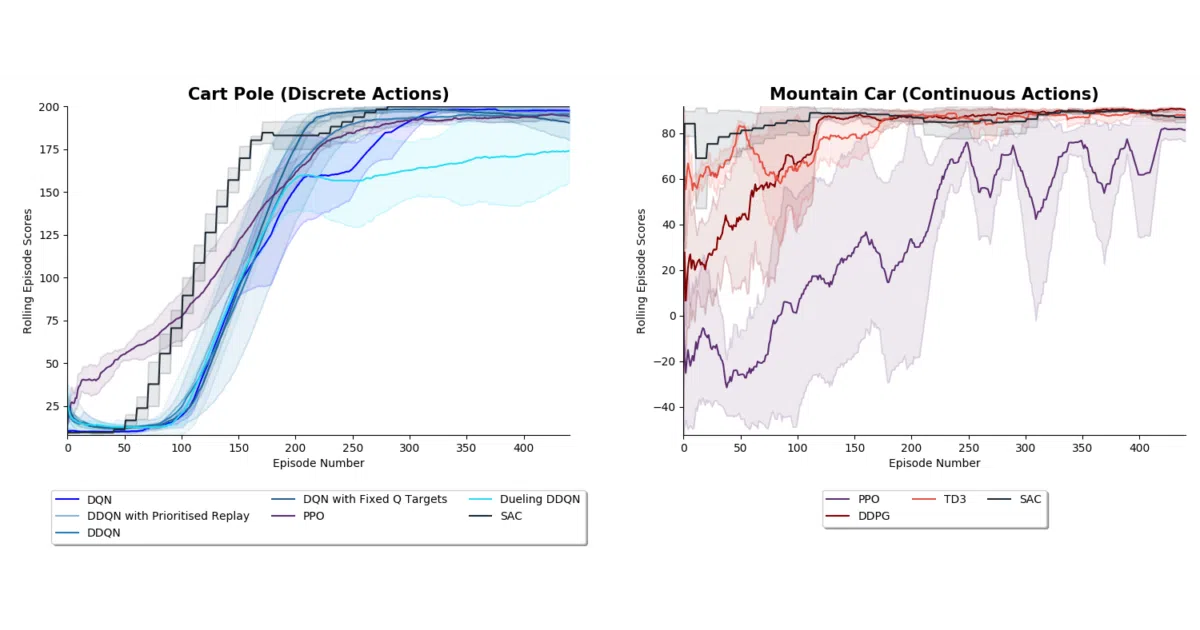
This repo is a curated shelf of PyTorch implementations spanning the modern deep reinforcement learning canon. It covers value-based methods like DQN and DDQN, policy-gradient workhorses like PPO and REINFORCE, actor-critic variants such as TD3 and SAC, and even hierarchical oddities like h-DQN and DIAYN, all wired to solve benchmarks including Cart Pole and Mountain Car. The code is split into clean agent categories—actor_critic_agents, DQN_agents, and so on—so you can locate a specific paper’s implementation without spelunking through monolithic notebooks.
The interesting bit
Rather than treating algorithms in isolation, the author pairs them with custom environments designed to expose specific failure modes—like the Long Corridor’s delayed gratification—to show exactly why hierarchical tricks matter. The included results graphs replicate published paper findings, which makes the repo a useful sanity-check tool when your own reimplementation starts drifting.
Key highlights
- Eighteen algorithms, from classic DQN to Soft Actor-Critic and DIAYN.
- Custom environments including Bit Flipping, Four Rooms, Long Corridor, and Ant-Maze/Push/Fall.
- Reproduced paper results for Hindsight Experience Replay and hierarchical RL, plotted with mean and standard deviation across three random seeds.
- Modular structure separating agents by family (
actor_critic_agents,policy_gradient_agents, etc.). - Works with OpenAI Gym and custom
gym.Envsubclasses.
Caveats
- The hierarchical section is still filling out; the author notes plans to add more algorithms there.
- Demonstrated results are limited to lightweight benchmarks (Cart Pole, Mountain Car, Bit Flipping, Fetch Reach), with no supported claims for larger domains like Atari.
- Typos in the README and a Travis CI badge suggest active maintenance has tapered off.
Verdict
A solid pick for students and researchers who want a readable, runnable map of modern deep RL in PyTorch. Look elsewhere if you need a single, battle-hardened framework for production training pipelines.
Frequently asked
- What is p-christ/Deep-Reinforcement-Learning-Algorithms-with-PyTorch?
- It collects working PyTorch implementations of eighteen foundational deep RL algorithms so you can compare DQN, PPO, SAC, and friends without switching frameworks.
- Is Deep-Reinforcement-Learning-Algorithms-with-PyTorch open source?
- Yes — p-christ/Deep-Reinforcement-Learning-Algorithms-with-PyTorch is open source, released under the MIT license.
- What language is Deep-Reinforcement-Learning-Algorithms-with-PyTorch written in?
- p-christ/Deep-Reinforcement-Learning-Algorithms-with-PyTorch is primarily written in Python.
- How popular is Deep-Reinforcement-Learning-Algorithms-with-PyTorch?
- p-christ/Deep-Reinforcement-Learning-Algorithms-with-PyTorch has 5.9k stars on GitHub.
- Where can I find Deep-Reinforcement-Learning-Algorithms-with-PyTorch?
- p-christ/Deep-Reinforcement-Learning-Algorithms-with-PyTorch is on GitHub at https://github.com/p-christ/Deep-Reinforcement-Learning-Algorithms-with-PyTorch.