om-ai-lab/VLX-Seek
Vision model ditches coordinates for addressable region tokens
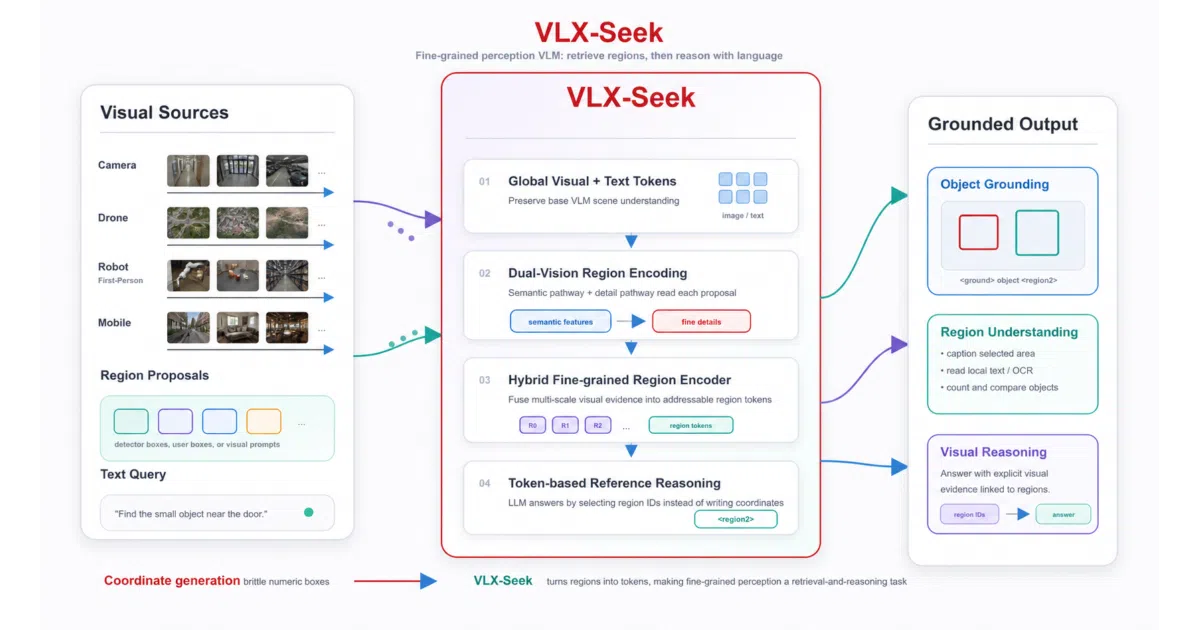
VLX-Seek reformulates visual grounding as region retrieval, letting a language model select and refer to pre-encoded region tokens instead of generating raw coordinates.
Collecting fresh signals — velocity needs a few days of history.
collecting data…
star history
What it does
VLX-Seek is a fine-grained perception vision-language model built for edge-side embodied vision—drones, robots, cameras, and inspection systems. It answers questions about images, locates objects, distinguishes instances, and explicitly rejects queries when a target is absent. The open-source release includes inference code and weights for the 10B-parameter VLX-Seek 1.5 model.
The interesting bit
Rather than forcing the language model to emit raw bounding-box coordinates like [x1, y1, x2, y2], VLX-Seek encodes candidate regions as addressable tokens and reframes localization as retrieval and reference. This turns spatial grounding into something closer to text reasoning: the model compares, selects, and points to regions instead of guessing long numeric sequences.
Key highlights
- Reformulates detection and grounding as region-token retrieval rather than coordinate generation, which the authors argue is more efficient and less brittle.
- Open-source release includes the 10B model with a faster proposal pipeline and additional Linear Attention layers for reduced inference cost.
- Explicit
Noneformat and hard-negative training help the model reject absent targets instead of hallucinating boxes. - Ships with integration for the open-source WeDetect-Base-Uni proposal detector; you can also inject your own bounding boxes via
--bbox-list. - Trained on expanded embodied-scene data including drone, surveillance, and robot viewpoints.
Caveats
- Only the 10B model is currently open-sourced; the smaller 0.6B and 3B variants are planned but not yet released.
- The internally trained OPN region detector referenced in the blog is withheld due to company policy, so the open-source repo substitutes WeDetect-Base-Uni.
- Linux is the primary tested platform; GPU recommended.
Verdict
Worth a look if you’re building robotics, drone, or edge-vision systems that need precise, token-efficient spatial grounding. Skip it if you just need a general-purpose chat-with-images model without fine-grained localization.
Frequently asked
- What is om-ai-lab/VLX-Seek?
- VLX-Seek reformulates visual grounding as region retrieval, letting a language model select and refer to pre-encoded region tokens instead of generating raw coordinates.
- Is VLX-Seek open source?
- Yes — om-ai-lab/VLX-Seek is open source, released under the Apache-2.0 license.
- What language is VLX-Seek written in?
- om-ai-lab/VLX-Seek is primarily written in Python.
- How popular is VLX-Seek?
- om-ai-lab/VLX-Seek has 1k stars on GitHub.
- Where can I find VLX-Seek?
- om-ai-lab/VLX-Seek is on GitHub at https://github.com/om-ai-lab/VLX-Seek.