niais/Awesome-Skeleton-based-Action-Recognition
A curated graveyard of skeleton-action papers
A living bibliography that tracks who beat whom on the NTU RGB+D leaderboard, and by how much.
Not currently ranked — collecting fresh signals.
star history
What it does This repo is a curated index of papers, code links, and benchmark results for skeleton-based action recognition — the subfield of computer vision where you classify human actions from joint coordinates (think Kinect-style stick figures) rather than raw pixels. It catalogs supervised, semi-supervised, and unsupervised methods, with a heavy tilt toward graph neural networks and attention mechanisms.
The interesting bit The value isn’t the code — there barely is any — but the leaderboard archaeology. The maintainers track which models actually run on which datasets and link to GitHub repos when they exist, which in this field is rarer than you’d hope. The NTU RGB+D and NTU RGB+D 120 tables let you trace the arms race from RNNs through ST-GCN to the current crop of shift-convolutions and channel-wise topology refinements.
Key highlights
- Covers ~100+ papers from 2012–2022, with arXiv links and GitHub repos explicitly flagged
- Leaderboard tables for NTU RGB+D (60 classes) and partial coverage of NTU RGB+D 120
- Includes adversarial attack papers — a niche most bibliographies skip
- Links to related portals like Quo Vadis, which hosts actual pre-trained models
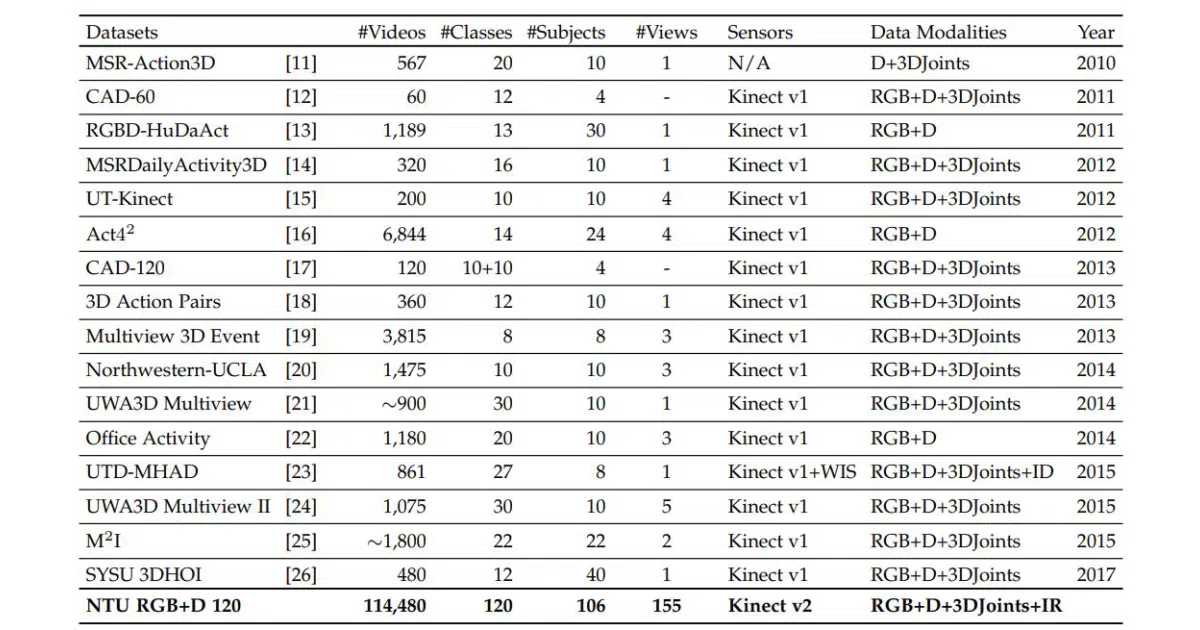
- Datasets section with download links and a visual comparison chart
Caveats
- Several TODO items remain unchecked: semi-supervised and unsupervised leaderboards, plus adversarial methods list
- Some arXiv papers lack code links and are excluded from performance tables — the README notes this but doesn’t always mark which ones
- “Semi-supervised and Unsupervised Skeleton Rrepresentation” — sic on the typo, and the section is thinner than supervised
Verdict Worth bookmarking if you’re entering this field or writing a survey. Skip it if you want runnable code; most papers here are pointers, not implementations. The 687 stars suggest the audience is primarily grad students hunting for baselines to beat.
Frequently asked
- What is niais/Awesome-Skeleton-based-Action-Recognition?
- A living bibliography that tracks who beat whom on the NTU RGB+D leaderboard, and by how much.
- Is Awesome-Skeleton-based-Action-Recognition open source?
- Yes — niais/Awesome-Skeleton-based-Action-Recognition is an open-source project tracked on heatdrop.
- What language is Awesome-Skeleton-based-Action-Recognition written in?
- niais/Awesome-Skeleton-based-Action-Recognition is primarily written in HTML.
- How popular is Awesome-Skeleton-based-Action-Recognition?
- niais/Awesome-Skeleton-based-Action-Recognition has 685 stars on GitHub.
- Where can I find Awesome-Skeleton-based-Action-Recognition?
- niais/Awesome-Skeleton-based-Action-Recognition is on GitHub at https://github.com/niais/Awesome-Skeleton-based-Action-Recognition.