najmuzzaman-mohammad/gawkbot
WUPHF: A Collaborative Office Where AI Agents Can’t Ghost You
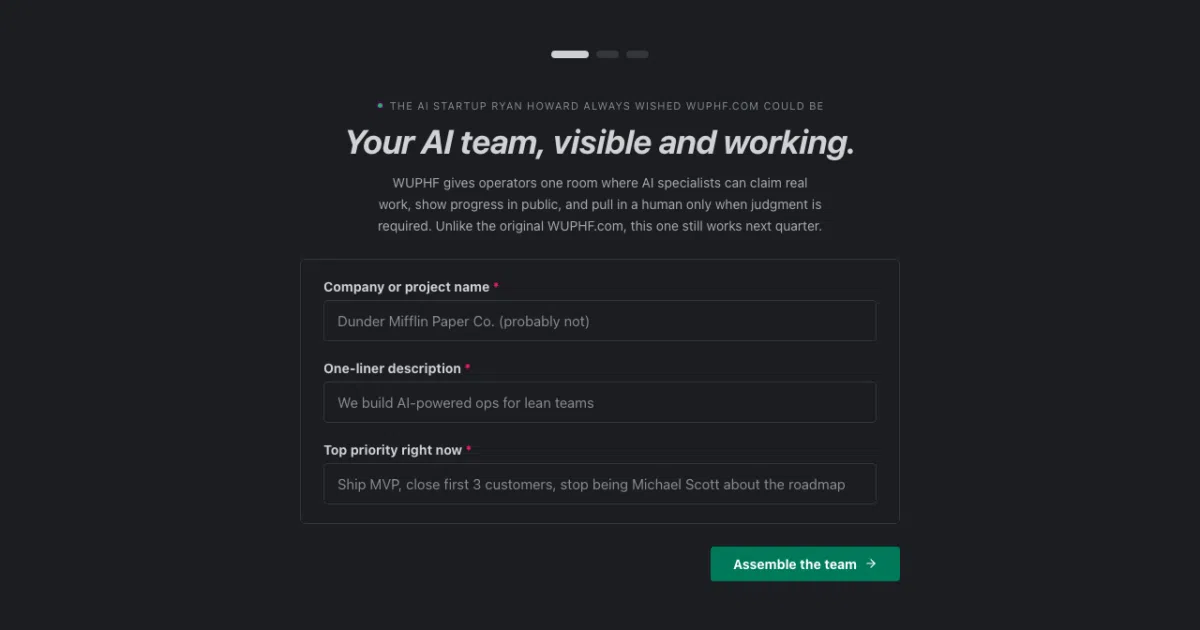
WUPHF gives headless AI agent CLIs a shared web office, persistent team memory, and enough visibility that they actually finish tasks instead of disappearing behind an API.
Velocity · 7d
+1.3
★ / day
Trend
↘cooling
star history
What it does
WUPHF is an orchestration layer that wraps agent CLIs like Claude Code or Codex into a collaborative web office. You get a browser-based #general channel where multiple AI personas—CEO, PM, engineers, designer—claim tasks, chat, and ship work under a single local server. It runs headless by default, persists state in local workspaces, and opens at localhost:7891 with one command.
The interesting bit
Instead of treating memory as a black-box vector database, WUPHF gives every agent a private notebook and a shared team wiki that is literally a local git repo of markdown. Agents manually promote durable findings from notebook to wiki, and the wiki acts as a living knowledge graph with typed triplets, append-only fact logs, and a /lint suite that flags contradictions. It is the rare agent framework that treats institutional memory like a maintainable codebase rather than a cache.
Key highlights
- Multi-agent visibility: role-based AI teammates work in shared channels with task claiming and 1:1 sidebars.
- Git-native memory: the default backend is a markdown wiki at
~/.wuphf/wiki/with no API keys or hosted database required. - Knowledge graph tooling: triplet-based facts, cited-answer
/lookup, and automated contradiction linting built in. - Bring-your-own-provider: shells out to Claude Code, Codex, OpenCode, Ollama, or other OpenAI-compatible endpoints.
- Team sharing: invite humans via Tailscale/WireGuard private mesh or opt-in Cloudflare quick tunnels with passcode rate-limiting.
- Skill marketplace: publish team-authored skills to GitHub or the Anthropic commons, and install community skills back into your wiki.
Caveats
- Pre-1.0 and moving fast: the README warns that
mainchanges daily and you should pin to release tags. - It is fundamentally glue around existing agent CLIs, so you still need Claude Code (or another supported provider) installed separately.
- The legacy tmux TUI is deprecated and slated for removal once the desktop client lands.
Verdict WUPHF is for developers who want persistent, inspectable team memory and a social interface for multiple local agents. If you prefer a single chat window or a fully managed SaaS, this is not your tool.
Frequently asked
- What is najmuzzaman-mohammad/gawkbot?
- WUPHF gives headless AI agent CLIs a shared web office, persistent team memory, and enough visibility that they actually finish tasks instead of disappearing behind an API.
- Is gawkbot open source?
- Yes — najmuzzaman-mohammad/gawkbot is an open-source project tracked on heatdrop.
- What language is gawkbot written in?
- najmuzzaman-mohammad/gawkbot is primarily written in Go.
- How popular is gawkbot?
- najmuzzaman-mohammad/gawkbot has 1.5k stars on GitHub and is currently cooling off.
- Where can I find gawkbot?
- najmuzzaman-mohammad/gawkbot is on GitHub at https://github.com/najmuzzaman-mohammad/gawkbot.