mvschwarz/openrig
A rig for your harnesses: run Claude Code and Codex as one team
OpenRig wraps AI coding agents in persistent, YAML-defined teams with roles, shared context, and tmux sessions you can actually attach to.
Feature · 06 Oct 2026
The Rig That Wraps Your Agent Harnesses
OpenRig bets that the thing worth managing isn't any single coding agent — it's the topology they form when you run a dozen of them at once.
Read the in-depth article →
Velocity · 7d
+30
★ / day
Trend
↘cooling
star history
What it does
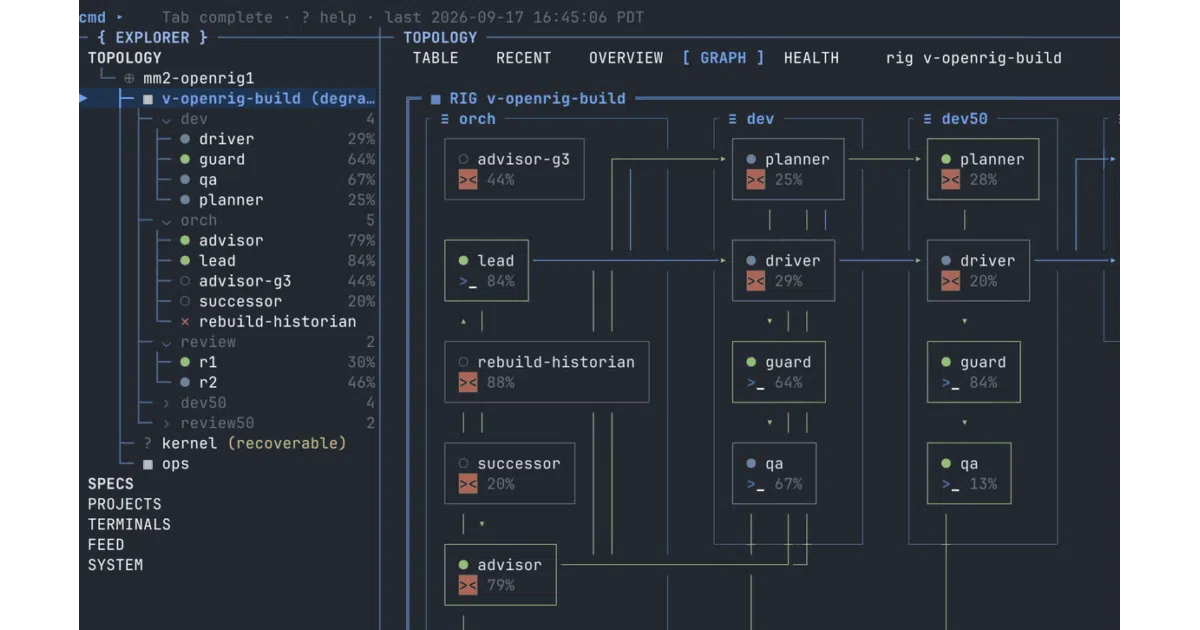
OpenRig is a multi-agent harness for AI coding agents — not the agents themselves, but the team they form when you run several at once. You define a topology in YAML (pods, edges, continuity policies), boot it with one command, and get tmux sessions running Claude Code and Codex side by side, managed as a single system. A lead agent coordinates specialists; you talk outcomes and get back results plus decisions that need a human.
The interesting bit
The pitch line is honest: “a harness wraps a model, a rig wraps your harnesses.” It treats terminal sprawl as the actual problem — which sessions are running, how they relate, how to recover after a reboot — and answers with snapshots (rig down --snapshot, restore by name), adoption of already-running Claude/Codex sessions, and a TUI that shows the rig as a graph and a seat table. It can even discover your existing stray sessions and fold them into a managed rig instead of killing them.
Key highlights
- Ships starter rigs:
first-project(two Codex seats),conveyor(four seats, mixed Claude Code and Codex),product-team,adversarial-review,research-team, and asecrets-managerwith a Vault-managing specialist agent - Messaging across agents via
rig send,rig broadcast, andrig chatroom; topologies evolve live withrig grow/rig shrink - Every agent stays a real tmux session you can attach to and work with directly
- YOLO mode (full permission bypass) is off by default and requires explicit opt-in
- Apache 2.0, TypeScript, requires Node 20/22/24 and tmux
Caveats
- Setup is invasive: it writes trust settings, executable hooks, and config into
~/.claude.json,~/.codex/config.toml,~/.tmux.conf, and workspace files — the README itself tells you to back things up first, and notes some writes can replace existing entries without full rollback - Activity relays send event metadata to the daemon, and plugin init phones home to a GitHub release endpoint; provider/MCP connections have their own data flows
- The README is dense — expect a real reading session before your first
rig up
Verdict
Worth a look if you’re already juggling multiple Claude Code/Codex sessions and want structure, persistence, and recovery instead of tab chaos. If one agent in one terminal does the job, this is machinery you don’t need.
Frequently asked
- What is mvschwarz/openrig?
- OpenRig wraps AI coding agents in persistent, YAML-defined teams with roles, shared context, and tmux sessions you can actually attach to.
- Is openrig open source?
- Yes — mvschwarz/openrig is open source, released under the Apache-2.0 license.
- What language is openrig written in?
- mvschwarz/openrig is primarily written in TypeScript.
- How popular is openrig?
- mvschwarz/openrig has 8.8k stars on GitHub and is currently cooling off.
- Where can I find openrig?
- mvschwarz/openrig is on GitHub at https://github.com/mvschwarz/openrig.