mrdbourke/pytorch-deep-learning
The Self-Proclaimed Second-Best PyTorch Course
Course materials that exist because the author thinks certificates are meh and the only way to learn PyTorch is to write hundreds of lines of it.
Velocity · 7d
+6.0
★ / day
Trend
↘cooling
star history
What it does
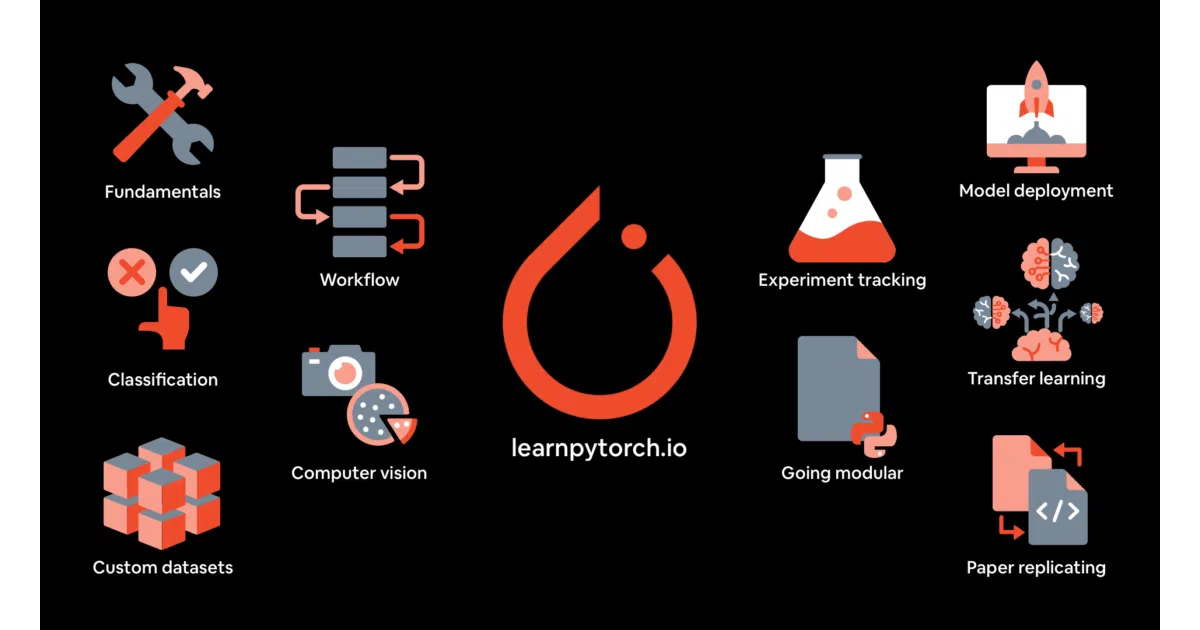
This repository holds the complete materials for the Zero to Mastery “Learn PyTorch for Deep Learning” course. It bundles Jupyter notebooks, slides, exercises with solutions, and an online book covering everything from tensor fundamentals to model deployment. The curriculum centers on FoodVision, a running computer vision project where you classify food images while picking up workflows, transfer learning, and experiment tracking.
The interesting bit
The author cheerfully admits this is only the second best place to learn PyTorch, right after the official documentation. That humility sets the tone for an aggressively code-first curriculum taught in apprenticeship style, with the motto “if in doubt, run the code.”
Key highlights
- Nine sections progressing from fundamentals to paper replication and deployment, each with exercises and slides
- 321 videos and roughly 25 hours of YouTube content covering the first five sections
- All notebooks designed to run in Google Colab, sidestepping local GPU setup
- Includes a dedicated PyTorch 2.0 tutorial; the author notes existing materials remain backward-compatible
- Curated extra resources for NLP, time series, ML engineering, and dataset hunting
Caveats
- Explicitly designed for beginners; the author warns that if you already have a year of ML experience, you may outpace the material
- The prerequisite section recommends the instructor’s paid bootcamp, revealing a commercial ecosystem around the free materials
Verdict
Pick this up if you know some Python and want to brute-force your way into deep learning by writing code until it feels familiar. Leave it if you already read PyTorch papers for fun or need advanced theory rather than guided repetition.
Frequently asked
- What is mrdbourke/pytorch-deep-learning?
- Course materials that exist because the author thinks certificates are meh and the only way to learn PyTorch is to write hundreds of lines of it.
- Is pytorch-deep-learning open source?
- Yes — mrdbourke/pytorch-deep-learning is open source, released under the MIT license.
- What language is pytorch-deep-learning written in?
- mrdbourke/pytorch-deep-learning is primarily written in Jupyter Notebook.
- How popular is pytorch-deep-learning?
- mrdbourke/pytorch-deep-learning has 19.3k stars on GitHub and is currently cooling off.
- Where can I find pytorch-deep-learning?
- mrdbourke/pytorch-deep-learning is on GitHub at https://github.com/mrdbourke/pytorch-deep-learning.