morluto/rea
Your agent finally gets a disassembler it can actually drive
REA hands reverse-engineering tools — Hopper, Ghidra, process capture, JS reconstruction — to coding agents as one consistent MCP workflow.
Feature · 11 Oct 2026
The Reverse-Engineering Agent That Refuses to Guess
REA hands coding agents Hopper and Ghidra and asks them to investigate binaries the way a careful human analyst would — with evidence, citations, and an honest ledger of everything they still don't know.
Read the in-depth article →
Velocity · 7d
+1837
★ / day
Trend
↘cooling
star history
What it does
REA lets you point an agent at an app — no source code required — and ask how a feature works. The agent decompiles, traces behavior across layers, collects reproducible Evidence records, and can then build an adapted version of the feature for your own stack. It wraps the messy parts of reverse engineering (tool selection, API wrangling, evidence shuffling) behind a CLI and MCP integration that Claude Code, Codex, Cursor, Gemini CLI, Windsurf, and Claude Desktop can all use.
The interesting bit
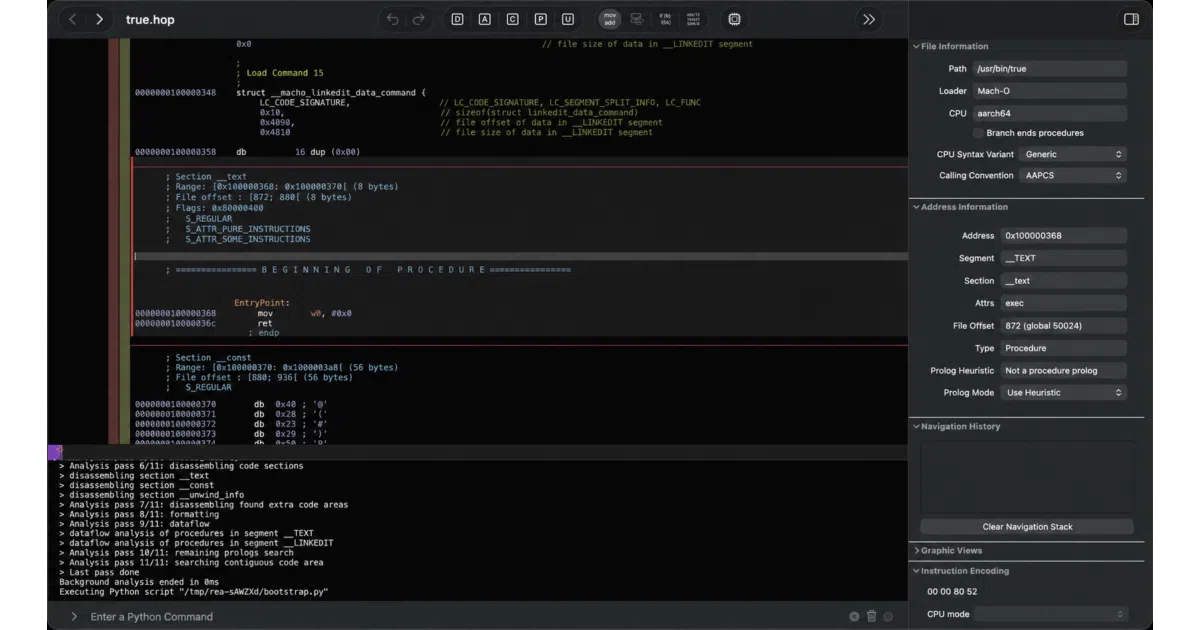
The boring part is the value: REA manages the analysis tools themselves — installing Hopper, running it headless on an isolated Xvfb display on Linux, even auto-selecting the demo-mode dialog by verifying its geometry before clicking. It also keeps a hard line between static inference and runtime observation, so the agent doesn’t confuse what a binary looks like it does with what it actually does.
Key highlights
- Deep native analysis via Hopper or bring-your-own Ghidra, with function dossiers, xrefs, CFGs, and decompilation
- Execution-free managed PE/CLI triage, plus an experimental Windows x64 Ghidra path for native PE files
- Passive observation of websites, Electron pages, and Node/Electron via the V8 Inspector
- JavaScript/source-map reconstruction and provider-neutral graphs connecting app layers
- Fully local analysis — nothing is uploaded to a hosted service
Caveats
- Deep binary work depends on Hopper (separate license, free demo works) or a Ghidra installation you supply; REA installs neither Ghidra nor Java
- Windows support is explicitly experimental and Ghidra-only for native PE files
- Devin is detected but left unconfigured, since it has no documented local MCP boundary
Verdict
Worth a look if you do CTF work, competitive analysis, or just want to know how an app pulls off a feature — and you’d rather your agent read the disassembly than you. Skip it if you only ever work with source you already have.
Frequently asked
- What is morluto/rea?
- REA hands reverse-engineering tools — Hopper, Ghidra, process capture, JS reconstruction — to coding agents as one consistent MCP workflow.
- Is rea open source?
- Yes — morluto/rea is open source, released under the MIT license.
- What language is rea written in?
- morluto/rea is primarily written in TypeScript.
- How popular is rea?
- morluto/rea has 472.9k stars on GitHub and is currently cooling off.
- Where can I find rea?
- morluto/rea is on GitHub at https://github.com/morluto/rea.