moorcheh-ai/memanto
An agent that actually remembers — and answers back
MEMANTO treats memory as an active agent, not a passive vector dump, with typed storage and instant retrieval.
Not currently ranked — collecting fresh signals.
star history
What it does
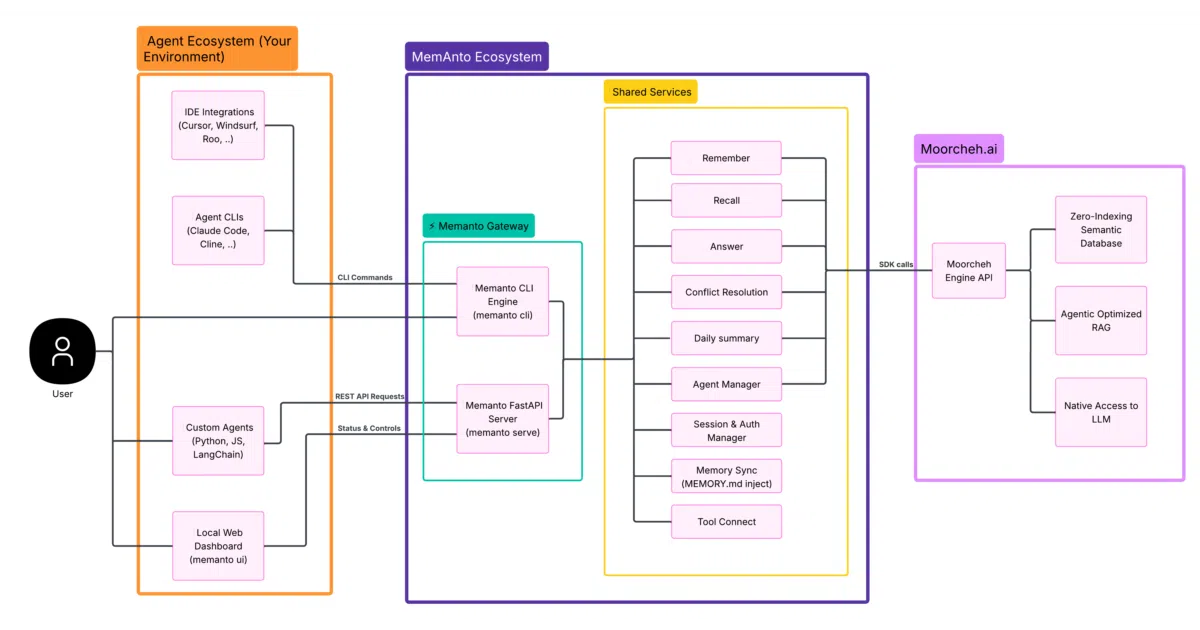
MEMANTO is a memory layer for AI agents built around three operations: remember, recall, and answer. It stores agent context in 13 typed categories (facts, preferences, goals, relationships, etc.), retrieves them with sub-90ms latency, and can generate grounded responses directly from memory without calling an external LLM API. The backend runs on Moorcheh’s “no-indexing” semantic database, which claims exact search and zero ingestion delay.
The interesting bit
The project started from an unusual source: asking LLMs what frustrated them about their own memory. Their complaints — static context injection, no temporal decay, flat storage, silent contradictions — became a six-gap design brief. MEMANTO’s response is typed semantic memory with versioning, recency signals, provenance metadata, and explicit conflict detection. It’s a rare case of a tool built from first-party gripes rather than benchmark chasing.
Key highlights
- Benchmark claims: 89.8% on LongMemEval and 87.1% on LoCoMo, with public datasets on Hugging Face
- 13 built-in memory types for structured retrieval and cleaner contradiction detection
- Zero idle cost via serverless architecture; scales to zero when unused
- Native CLI with agent lifecycle management, file upload, temporal queries (
--as-of,--changed-since), and daily summary workflows - Integrations with Claude Code, Cursor, Copilot, Gemini CLI, and roughly a dozen other agent ecosystems
- Peer-reviewed research paper published on Hugging Face
Caveats
- Requires a Moorcheh API key; no self-hosted backend option is mentioned
- REST API is local-only — “MEMANTO does not have a hosted API server yet”
- Benchmark comparisons reference Mem0, Zep, and Letta, but the README doesn’t detail methodology or whether results are from independent evaluation
Verdict
Worth a look if you’re building long-horizon agents and have hit the limits of passive RAG memory. Skip it if you need a fully self-hosted stack or are allergic to vendor API dependencies.
Frequently asked
- What is moorcheh-ai/memanto?
- MEMANTO treats memory as an active agent, not a passive vector dump, with typed storage and instant retrieval.
- Is memanto open source?
- Yes — moorcheh-ai/memanto is open source, released under the MIT license.
- What language is memanto written in?
- moorcheh-ai/memanto is primarily written in Python.
- How popular is memanto?
- moorcheh-ai/memanto has 2.3k stars on GitHub.
- Where can I find memanto?
- moorcheh-ai/memanto is on GitHub at https://github.com/moorcheh-ai/memanto.