modiqo/waggle
Agent handoffs by reference, not by value
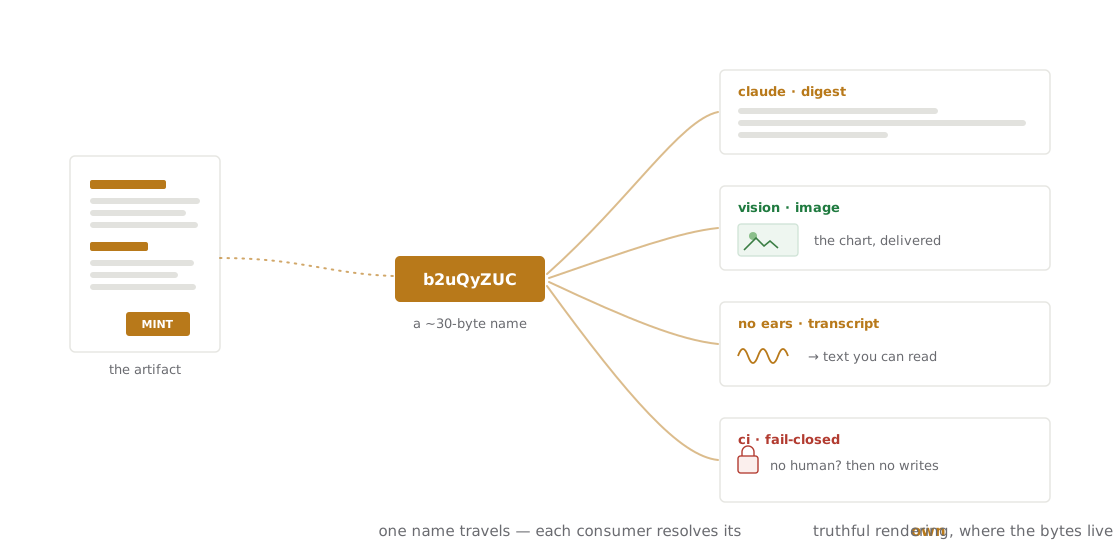
It replaces pasted context between agents with a ~30-byte token that resolves into per-agent projections and leaves an audit trail.
Not currently ranked — collecting fresh signals.
star history
What it does
Waggle is a reference layer for multi-agent systems. Instead of pasting an artifact’s full text into every subagent’s prompt, an orchestrator hands off a roughly 30-byte token. The consumer resolves that token through an MCP server to fetch only the slice or projection its model needs, while the system logs every read in a payload-free append-only log. It is essentially content-addressed, immutable handoff infrastructure that sits outside any single vendor’s harness.
The interesting bit
The protocol treats agent handoffs as a distributed-systems problem. A sealed, deterministic matcher returns a different projection for each consumer—so a small-context model gets an outline instead of the full 9,000 tokens—while supersede and revoke propagate to every holder automatically.
Key highlights
- A ~30-byte token replaces full-context pasting, cutting the duplication overhead that vendors blame for roughly 15× token bloat in multi-agent systems.
- Content-addressed snapshots at mint create immutable artifacts with lineage, Ed25519-signed attribution, and propagation of corrections.
- Reads are logged in a payload-free append-only log, enabling telemetry like “which subagent actually opened its input?” that filesystem paths cannot provide.
- MCP-native integration means Claude Code, Codex, and Cursor all speak the same token without language bindings or accounts.
- A lens engine discovers structure from content type—prose outlines, source-code symbols via tree-sitter, binary extraction—so the same loop works on a report or a lockfile.
Caveats
- For purely local, short-lived tasks with no audit requirements, the README concedes that a raw filesystem path with standard tools scores 90% on their benchmark—competitive with waggle’s 96%—making waggle unnecessary overhead.
- Harnesses must speak MCP to resolve tokens; non-MCP agents are outside the loop.
Verdict
Waggle is for anyone building multi-agent harnesses where accountability, cross-machine reach, or immutable handoff history matters. If you are running a single local agent that already trusts its filesystem, it is probably overkill.
Frequently asked
- What is modiqo/waggle?
- It replaces pasted context between agents with a ~30-byte token that resolves into per-agent projections and leaves an audit trail.
- Is waggle open source?
- Yes — modiqo/waggle is open source, released under the Apache-2.0 license.
- What language is waggle written in?
- modiqo/waggle is primarily written in Rust.
- How popular is waggle?
- modiqo/waggle has 634 stars on GitHub.
- Where can I find waggle?
- modiqo/waggle is on GitHub at https://github.com/modiqo/waggle.