mobarski/ask-my-pdf
Board game rules, decoded by two research papers and your credit card
A Streamlit app that answers questions about PDFs by combining two recent retrieval-augmented generation techniques—primarily so the author doesn't lose at board games.
Not currently ranked — collecting fresh signals.
star history
What it does
Upload a PDF, ask a question, get an answer generated by GPT-3. The app is built for Streamlit Community Cloud and requires users to bring their own OpenAI API key. The author openly admits the primary motivation: settling board game rule disputes without flipping through manuals.
The interesting bit
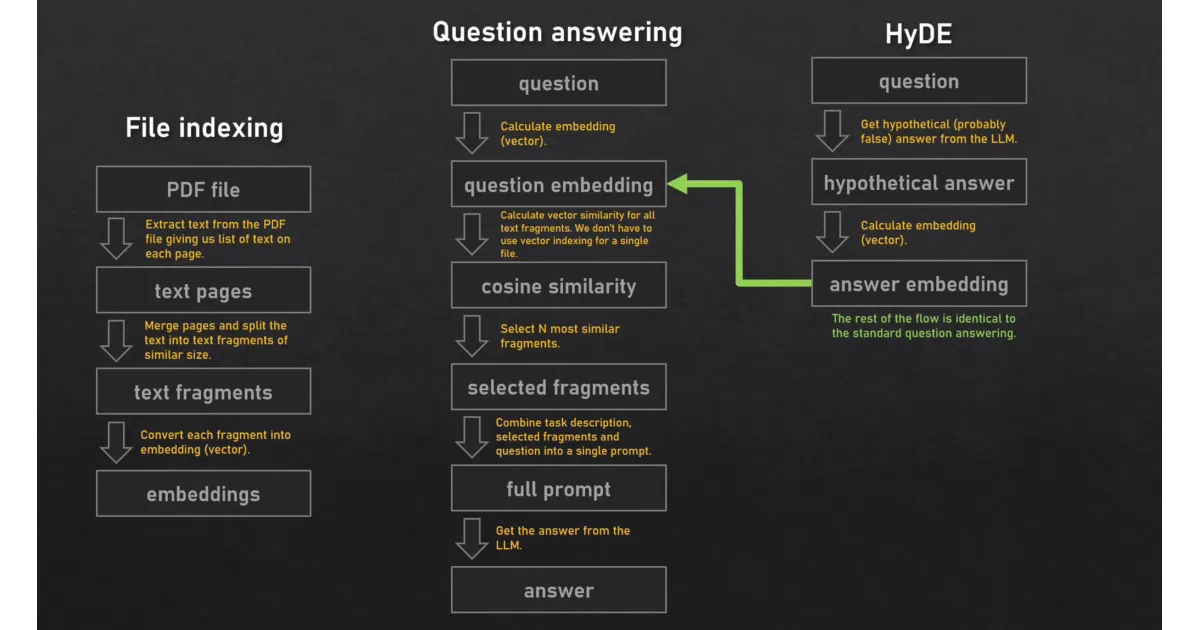
Instead of dumping the whole PDF into the context window, the app implements two 2022-2023 research papers: RALM (retrieval-augmented in-context learning) and HyDE (Hypothetical Document Embeddings), which generates a fake ideal answer to improve retrieval. The README includes architecture diagrams showing how these pieces fit together—rare diligence for a 600-star side project.
Key highlights
- Implements RALM + HyDE from recent academic papers, not just “stuff all text into GPT-3”
- Multiple storage backends: local filesystem, S3, or in-memory dict
- Embeddings cache can persist to disk or S3 to save API costs
- Usage stats and feedback can route through Redis
- Configurable per-user budgets for community deployments
Caveats
- Explicitly labeled a Proof of Concept with “bugs or unfinished features”
- Requires your own OpenAI API key; no free tier, no self-hosted model option
- No information on supported PDF types, chunking strategy, or maximum document size
Verdict
Worth a look if you’re studying RALM/HyDE implementations or need a quick PDF Q&A prototype. Skip it if you want production reliability, open-source models, or a solution that doesn’t meter your OpenAI spend.
Frequently asked
- What is mobarski/ask-my-pdf?
- A Streamlit app that answers questions about PDFs by combining two recent retrieval-augmented generation techniques—primarily so the author doesn't lose at board games.
- Is ask-my-pdf open source?
- Yes — mobarski/ask-my-pdf is open source, released under the MIT license.
- What language is ask-my-pdf written in?
- mobarski/ask-my-pdf is primarily written in Python.
- How popular is ask-my-pdf?
- mobarski/ask-my-pdf has 598 stars on GitHub.
- Where can I find ask-my-pdf?
- mobarski/ask-my-pdf is on GitHub at https://github.com/mobarski/ask-my-pdf.