mit-han-lab/lite-transformer
A transformer that knows when to skim and when to study
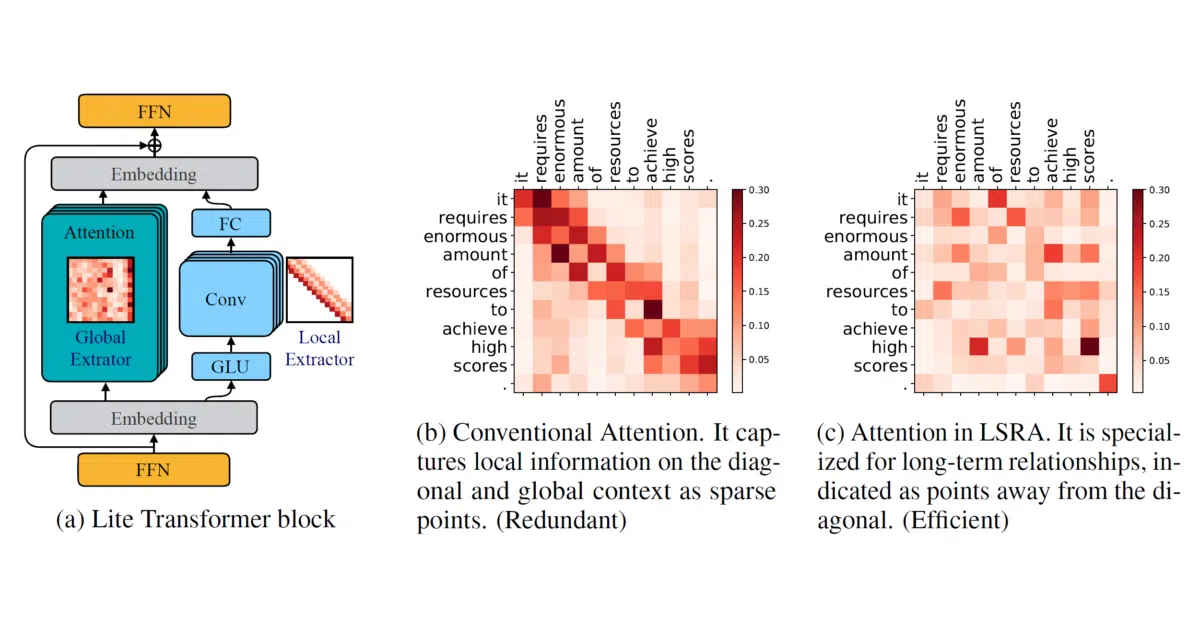
MIT's 2020 ICLR paper splits attention into long-range and short-range specialists, trading full self-attention for speed.
Not currently ranked — collecting fresh signals.
star history
What it does
Lite Transformer replaces the standard transformer’s uniform attention with two parallel branches: one using dilated convolution for long-range dependencies, the other using regular self-attention for local detail. The idea is that not every token pair needs the full quadratic treatment. It’s built as a fork of fairseq, with CUDA kernels for light/dynamic convolution layers that you’ll need to compile yourself.
The interesting bit
The long-short split is the core bet: convolution handles the “skimming” (global structure), attention handles the “close reading” (local semantics). The README is admirably concrete about compute budgets — models at 90M, 360M, and 527M multiply-adds, with BLEU scores listed for each — which makes the efficiency claim checkable rather than hand-wavy.
Key highlights
- Pretrained checkpoints for WMT'14 En-Fr, WMT'16 En-De, CNN/DailyMail summarization, and WIKITEXT-103 language modeling
- Distributed training setup included (multi-node, 16+ GPUs)
- Language modeling lives on a separate
language-modelbranch - Requires PyTorch ≥1.0, Python ≥3.6, and NCCL for training
- Custom CUDA modules need manual build via
setup.pyin twofairseq/modulessubdirectories
Caveats
- The repo appears dormant (2020 paper, 611 stars, no recent activity visible); fairseq has likely moved on
- Installation involves multiple manual compilation steps that may bit-rot with newer CUDA/PyTorch versions
- No issue tracker or discussion visible in the README to gauge current usability
Verdict
Worth studying if you’re designing efficient attention variants or benchmarking against 2020-era efficiency baselines. Skip it if you need a maintained, batteries-included training stack — fairseq itself, or modern alternatives like Hugging Face or Megatron, will be less archaeologically demanding.
Frequently asked
- What is mit-han-lab/lite-transformer?
- MIT's 2020 ICLR paper splits attention into long-range and short-range specialists, trading full self-attention for speed.
- Is lite-transformer open source?
- Yes — mit-han-lab/lite-transformer is an open-source project tracked on heatdrop.
- What language is lite-transformer written in?
- mit-han-lab/lite-transformer is primarily written in Python.
- How popular is lite-transformer?
- mit-han-lab/lite-transformer has 609 stars on GitHub.
- Where can I find lite-transformer?
- mit-han-lab/lite-transformer is on GitHub at https://github.com/mit-han-lab/lite-transformer.