micytao/vllm-playground
Herding vLLM subprocesses, containers, and remotes from one browser tab
vLLM Playground exists because juggling local, container, and remote vLLM servers from the terminal gets old fast.
Collecting fresh signals — velocity needs a few days of history.
collecting data…
star history
What it does
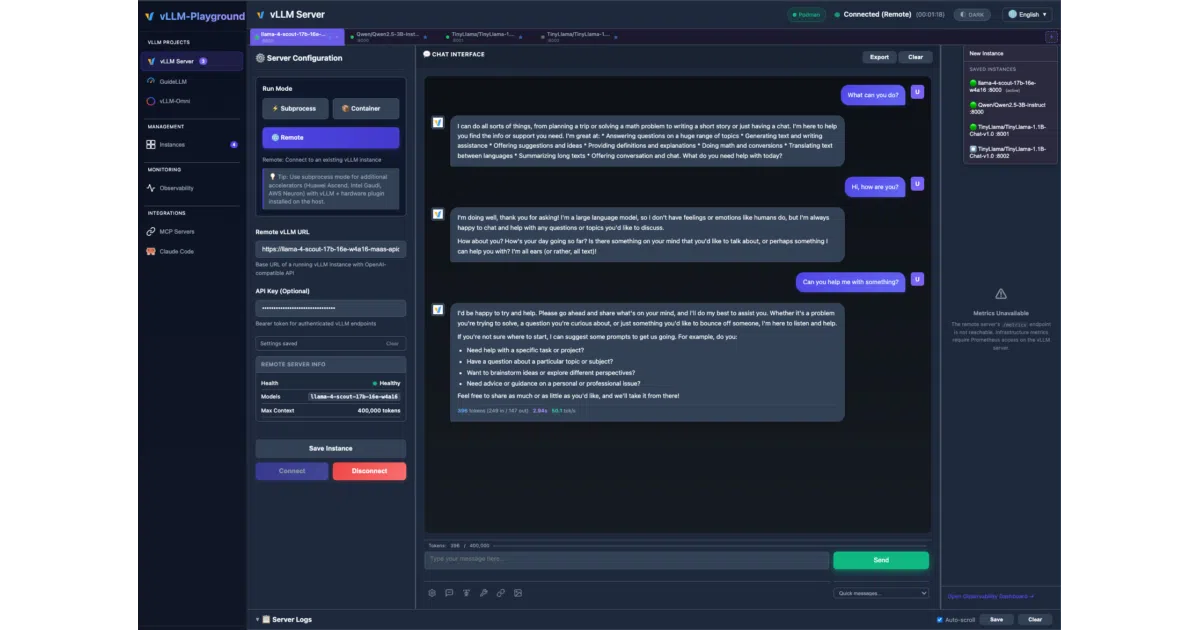
vLLM Playground is a FastAPI and JavaScript web UI that wraps the vLLM inference engine. It lets you start, stop, and switch between multiple vLLM backends—subprocess, container, or remote—through browser tabs, then chat with them, run vision models, or benchmark throughput. The project also folds in extras like multimodal generation, tool calling, and an observability dashboard.
The interesting bit
The most unusual trick is the Claude Code integration: it embeds a web terminal so you can point Anthropic’s coding agent at open-source models served by your own vLLM instance. Add in MCP (Model Context Protocol) support for agentic tool use with human approval, and the UI starts to feel less like a chat wrapper and more like a local AI ops console.
Key highlights
- Multi-instance management — Run subprocess, container, and remote vLLM servers in parallel, switching between them via tabs and a registry-backed Instances page.
- Multimodal and vision support — Chat with VLMs such as Qwen2.5-VL and LLaVA, and generate audio or images through vLLM-Omni integration.
- Claude Code backend — Use open-source models as the engine for Anthropic’s Claude Code through an embedded terminal interface.
- Enterprise deployment traits — Runs on macOS Apple Silicon (CPU and Metal GPU), and ships with OpenShift/Kubernetes manifests for dynamic pod creation.
- Agentic tooling — MCP server integration with presets for filesystem, Git, fetch, and time tools, plus function calling for Llama, Mistral, and Qwen.
Verdict
Developers already running (or struggling to juggle) multiple vLLM instances will get the most mileage; if you just need a single local chat UI, this is probably overkill.
Frequently asked
- What is micytao/vllm-playground?
- vLLM Playground exists because juggling local, container, and remote vLLM servers from the terminal gets old fast.
- Is vllm-playground open source?
- Yes — micytao/vllm-playground is open source, released under the Apache-2.0 license.
- What language is vllm-playground written in?
- micytao/vllm-playground is primarily written in JavaScript.
- How popular is vllm-playground?
- micytao/vllm-playground has 532 stars on GitHub.
- Where can I find vllm-playground?
- micytao/vllm-playground is on GitHub at https://github.com/micytao/vllm-playground.