microsoft/table-transformer
Turning table extraction into an object-detection problem
Because PDFs love to bury structured data inside images that spreadsheets can't parse.
Not currently ranked — collecting fresh signals.
star history
What it does
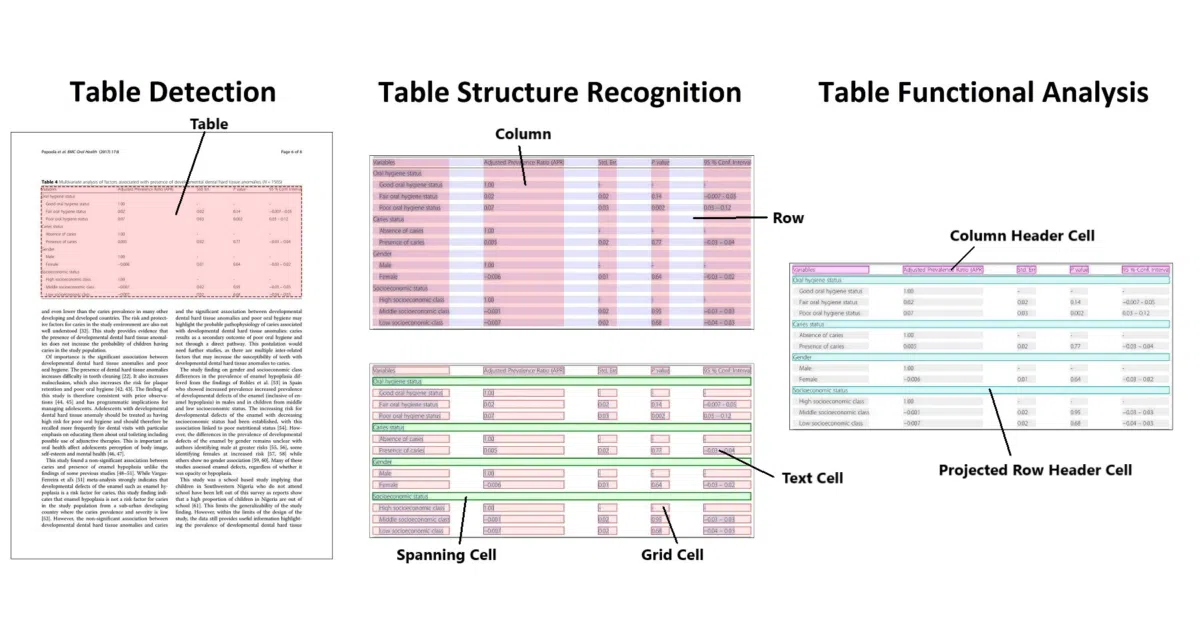
TATR is an object-detection model—built on DETR—that finds tables in document images and breaks them down into rows, columns, and cells. It ships with pre-trained weights, an inference pipeline that emits HTML or CSV, and the official PubTables-1M dataset used to train it. The repo also implements GriTS, the grid-based metric the authors proposed to evaluate table structure recognition.
The interesting bit
Instead of treating table extraction as a sequence or layout problem, it frames everything as bounding-box detection: tables, rows, columns, and even projected headers are just objects to localize. That architectural choice means you can train it like a standard vision model, though you still need to bring your own text extraction—TATR detects structure from pixels, but OCR or PDF text is required to fill in the actual cell content.
Key highlights
- Pre-trained models include
TATR-v1.1variants trained onPubTables-1M,FinTabNet.c, or both combined. PubTables-1Mcontains nearly 950k fully annotated tables with bounding boxes in both image and PDF coordinates.- The repo provides training scripts, evaluation code, and canonicalization utilities for existing datasets like
FinTabNetandSciTSR. GriTSmetrics are included for measuring topology, content, and location similarity independently.- Detection
AP50onPubTables-1Mis reported at 0.995; structureAP50at 0.970 forTATR-v1.0.
Caveats
- The model detects structure from pixels; populating cells with text requires a separate OCR or PDF text extraction step.
- Training your own model is expected for domains outside the provided
PubTables-1MandFinTabNet.cdatasets.
Verdict Researchers and engineers building document-parsing pipelines should look here for a well-documented baseline and a massive labeled dataset. If you need an end-to-end, OCR-inclusive one-liner, this is only half the pipeline.
Frequently asked
- What is microsoft/table-transformer?
- Because PDFs love to bury structured data inside images that spreadsheets can't parse.
- Is table-transformer open source?
- Yes — microsoft/table-transformer is open source, released under the MIT license.
- What language is table-transformer written in?
- microsoft/table-transformer is primarily written in Python.
- How popular is table-transformer?
- microsoft/table-transformer has 2.9k stars on GitHub.
- Where can I find table-transformer?
- microsoft/table-transformer is on GitHub at https://github.com/microsoft/table-transformer.