michael-denyer/pstack-claude
Cursor's pstack, ported to the harness you actually use
A faithful port of Lauren Tan's opinionated Cursor skill stack, giving Claude Code, Codex, and friends the same disciplined, evidence-first agent workflows.
Feature · 05 Oct 2026
The Methodology That Outgrew Its IDE
pstack-claude is an unofficial port of Lauren Tan's Cursor discipline system — proof that the valuable part of an agent workflow was never the IDE it ran in.
Read the in-depth article →
Velocity · 7d
+65
★ / day
Trend
→steady
star history
What it does
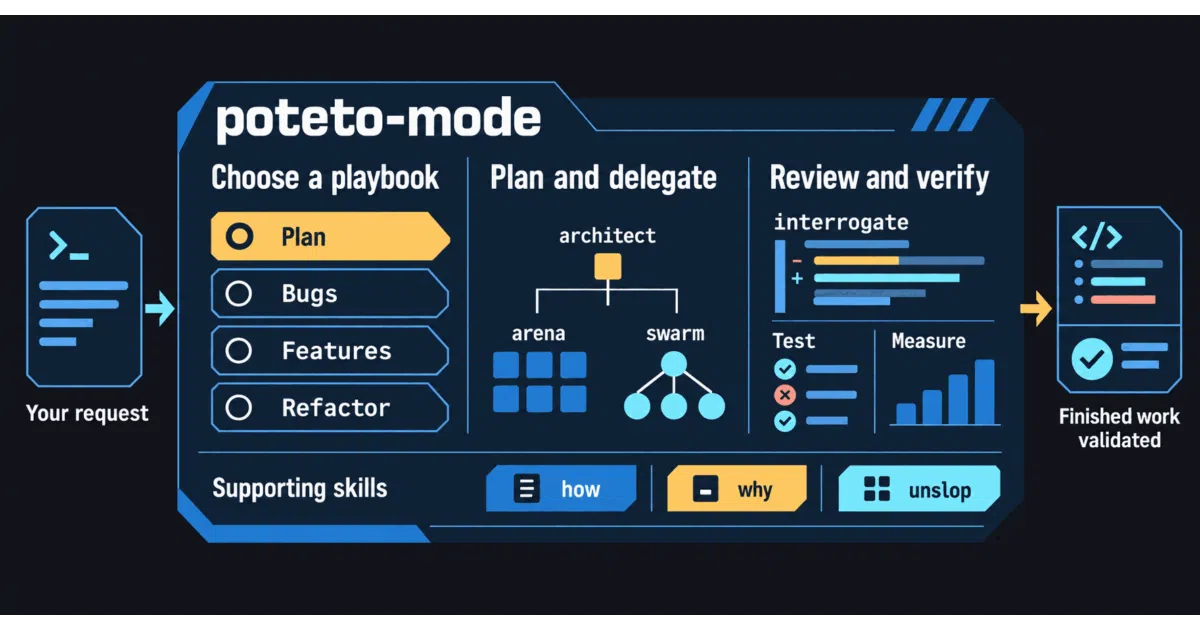
The front door is poteto-mode: tell it your goal and it picks the right playbook from a stack of skills originally built as a Cursor plugin and translated here for Claude Code, Codex, Pi, OpenCode, Gemini CLI, and Prime Agent. For a bug, it reproduces the failure, investigates with how and why, delegates the fix, then reruns the failing case — you get the fix plus the failing and passing evidence. Further playbooks cover planning, features, refactoring, performance, investigations, prototypes, PR maintenance, shipping, and longer projects.
The interesting bit
The engineering is translation, not invention: Cursor’s primitives — skills, hooks, slash commands — remapped onto other runtimes, with a routing hook that intercepts requests on Claude Code and Codex so the playbook choice happens before the agent starts improvising. There’s also boundary discipline: a fix that crosses a function boundary pulls in architect before implementation, not after.
Key highlights
poteto-moderoutes a plain-language goal to the right workflow — plan, bugs, features, refactor, and more.- Bug fixes come with receipts: the failing case before, the passing case after.
- A supporting cast —
how,why,unslop,interrogate,tests,measurements,arena,swarm— handles investigation, review, and verification. - Skills-only installs extend it to any harness, not just the six with dedicated support.
- Model defaults and automatic routing are configurable via
setup-pstack.
Caveats
- As a faithful port, it tracks Lauren Tan’s upstream pstack; port scope and maintenance details live in
docs/reference.mdrather than the README. - Automatic routing is on by default via an installed hook, and Codex makes you explicitly trust that hook before it runs — welcome discipline or an extra nag, depending on your temperament.
- “Improves agent outcomes” is asserted, not benchmarked; the rigor lives in the workflow design, not in published numbers.
Verdict Worth a look if you run Claude Code, Codex, or Gemini CLI and want your agent working from playbooks instead of vibes. If you’d rather author your own workflows, this is someone else’s opinions — faithfully translated, but someone else’s.
Frequently asked
- What is michael-denyer/pstack-claude?
- A faithful port of Lauren Tan's opinionated Cursor skill stack, giving Claude Code, Codex, and friends the same disciplined, evidence-first agent workflows.
- Is pstack-claude open source?
- Yes — michael-denyer/pstack-claude is open source, released under the MIT license.
- What language is pstack-claude written in?
- michael-denyer/pstack-claude is primarily written in JavaScript.
- How popular is pstack-claude?
- michael-denyer/pstack-claude has 4.2k stars on GitHub and is currently holding steady.
- Where can I find pstack-claude?
- michael-denyer/pstack-claude is on GitHub at https://github.com/michael-denyer/pstack-claude.